Showing posts with label equipment. Show all posts

Wednesday, March 2, 2016

Limiting magic items that are too awesome

It looks fun now
but wait until
book 11.
This is for those of you who want to give people cool items but who don't want any 'Sommerswerd problems'.

This is what I mean.  A recap...

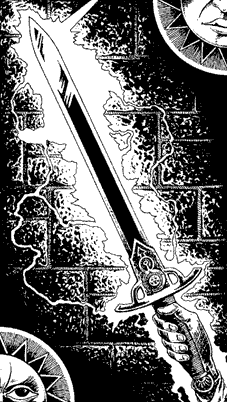
In Lone Wolf 2, you get the uber Kai weapon the Sommerswerd.  This weapon gives you +8 to combat skill, absorbs all hostile magic used against you and deals double damage against undead creatures.  It means that you go from a the scared prey of the helghasts who spent all their time up until now skulking in the countryside, running from overwhelming opposition and having people sacrifice themselves for you to a super warrior who kicks major butt in the final battle and then obliterates a darklord, one of the most powerful creatures on Magnamund.

However, since you don't have to do book 2 to do the other books, in every book after that, you may or may not have the Sommerswerd and its huge bonus.  This led to balance problems.


'Joe Dever has said that the sword's bonus made it difficult to create balanced statstics for enemies that would challenge someone with the blade but would not make the book too difficult for someone without it.
Some attempt was made at balance. Beginning in the Magnakai series, some battles turn out to be more difficult if the Sommerswerd is used, which is reasoned either by its divine presence alerting Lone Wolf's foes, or having them use high-powered weapons which cancel out the advantages the sword offers.'
Everyone likes cool stuff, but it is important that it does not completely unbalance the game either by making it too easy or by making it impossible for the player who isn't lucky enough to get the item (and if you can't do that, just do the decent thing and kill them off early as to not waste their time).
The magic items in Advanced Fighting Fantasy are pretty good at not being too powerful, so you could have a look at that.  Other ways of making cool magic items that aren't too powerful:
A ring of fire would
go down well here too.
Give them one specific use in the gamebook (one of Ian Livingstone's favourites) - such as the Ring of Fire in City of Thieves, the cyclop's eye in Warlock of Firetop Mountain or any item that Yaztromo sells in Forest of Doom.
Make them versatile but not very powerful - the pocket myriad in Citadel of Chaos is a good version of this.  You can use it in several situations but it is rarely the best option.  You can do this one of two ways - either it has a lesser effect than a better item or it has the same effect but only on a certain die roll.
Limit their uses - give an item charges or make it one use.  The ring of communication in Keep of the Lich Lord has only 3 uses.
Put a cost on the use of the item - similar to limiting their uses.  You can use the item as many times as you like but it will drain one of your stats such as crushing the herbs and using the sleep and invisibility spells in Daggers of Darkness.
The item only works on a certain die roll - either the roll is completely random or you need to succeed in an ability check to use it.  There's a scene in Fabled Lands where you try to resurrect someone but the spell requires two ability checks.
The item comes with a penalty - the ring of confusion in Island of the Lizard king comes with a -2 skill penalty which balances out its ability to let you see through illusions.
The item could have beneficial or baneful effects - either you roll a die each time or the situation does not match the item, sometimes it works like a charm and sometimes it spells destruction.  The deck of many things is a classic example.
The item can only be used by certain people - There's some restriction based on race, alignment, ability score or pretty much anything that means that it can only be used by certain people.  The Singing Death in Sword of the Samurai gets more awesome if your honour is high.

Wednesday, October 6, 2010

Dice in gamebooks part 2 - bookkeeping

I was going to say something positive about random elements in gamebooks, but I think I'll do all the negatives first.

Dice usually have numbers on them. Even if the dice have symbols, you can express them in terms of a probability, which is a number. This seems a bit of an obvious statement. However, this leads to all the possibilities of working with numbers and probabilities.

If you use numbers, then you can manipulate numbers. This leads to a lot of work.

I remember reading a few choose your own adventure books. I think the only time I had to keep track of something was whether I had picked up some item. The other times, all I had to do was make a choice and enjoy the story. I didn't like it at the time, though. I wanted stats, so that I could get lots of items that increase them. I used to play Fighting Fantasy books with the challenge of finishing with the most items and gold pieces. More about that in another post though.

Choose your own adventure books were not hard work. Make a choice, read a it of story. Make another choice etc. This , coupled with a very non linear format where there were sometimes several happy ends meant that you could immerse yourself in the fantasy world without having to swim to the surface of reality to check an adventure sheet to see if some stat was good enough for you to do anything. Nowhere was blocked off to you because of some dice roll at the begining.

Of course, I could never improve anything. The only reward I had was a happy ending. But it wasn't complicated.

On the other end of the scale were certain Fighting Fantasy books which were laden with items which improved your chances in some way, usually in combat. This was great as it meant progression, but it also meant that some combats involved rolling several dice and it was difficult to keep up. right, so I have a sword that adds 2 to my attack strength, but I can fire an arrow at my opponent first and test my skill to cause 2 stamina points of damage, then deduct an arrow from my adventure sheet. Then every time my opponent hits me, there is a table to see how much damage it causes, so I roll a die for that, but then I roll a die because I'm wearing armour and it will reduce my opponent's damage by 1 if I roll a certain number.

Then I'd forget how to adjust my stamina because the attack strength roll was about 5 minutes ago.
The Sorcery! series was the worst offender for this, especially since you would be walking around laden down with four books worth of stat changing equipment as well as a huge list of spell components which you had to check every time you were given the option of casting a spell.

I loved the Sorcery! series for many reasons, but simplicity was not one of them. Rolling dice, then adding and subtracting modifiers can detract from the setting, themes and characterisation of the book part of the gamebook. It just turns into a number crunching exercise where I wouldn't care if I owned some wonderful piece of magical treasure; all that mattered was the numbers associated with it.

Fortunately, the items with modifiers did not spoil the feeling of Sorcery! and all of its diverse and interesting wierdness.

Legend of Zagor, however, did not escape so easily.

My feeling about the gambook is best summed up in this thread from the official Fighting Fantasy website:

http://www.fightingfantasy.com/phpBB3/viewtopic.php?f=7&t=228

"Go into a room, fight something, pick up item, leave room. Go into another room, fight something, pick up item, leave room. Go into another room, fight something, pick up item, leave room. Go into another room, fight something, pick up item, leave room. Go into another room, fight something, pick up item, leave room. Go into another room, fight something, pick up item, leave room.

Some books you cheat with because otherwise they are impossible. This one you cheat with just to get it over."

If a gamebook does need stats, then there needs to be a limit of the number of things (items, spells etc.) that can modify them and by how much. For example, maybe everything that restores stamina in a Fighting Fantasy book should restore a certain number of stamina most of the time to avoid confusion. Talisman of Death was good at this. The vast majority of things restored 4 stamina points with a few things restoring 2 and a couple of things 6.

If you go further and use dice to determine something, then ways of manipulating the dice roll should be limited. For example, all magical weapons add 1 to your attack strength and that's it.

Otherwise you end up bookkeeping, which is something I don't want to do in my leisure time.