Showing posts with label gamebook. Show all posts

Saturday, August 19, 2023

Writing Gamebooks the Uncle Mac Way


All right, kids, gather 'round and park your butts. Uncle Mac is gonna talk your ear off for a bit.

Quite a few of you write gamebooks, or want to write them and are still figuring out the best way to do it. Word on the 'net is there are a number of softwares you can use to help navigate the labyrinthine process of piecing a gamebook together. I shall refrain from commenting on those, because I am what you might call a "cantankerous old coot" and prefer not to go out of my way to learn newfangled technologies if I don't find it absolutely necessary.

Writing screenplays, for example, required that I purchase special software to write in screenplay format easily. My word processor of choice is problematic enough without my having to jury-rig its default formatting to the anal retentive degree required by the film industry. So I broke down and bought Fade-In (not a plug, but kind of a plug).

My approach to writing gamebooks was different. I didn't bother getting any computerized aides because I found a way to write and organize gamebooks without them that suits me fine. And also because I prefer to do things the hard way, apparently.

Being a decent writer is a good start to writing a good gamebook. Natch. Most of you probably figured that out already. But it's best if you also have experience as a game designer. For simpler gamebooks like CYOA, it can help you better organize the book's structure and keep it engaging; for more advanced works ranging from Interplanetary Spy to Fighting Fantasy, it's essential if you want to design effective mechanics, puzzles, and games. In either case, it can help a lot with worldbuilding, too. You'd be surprised how much easier it is to world-build with a board game, video game, or tabletop RPG prototype than with a simple novel and a ream of research notes as long as your leg.

So far I'm wearing my Captain Obvious cape. You didn't come here to listen to me prattle about writing a chapter book. Writing a chapter book isn't all that hard. The tricky part is writing a chapter book with forking paths, and then mixing them up, all without losing track of which choices lead where.

I have seen a few useful ideas for structuring a gamebook on the 'net, but when I started out writing gamebooks I found their usefulness was pretty limited. The most common method I've seen is to map the book somehow, either with a diagram, or with index cards / sticky notes.

Ghetto Scribble Diagram Method

Plot Map for Dinah-Mite #2 and several painkillers.

At a glance, the diagram approach looks like it's more trouble than it's worth. I've found it does have its uses, however. Much like writing a synopsis before tackling a story in detail, a plot map like this can help get you started on a new gamebook project when you aren't quite sure where you're going. 

It is messy, however, due to the amount of erasing you'll end up doing whenever you re-plot a section, and I mostly recommend this method if you want a quick and dirty way to get the ball rolling.

Index Card / Sticky Note Method

The index card/sticky note method has its uses, too. Basically it's the same as the plot map technique, except it's easier to rearrange things and add new chapters. It has the added bonus of making it a lot easier to decide on chapter order: once you have all your paths sorted out, rearrange the cards into whatever order suits you and then number them.

The downsides here are 1) running out of space, which may require the purchase of a bulletin board dedicated to your gamebook projects; and 2) the page-organizing aspect only really works if you are going the CYOA route of one-page chapters, OR the Fighting Fantasy style gamebook with paragraph chapters rather than page chapters. If you want to write a basic gamebook with more involved narrative like Dragontales, the sticky notes won't help you with reorganizing pages.

Uncle Mac's Method


When I sat down to write the first Dinah-Mite gamebook, Holiday in Castle Quarantine, I quickly realized that the above techniques would only get me so far. I didn't want to write chapters as short as Which Way, nor as long as Dragontales; and I wanted a protagonist with a backstory rather than the generic "You" of CYOA. Essentially I wanted to write a maze-like adventure in the style of The Wizard of Oz, Harry Potter, and The Neverending Story, something that would stand on its own as a story or as a gamebook.

Both Holiday in Castle Quarantine and its upcoming sequel were written in two main drafts: the Chapter Draft and the Page Draft. Someone else probably writes their gamebooks the same way and has their own name for it, so I'll refrain from pretending I've invented something super unique and useful and worthy of accolades. I can only be so pretentious in one sitting.

Phase 1: The Chapter Draft

Let's assume for the sake of argument that I'm writing a Dinah-Mite story where Dinah has a misadventure in the American West. I start by writing the first chapter as if it were a linear novel, and I give the chapter a header that reads "Ch1." When I reach the first fork in the plot at the end of Ch1, instead of listing a page number, I list a chapter number.

If Dinah enters the saloon, turn to Ch2.
If she explores the train station first, turn to Ch5.

Nearly all of the chapters are only a few pages long, so now I start adding blank pages with appropriate chapter headers (Ch2, Ch3, Ch4, etc). As I add each new page, I write a one-sentence summary of what will happen in that chapter. This helps spark ideas for what happens next, if I haven't already started a plot map like the one pictured earlier.

If I don't know which chapter will come next, I'll use "ChX, ChY, ChZ" as placeholders. And if I think I might have a puzzle in a particular chapter, I'll list generic options that I can figure out later.

=========
Ch2
Dinah enters saloon full of surly, uncooperative customers who are angry that the player piano isn't working. She tries to get piano working to lighten the mood.

Solution A? Turn to Ch3.
Solution B? Turn to Ch4.

=========
Ch3
Dinah gets eaten by the player piano, but at least the music her dead body produces is catchy.

~ THE END ~ 

=========
Ch4
Everyone starts dancing. Dinah befriends saloon keeper.

~ Dinah gets the Poker Chips ~
Turn to ChX.

=========
Ch5
Dinah enters train station and meets lost hillbilly kid, who helps her if she doesn't anger him.

Choice A? Turn to Ch6.
Choice B? Turn to Ch7.

=========
Ch6
Dinah and hillbilly kid hit it off. He hooks her up with a horse to ride to the next town.

~ Dinah got the Work Horse ~
Turn to ChY.

=========
Ch7
Hillbilly kid tells Dinah to jump in a lake and won't talk to her anymore. Now has to find another way to reach her destination.

Turn to ChZ.

=========

Eventually I make my way through every possible idea for branching paths, coming up with games and puzzles on the fly (or creating placeholders). Once I know how many chapters I'm dealing with, I go back and write the chapters proper. When the entire book is written, and every chapter has been thoroughly edited and proofread, that leads into...


Phase 2: The Page Draft

So now I have all the chapters written in the order I came up with them, and they all have a chapter header designation. Now comes the tedious part: I rearrange all the chapters until they're thoroughly mixed up (preferably with a lot of space between sequential chapters).

I then go through the document and find every instance of the chapter headers listed thusly: Ch1, Ch2, Ch3, etc using the Find/Replace function, and replace them with their designated page number. So if Ch2 is on page 100, I Find/Replace all instances of "Turn to Ch2" with "Turn to Page 100."

Finally I go through every chapter and remove the "Ch" from the header, and probably add a cute bit of art around the chapter number to indicate which act of the book the reader is in.

==========

Some of you will no doubt find the Chapter Draft/Page Draft method standoffish. The disclaimer did mention that I like to do things the hard way. But I've found this method makes it easy to streamline cranking out chapter content. Also, by the time you're done putting it all together, it's already organized the way you want it, formatting and all. Relying on the sticky note method could lead to chapters occupying the wrong page numbers, forcing you to seek out the point where you went wrong and reorganize your chapters all over again.

Of course, the previously mentioned gamebook software probably makes all of this easier. If you don't want to bother experimenting with a new interface, though, give these methods a try and see if they gel with you a little better.

Time for bed. Uncle Mac out. Come visit anytime.


Thursday, December 23, 2021

Rulers of the NOW Part 1

Cover by Sammy

Hello all! Happy December 23rd. December 23rd 2041 is the day that the events of Rulers of the NOW kick off, so I thought I would give you the first 219 sections of the book as a taster.

https://drive.google.com/drive/folders/1sj93qv2jiRqf5-qGAqdq907yxUDhE_yp?usp=sharing

Incidentally, December 23rd 2041 will be a Monday.

Wednesday, October 9, 2019

Cybe's Website - awesome gaming and gamebook website


Alison Cybe is a great award winning author who has made many wonderful things including Shush! A Horror Anthology and I was a Gay Teenage Zombie.

She has also written many RPG adventures and has very thorough write ups on her fabulous website (It is so slick and gorgeous).

She also made a great video at Fighting Fantasy Fest.

Alison has write ups of the first 24 Fighting Fantasy books.

You can also get Alison's awesome playthroughs by supporting her Patreon for a mere £5 a month or more.

Happy gamebooking!

Wednesday, March 2, 2016

Limiting magic items that are too awesome

It looks fun now
but wait until
book 11.
This is for those of you who want to give people cool items but who don't want any 'Sommerswerd problems'.

This is what I mean.  A recap...

In Lone Wolf 2, you get the uber Kai weapon the Sommerswerd.  This weapon gives you +8 to combat skill, absorbs all hostile magic used against you and deals double damage against undead creatures.  It means that you go from a the scared prey of the helghasts who spent all their time up until now skulking in the countryside, running from overwhelming opposition and having people sacrifice themselves for you to a super warrior who kicks major butt in the final battle and then obliterates a darklord, one of the most powerful creatures on Magnamund.

However, since you don't have to do book 2 to do the other books, in every book after that, you may or may not have the Sommerswerd and its huge bonus.  This led to balance problems.


'Joe Dever has said that the sword's bonus made it difficult to create balanced statstics for enemies that would challenge someone with the blade but would not make the book too difficult for someone without it.
Some attempt was made at balance. Beginning in the Magnakai series, some battles turn out to be more difficult if the Sommerswerd is used, which is reasoned either by its divine presence alerting Lone Wolf's foes, or having them use high-powered weapons which cancel out the advantages the sword offers.'
Everyone likes cool stuff, but it is important that it does not completely unbalance the game either by making it too easy or by making it impossible for the player who isn't lucky enough to get the item (and if you can't do that, just do the decent thing and kill them off early as to not waste their time).
The magic items in Advanced Fighting Fantasy are pretty good at not being too powerful, so you could have a look at that.  Other ways of making cool magic items that aren't too powerful:
A ring of fire would
go down well here too.
Give them one specific use in the gamebook (one of Ian Livingstone's favourites) - such as the Ring of Fire in City of Thieves, the cyclop's eye in Warlock of Firetop Mountain or any item that Yaztromo sells in Forest of Doom.
Make them versatile but not very powerful - the pocket myriad in Citadel of Chaos is a good version of this.  You can use it in several situations but it is rarely the best option.  You can do this one of two ways - either it has a lesser effect than a better item or it has the same effect but only on a certain die roll.
Limit their uses - give an item charges or make it one use.  The ring of communication in Keep of the Lich Lord has only 3 uses.
Put a cost on the use of the item - similar to limiting their uses.  You can use the item as many times as you like but it will drain one of your stats such as crushing the herbs and using the sleep and invisibility spells in Daggers of Darkness.
The item only works on a certain die roll - either the roll is completely random or you need to succeed in an ability check to use it.  There's a scene in Fabled Lands where you try to resurrect someone but the spell requires two ability checks.
The item comes with a penalty - the ring of confusion in Island of the Lizard king comes with a -2 skill penalty which balances out its ability to let you see through illusions.
The item could have beneficial or baneful effects - either you roll a die each time or the situation does not match the item, sometimes it works like a charm and sometimes it spells destruction.  The deck of many things is a classic example.
The item can only be used by certain people - There's some restriction based on race, alignment, ability score or pretty much anything that means that it can only be used by certain people.  The Singing Death in Sword of the Samurai gets more awesome if your honour is high.

Wednesday, May 27, 2015

When exploring gets boring

One of the reasons that we play gamebooks and RPGs in general is to immerse ourselves into new worlds and explore dark corners for shining new treasure.  We want to know what kind of people and monsters populate the world, interact with its people and know what the weather will be like tomorrow.

In writing a few site based scenarios, I have discovered that if I am not careful, I could turn what should be a voyage of discovery into a boring crawl around a load of non descript corridors.  So here is what I have discovered:

Is the 'Which door' choice really necessary?:  I've borrowed this term from Ashton Saylor.  It stems from the most common use of this choice - you are in a dungeon and you are standing in front of two doors.  Which one do you go in?  Ashton discusses the many issues with this choice.  I will look at it from an exploration point of view. 

Say you in an abandoned dungeon with two doors.  You go through one, have an encounter and then move on deeper into the dungeon or you choose the next door.  That is frustrating in many ways.

I wish I'd taken a left.
Not allowing backtracking

From an exploration point of view, the which door choice can be frustrating if the book does not allow you to backtrack for no good reason.  Why can't I just wander around Deathtrap Dungeon until I've found all of the gems?  How about exploring all of the corridors of Firetop Mountain or all of the streets to Port Blacksand?  The real life answer is that you can, but it would turn the book into a time consuming exercise, which takes away any real choice and, barring bad dice rolls, makes victory a lot easier. 

There are some ways to keep someone from just exploring everywhere.  One is by blocking off the route back (One FF book does have a portcullis descend after going past a certain point).  This works up to a point, but it might look a bit contrived if EVERY door sealed shut behind you and EVERY passage had a portcullis or boulder block it up.

Another way is to have a time limit.  If the consequences of being late are severe, then I could just put in the text 'You can only visit one place before x happens.' and then use the narrative to guide the player then.  Giving the player a time score where something bad happens if it reaches a certain level also works but in a different way - you still have to give the player the freedom to move around and they have to discover for themselves that they can't explore every nook and cranny before their mission fails.

Choosing a direction at every junction

This route (pun intended) certainly allows the player to backtrack.  However, the player has to make a directional choice at every point and this can get tedious.  It certainly has a point if the aim of the game is to make a map and if clues involving directions are involved but even if these are used to good effect, there is a rist that the player will just get annoyed and making a load of directional choices instead of juicy action adventure choices or choices where you interact with the characters.

This method certainly has its uses if mapping is important or if there is a time limit and people give you hints on a route but it must be used sparingly.  I think Scorpion Swamp did this a little too much (I do think that Scorpion Swmp does have loads of good stuff about it though such as a magic system and three quests). 

A happy medium?


Each building is numbered.
How about this.  If a player arrives at a place where they are free to explore wherever they want and there is no real time limit, I could have a paragraph describing the place that they are exploring along with a description of rooms don't really contain anything interesting or if something is easy to find, have them automatically get it.  This saves them turning to lots of paragraphs saying 'You open the door to a room with a pouch containing 10 gold pieces.'  followed by 'You open the door to the other room to find a sword.'.  Instead, they read a description of the place that they are exploring and then add any items to their equipment list.

Then, list all of the places of interest that require further exploration for the hero to go to.  No 'East or west?' choices as the player already knows their way around.  There's no need to describe every corridor and room and the player can get straight to the bits with the action in them.

This method is served very well by a map such as the ones you find in Grailquest 2 or in Destiny Quest.  Each location has a reference that you turn ti.

This still leads to a player being able to go everywhere, so you could impose a time limit on this either with a score or just by limiting the number of places the player can go (only introduce a new attribute when necessary.  Don't introduce a numerical attribute when a couple of sentences can serve the same function).  Another method of limiting the number of places a player can visit is by giving them an option of one place to go from several, each place having its own group of places to explore.  Going to place a allows you to explore places x, y and z while going to place b allows you to go to places c, d and e (or you could have them cross over so that you could go to place e from both places.

Any other suggestsions?

Wednesday, January 28, 2015

Under the bonnet

I am just playing through all the Lone Wolf books on my tablet for free (I would recommend the simple
version for expedience and also because maps and illustrations are part of the game in some books as well as being very pretty to look at.) Thanks, Joe Dever.

I remembered how easy to read they were.  There are no complex mechanics and combat is a case of just picking one number and cross referencing it.  All the complicated stuff is done for you.  Of course, some decisions have little to no difference between them in terms of consequences (fire on the Water is full of them), but that didn't seem to bother me as much as I thought it would as the story was well detailed and also I wasn't reading the other options.

Resolving situations was also a case of do you have x, y or z discipline?  If not, something bad happens (but usually quite minor) so it is easy to check.

Other things are determined by picking a random number and then seeing what happens.  Sometimes you modify it if you have a discipline.

And that's it - the rules for almost every situation are not made apparent - you see them work, but the mechanics stay under the bonnet.  It's usually a case of having the right discipline or getting the right random number.

This reminded me that simple rules are needed to make the reading experience less clunky.  An absence of dice is a big advantage (in Lone Wolf, you just put your finger on a random number table) and the fewer numbers to modify, the better (just Combat Skill and Endurance).  Of course, that means that it is harder to know whether you will be able to deal with different situations (am I a good negotiator?  What about sneaking around?), but that is the trade off you make, and it doesn't have to be a bad thing.

The message of David and Goliath by Malcolm Gladwell is that more is not necessarily better.  David did not beat Goliath despite his weakness, but rather because of it.  It goes on to highlight other situations where more is not necessarily better, such as how the heavily armed British Army turned the Catholics of Northern Ireland against them with their heavy handed approach or how dyslexia might be an advantage, or how it is better to be top of the class in an unknown university rather than bottom of the class at a prestigious university.

So a really simple and even fragmentary system (compared to an RPG system) for gamebooks might be an advantage and trying to emulate the exhaustive approach of an RPG system is a waste of time.  Let's see why.

A gamebook is something that is read until you complete it, or until you realise that the probability of winning is lower than the probability of being struck by lightning just as you win the lottery or until you are tired of wandering around and decide to buy a house and settle down.  Compared to an RPG (where you can spend up to a decade playing one campaign), you spend very little time playing a gamebook, you come across fewer situations and you cannot make up your own actions.  So a full set of rules that cover every situation might not be needed if you only have to sneak past someone once.  The only stats you really need are the ones you use a lot, and, with some imagination, you can have few stats cover a lot of different situations (like luck in Fighting Fantasy) and if something comes up that isn't covered by the stats, then you just roll a die and assign outcomes to the results.  As long as the outcomes are logical and the probabilities believable, then I don't mind.  Lone Wolf does this a lot.  There are lots of situations where you just have to pick a random number and see what happens.

And you don't need to make the tests completely consistent between books.  So you succeed at sneaking on a 1-4 on 1d6 in book x but only on a 1-3 in book y.  The situations could be different.  You could be playing different characters with different levels of skill in sneaking.  The guards could be more alert in book y.

It used to bother me that I din't know the exact justification for why rolls like that were different and tried to come up with a consistent and full gamebook system.  I've realised now that it is futile.  Full systems are for RPGs where players can suggest what they want, DMs need guidelines for everything that might come up and you have to be consistent over a long time because you might have built a whole world.

In Fire on the Water, a sword costs 4 gold crowns from one shop and a night in an inn costs 2 gold crowns.  Is it realistic that spending two nights in an inn is worth the same amount of money as the materials and the time and equipment of a highly trained individual has to use forming those materials into a sword?  No it's not.  Does the reader of the Lone Wolf series have to manage the day to day living expenses of Lone Wolf? Does the reader have the chance to go to all the shops and compare prices?  Does the reader get the chance to buy their own steel and make their own swords? No, they don't.

Also, in Lone Wolf, it doesn't seem to matter what weapon you fight with most of the time (apart from weaponskill purposes).  Fighting someone with a spear is exactly the same as fighting someone with a sword, yet we can see that the techniques are different and each weapon has its own advantages and disadvantages.  The Wizard from Tarnath Tor is a gamebook that cares a lot about what weapon you use.  Apart from that, most gamebooks don't apart from the odd "Do you have a blunt weapon vs skeletons" classic.

So calculating realistic costs for these things will take a lot of time for something that the reader is not going
to appreciate (No reviewer I have ever read has ever spent time going into the relative cost of all the items in a particular gamebook).  Or it will provide far too much detail in the rules and prevent the reader from actually reading the story.

There is one disadvantage in not having a comprehensive system and that is if multiple authors are writing a gamebook with the same system.  That can lead to some inconsistencies between them.  The solution would be for them all to talk about each die roll, or for them to come up with a complete system and then work out which bits stay hidden.  Or maybe just carry on doing their own thing.  Maybe it's something people don't really get bothered about.

So the rules-lite nature of gamebooks can be a advantage.  As long as my suspension of disbelief is not broken by the results of a die roll, then I don't mind that I didn't see how it was determined and that the system (whether by careful calculation, intuition or just plain arbitrary thinking) remains under the bonnet.


Sunday, November 30, 2014

Stupid decisions in gamebooks

There are a few times in gamebooks when you can really see that a decision is going to have really bad
consequences.But then they surprise us with having really good unexpected consequences.

One of the main problems with writing a gamebook is in making sure that the consequences of what people choose to do will be logical.  This requires a bit of forethought.  In RPGs, the referee has the luxury of thinking through every action players decide to take, listening to the rationale behind them, and, possibly altering the scenario to fit those choices.

Gamebook writers cannot do that.  We must think of all the likely actions that someone would want to take in the situation described and then think of the likely consequences from that action.  For some reason or another, we might want to include 'stupid' decisions.  Decisions that look obviously bad.  Or maybe they don't look obviously bad.  In that case, how can we make sure that those decisions will not be seen as unfair?  That will really kill someone's enjoyment.

Why are obviously bad options included?  Sometimes, if it looks obviously bad, it is (Ashton Saylor has one in his gamebook Castle of Bones where the character can choose to jump off a cliff.  With the consequences you would expect).  Other times, you don't know where the consequence will lead, and it looks stupid, but it actually produces good results (the fortune teller scene in the Castle of Lost Souls by Dave Morris and Yve Newnham is an example of this.  The best way to get the ball is to ask her for a drink.  That way, you distract her, get her drunk and manage to get back to her tent to get the crystal ball (there are other, non-castle examples).
How does taking a dump affect my initiative?

So why have obviously bad decisions?  A lot of gamebooks seem to have one early on (Demons of the Deep, Fellowship of Four), maybe to demonstrate what is expected of the hero(es) in those books.  In Demons of the Deep, the stupid decision is swimming to the surface where the pirates are (you can tell from the title where you are supposed to go) and in the Fellowship of Four, if you mind your own business when you hear about trouble, you don't even leave the inn.  The book is saying 'You need to understand what this book is about'

That is one reason why there are stupid decisions.  A lot of gamebooks have a 'philosophy'.  Sometimes it is spelled out (take the right path in Knightmare) and sometimes, you ahve to work it out by looking for consistencies in the consequences (in the Way of the Tiger series, direct confrontation is rarely the best option.  You are a ninja after all, not a valiant knight).  So the method to finding out if a decision is stupid is looking for clues in the book.  You might not see them at first, but the more you play the book, the more you might realise that actually, you should die at point x.

It should be noted that outside knowledge of the world may be of little use here.  In a gamebook world, the
author is a god and so relying on common sense, or even the laws of physics may still yield bad results.  However, it is fine if a gamebook is not realistic, as long as it is consistent.

And then there are gamebooks full of 'which door?' choices where one leads to success and one leads to death.  If there is no information to help you with this choice, then you cannot make a stupid decision, even if it is the death door as there was no thinking or logic or information involved in the process, so, in this case, success is based on luck (or prior playthroughs) rather than clues.

One reason why an obviously bad decision is included is that maybe the author does not see it as obviously bad.  Or maybe there is an option that you think has good consequences that turns out to be bad that the author would think is obvious.  I can't really give examples here as I don't know what the authors are thinking when they write their books, although it is for this reason I am always keen to hear how difficult people found my books and why to see if their opinion is similar to mine.  I have been guilty of making my options either too easy or completely arbitrary and I need to find a medium where there is challenge.  The author's idea of what is difficult might also be a metagame clue as to whether a decision is stupid or not.

The key to winning Creature of Havoc?
Telepathy.
I guess that no reader will be able to guess an author's intentions completely, unless the 'philosophy' of the book was the first thing decided (so that the author can write to it consistently) and that the author also spells out the philosophy or drops some clues about it.  In other cases, a 'failsafe' might be prudent, such as ways to heal damage from stupid decisions, or fate points to avoid death etc.  That way, the one time someone doesn't get my intentions, at least they will still live.


So what am I trying to say?


  • You can't make stupid decisions in gamebooks where the decision is completely uninformed and the consequences are arbitrarily decided.  Stop beating yourself up because you went through the nondescript door that just happened to have an insta kill monster disguised as treasure.
  • A decision might be obviously stupid (for various reasons).
  • The author and the player might have different opinions over what is stupid or not.  The author needs to make apparent to some degree the 'philosphy' of the book - telling the player what is stupid and what is not (Knightmare books do this best - right hand path and don't get into any fights!)
  • No matter how obvious you make your philosphy, you might want a mechanic that gives the player 'lives' or 'chances' in case they make a 'stupid' decision.
So it seems all down to the author.  I'm sure some people don't care about/love arbitrary deaths, whether its reading or writing them, but I want to avoid giving them to my readers.

Happy gamebooking!

Saturday, November 8, 2014

Lone Wolf - The Board Game by Gary Chalk live on Kickstarter


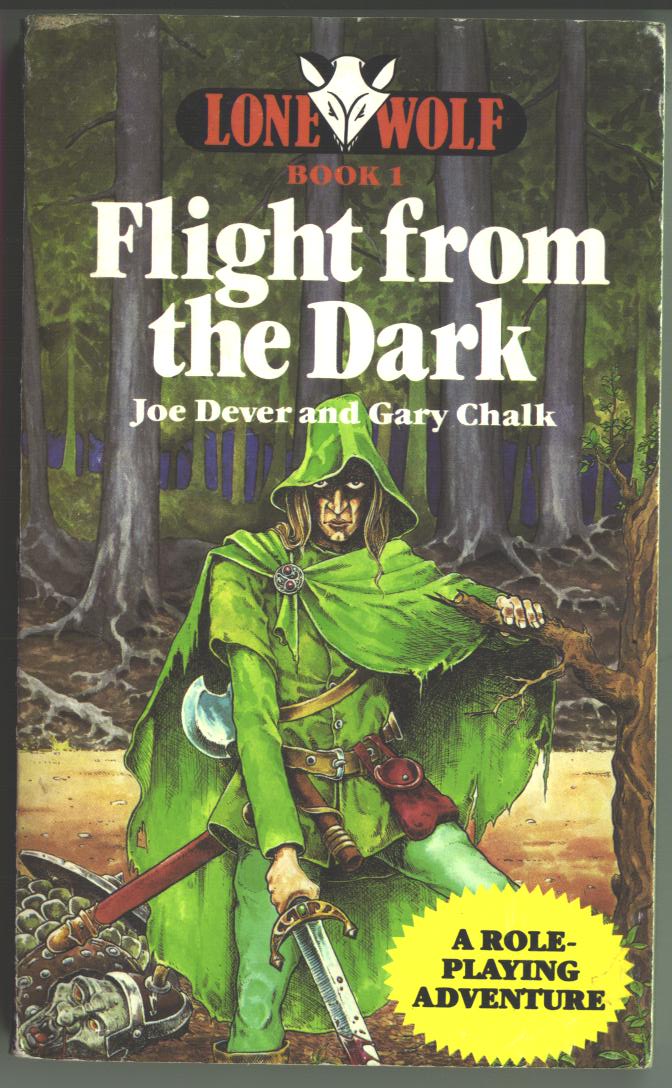
Lone Wolf Flight from the Dark cover
Courtesy of Demian's Gamebook Web Page

Lone Wolf has come a long way.  It keeps doing that.

Once upon a time, the names Joe Dever and Gary Chalk appeared atop this little, yet growing, gamebook series.  Then it kept growing.  It did spinoffs, even, and rumor has it that a videogame or two showed up on that newfangled ZX Spectrum.

I became aware of a resurgence years later when I heard tell of a Lone Wolf MMORPG.  "Magnamund Studios," eh?  Who are these fine folks?  Well, a short-lived bunch.  But I believe it was through the brief time I worked with them that I became aware of Project Aon, and thereafter Lone Wolf roleplaying games.  Oh, and since then, more videogames got released anyway.

But there was one game missing.  I still had my old copy of The Magnamund Companion, and I remembered the chapter "Modelling Magnamund."  Ah, real playing pieces!  Dramatic battles on the tabletop!  Yet it wasn't a real game for sale.

Funny thing about that.

Thirty years ago, Gary Chalk started developing Lone Wolf - The Board Game.  I'm pleased to share with you our Kickstarter project for the first printing, live now until December 5.

Lone Wolf - The Board Game box cover
Courtesy of Gary Chalk's pen
Click this link to see the project.

Click here to see what game Gary created.  (Beta rulebook.)

Click here or click here to play it.  (Free print-and-play demo.)

I've talked with Gary during the preparation of the Kickstarter.  This is a man worth catching in conversation.  When I simply asked how to say his name, cautiously hoping that his last name wasn't pronounced some funny way, he replied "I answer to anything, up to 'Stop, thief.'"

Beyond that, he answered my questions about The Magnamund Companion.  I would have thought that the pieces were authentic "Lone Wolf tabletop game pieces," but no, there never was any such thing.  Gary either created or repurposed (and certainly repainted; a hobby which he loves) everything in those old photos.  The game we are trying to fund now is the first and only "tabletop board game" this classic fantasy world has ever seen.

Battle mock-up
Courtesy of a massive design effort
It's more of a wargame, really, but being played on a board helps it run a lot more quickly and smoothly.  Speed, in fact, is one of the main selling points, and the project page discusses how quickly it runs for such a detailed simulation of Lone Wolf.  And goodness, does it work at that latter: the premise of the game's premade scenarios is to re-enact the battles of the early gamebooks on the tabletop.  I intend to do a project update (this here is the person maintaining the page) where I bring the readers with me in preparing one such scenario.

And it almost goes without saying that Gary's art has only gotten better over the decades of practice since he illustrated the first books.  All the playing pieces are 2-D art from his pen (and brushes).  Modern sensibilities might say 3-D miniatures are necessary in such a game; perhaps the modern version of what was shown in The Magnamund Companion.  I say 3-D has its place, and there's nothing like letting an expert 2-D artist loose on a project he loves.  As it looks now, a good chunk of early project backers seem to agree.

I'm enjoying sharing this project with the world.  In part, though, the best aspect simply is getting to talk with an amazing childhood hero on a regular basis and realizing that "hero" and "amazing" do apply.

(Post by Richard S. Hetley.  When not running Kickstarter projects, which hopefully is the better part, he can be seen trying to figure out what to do with his blog.)

Sunday, October 26, 2014

Codewords in gamebooks

Why use codewords?

Codewords are there to mark an event that has happened because it might have a consequence later on in the gamebook.  They can be used to mark many things such as things you've done, things you've learnt or friends you've made.

What codewords can you use?

Some codewords have something to do with why you got them.  For example, if you stole something, the codeword thief is used.  In Moonrunner, these words were used, but backwards.  When you read them in the gamebook, you can probably work out how you would have got them, so to a keen metagamer, these kind of codewords are clues.  Other gamebooks use completely irrelevant codewords, which give no information away, or, if the author is really devious, misleading.  One thing to point out is that having a codeword is not always good, so it's not a good (like rennur in Moonrunner).

Things you can do with codewords

In their Fabled Lands books, Dave Morris and Jamie Thomson made all of their codewords start with the same letter for each book (A for book 1, B for book 2 etc.) this gives you an indication of where you can get the codeword from, and it probably helped them a lot when they were planning out all the gamebooks at once.  They have also put all of the codewords at the end for you to tick off, rather than just write them down as they appear, so it is something for you to anticipate when you play the gamebook and also, you can aim for getting a certain number of codewords.

Also, the Crimson Tide has a neat little trick where if you follow the correct path, you will get a sequence of codewords that give you a clue as to what you do at the end.  Also, be aware that 400 is not the successful ending.  That's a devilish trick.

Items as codewords

There are some items that you obtain purely to mark that something has happened, such as the crystal pendant in Lone Wolf 2 (yes, they are all free online, so don't spend lots of money on book 28 for Kai's sake).  Anyway, an item could be a more physical version of a codeword, and may have other uses, for example, if someone sees the crystal star pendant, then they will know that you are friends with Banedon.  Siege of Sardath also uses items as codewords - in their case, it has rings with numbers associated with them to show that you have made friends with the elves and the dwarves.  In most cases, the item could be replaced with a codeword, but items have a difference feel to codewords.  They are less abstract.  However, if you lose the item as codeword, then things might break down.  You will have to work out which items are more important because of what they represent rather than your actual possession of them (so you could replace the option with 'If you were given a crystal star pendant, turn to x', but then I guess you could just say 'If you met Banedeon in book 1, turn to x').

codewords in apps

The thing with apps is that a lot of what is going on can be put 'under the bonnet'.  It might also provide some surprises.  So, you may not know any more that because the guy at the market stall told you about the secret entrance to the castle that when you get to the castle, you avoid the guards.  The app no longer needs to ask you any more, because it knows that you talked to the guy and it can skip the asking you bit (which means that you don't know that it was checking in the first place) and go straight for it.  Now the question is - does that encourage more replay or less?  If you know that the app is asking you something, you will know that there is an alternative at that point, but if you know that there are alternatives, but they are hidden, you might play the game more trying to find them all.  Maybe it depends on your level of persistence?

Sunday, September 22, 2013

Game turned gamebook - Heroquest

The board cover (larger image here)
including all the monsters and heroes.
Heroquest is a board game set in the Warhammer Fantasy world where four heroes would descend into a dangerous dungeon to complete a quest and fight the forces of chaos.  The game was for 2-5 players.  One of the players was the 'evil wizard' who would control the various goblins, orcs, fimir, chaos warriors and undead.

 The other players would take up the mantle of one of the four heroes.  Each hero has their own strengths and weaknesses - The barbarian was tough and powerful in combat but weak against mental attacks.  The wizard could cast spells but was weak in combat.  The elf was half way between the wizard and barbarian - he could fight well and cast some spells.  Finally, the dwarf was a good fighter and could disarm traps.

A special Heroquest die
The system was quite simple.  Each character had body points (hit points) and mind points(indicating how resistant they were to mental attacks.  The barbarian had a body score of 8 and a mind score of 2.  The wizard had a body score of 4 and a mind score of 6.)

Each character had a certain number of attack dice and defence dice.  When you wanted to attack someone, you would roll the number of attack dice you had.  Each skull counted as a hit.  Your target would then roll a die for each defence die they had.  If the target was a hero, then each white shield they rolled on defence would negate one skull on attack.  If the target was a monster, it would need to roll a black shield to negate an attack.  The target lost body points equal to the number of skulls the attacker rolled - the number of appropriate shields the defender rolled.

I'll use my broadsword!
Heroes could buy equipment or use spells to increase the number of attack or defence dice they rolled.

There were various adventures to play with their own special rules.  There were also several expansion packs and also Advanced Heroquest.  If you search on the internet, you will find plenty of custom content, such as this website, this website and this website.

Heroquest has also spawned a lot of computer games such as this one.


 Dave Morris wrote three Heroquest books which had a similar format to the Knightmare books - they all included a novella and a gamebook.  The second and third books also included a scenario for the boardgame.

The first gamebook from the first book, The Fellowship of Four, was actually a multiplayer gamebook, where the reader (or several readers) could play the barbarian, dwarf, elf and wizard.  The game was designed so that the best victory could be achieved most easily with the combined talents of all of the heroes (also, since each hero could only carry either three or two items, one of which being a weapon, a solo hero would find it a massive headache to get the right items to carry.)  Plus, some situations could only be avoided if players had someone else to back them up and most combats were against multiple foes so force of numbers was also a good thing.

The gamebook was actually quite challenging but if you were daring and clever enough then you could be richly rewarded.  There was some good mileage in such a short gamebook.

I also enjoyed the story, split into five chapters.  The first four focused on one of the heroes as they came together and the last one was how they saved the world together.

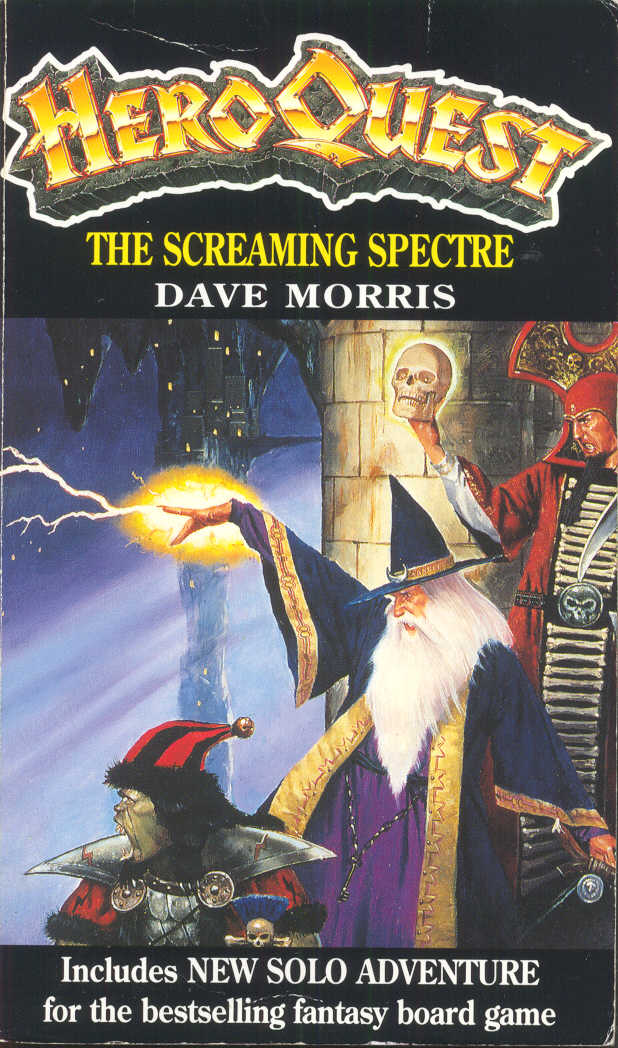
The second book, the Screaming Spectre, focused solely on the wizard character.  The novella was a mystery  rather than an action packed quest and so it was a little slower, but it was still good to watch it unfold.  The mechanics of the second gamebook were also different as it focused solely on the wizard character.  The trick to success was to choose the most effective spell to overcome the situation.  Since the wizard is weak in combat, fighting is not usually an effective option.  It was also a challenging gamebook but it could be bested with some thought to your spells.


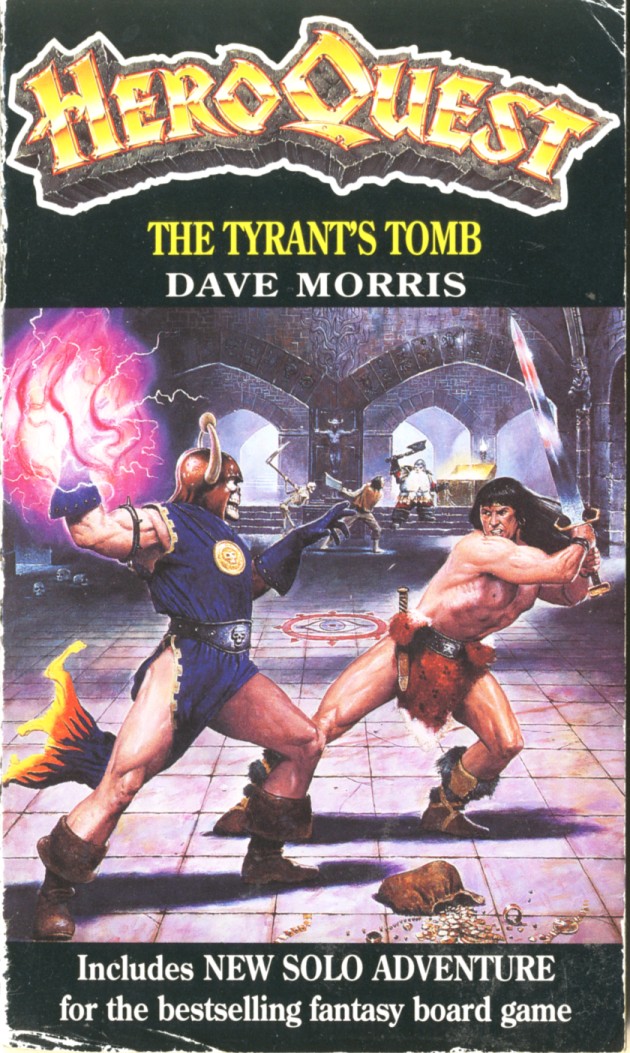
The final book, The Tyrant's Tomb, focused on the Barbarian.  The story was more action packed and involved a barbarian trying to break into a tomb to get lots of treasure.  Naturally, it all goes wrong.  Unlike the other two books, the gamebook's story is similar to the novella.  Strategy revolves more around gathering the correct items and combat as the barbarian cannot use spells.  I think this is the most difficult gamebook due to the tough opponents and the lack of healing in the book.

I don't know if there were ever going to be books based on the dwarf or the elf, but I guess Heroquest stopped being profitabe at some point.  However, typing it into google still shows that it has a cult following.


Like the Knightmare gamebooks, the Heroquest gamebooks could have been a bit longer; however, the Heroquest books are good to provide a few hours entertainment if you see them on Amazon as is the boardgame.

And if you want some free gamebooks to read, how about heading on down to the Chronicles of Arborell where this year's Windhammer Competition gamebooks are out!  There are 14 in all this year, so there will be something for everyone.  We are currently in the voting phase which will end on the 30th October.  To vote, you need to give the names of your 3 favourite books to Wayne Densley at  vote@arborell.com.