Showing posts with label lone wolf. Show all posts

Saturday, December 3, 2016

Eclipse of the Kai

This week, we received the news that Joe Dever, a prolific gamebook author most notably known for his Lone Wolf books, had died. Having grown up reading Joe's books, and continuing to read and enjoy them to this day, I'm going to presume to speak for the community of Lone Wolf fans in saying that this is a death that strikes a personal chord. The world has lost a number of great artists this year, but we're going to miss Joe Dever in particular. He was our guy
 

And maybe that's because fantasy gamebooks are a pretty niche area, and the superstars stand out. Or because Joe was extremely active on social media in recent years, personally interacting with fans and adding a huge amount of background information on the books and world he'd created. Maybe it's because he toured extensively to promote the books, allowing him to meet a broad section of his readers in person. Maybe it's thanks to his phenomenally generous gesture of essentially giving away all his work, granting Project Aon a licence to make online versions of his books available for free. Whatever the reason, he was a huge part of the gamebook community, and a familiar face to many of his readers. I think I'm not alone in feeling great sadness at his death.

I didn't know Joe well. I met him on two occasions, when I was interpreting for him at gaming trade shows in France. He struck me as extremely professional, and knowledgeable about every aspect of writing and publishing. He'd give us pointers on where we should display our signs for our stand, how to be more conscious of the direction of movement of visitors, things like that. He spent a great deal of time with visitors to the stand, and visibly enjoyed talking about his books, and the process of creating the world of Magnamund. For me personally, he was an inspiring example of the work ethic, and the level of focus, necessary to be a successful fantasy author. In quieter moments, he patiently answered my questions as well – he mentioned, for instance, how he developed the Giak language by placing toothpicks in his mouth, to see what sounds he could articulate if he had long, sharp teeth. He also told me a story about how, after his work on the multi-million selling Playstation game Killzone, Sony sent him an angry letter, accusing him of stealing the 'Helghast' in the game, 'from some fantasy series that some guy wrote in the 80s...'. 
 

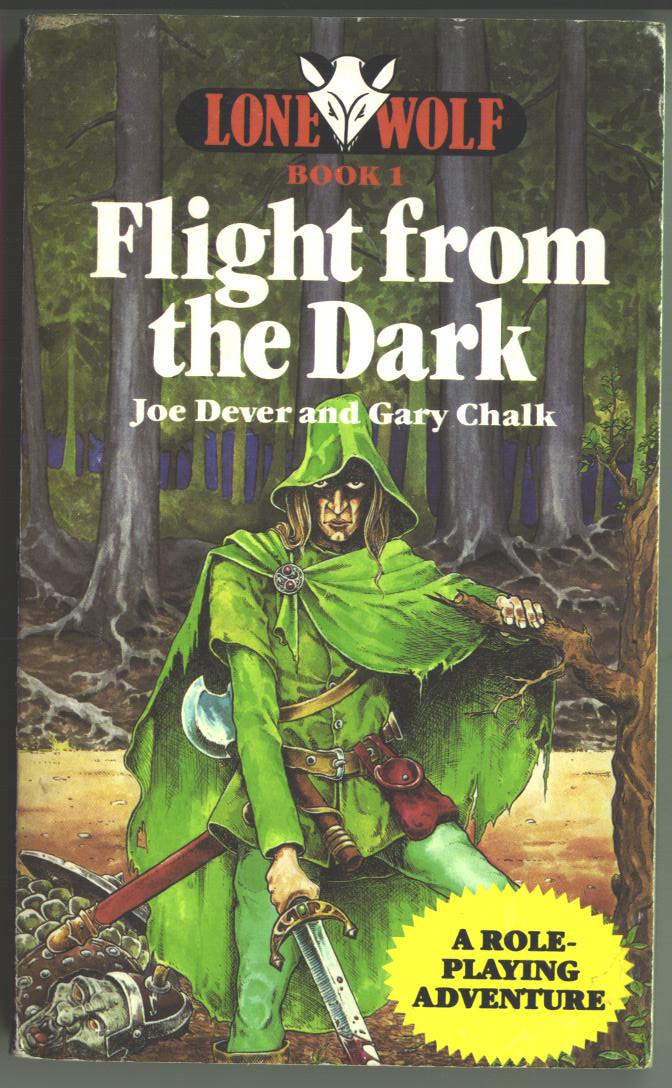
My own experience with Lone Wolf began when I was ten or eleven years old. I received 'Flight from the Dark' and 'The Jungle of Horrors' as Christmas presents one year. I'd never heard of the series before, and yet the level of detail in the books grabbed my attention at once. Magnamund was not a patchwork, generic fantasy world; it was a unique creation, with thousands of years of backstory to take into consideration. There were no Tolkienesque orcs or elves here; rather, it was home to Shianti, and Gourgaz, and Nadziranim. Lone Wolf himself, the psychic warrior monk on a personal mission to restore the glory of his slaughtered order, was a fascinating protagonist. The books were unlike any gamebooks, or for that matter any fantasy, I'd come across before.

Throughout my teen years I searched out the rest of the books – to the extent that, when I did my slightly cliché 'backpacker year abroad', I soon began carrying a satchel of Lone Wolf Grand Master books all over Australia, which I'd been unable to find in Britain. And this was because adding books to the collection, and so expanding the adventures of Lone Wolf, carried a special thrill. Not least in gameplay terms; each book developed Lone Wolf's abilities, making him more knowledgeable, more skilful, more powerful. Yet more important than this was the keen sense of continuity that pervaded the twenty-book arc. A supporting cast of recurring friends and villains surrounded Lone Wolf – enemies such as Vonotar the Traitor, and Darklord Gnaag; pals such as Banedon the magician, and poor, ill-fated Paido the Vakeros. A gamebook is rarely a lengthy medium, and yet staying with Lone Wolf over the course of twenty-plus books (a good arm's length on a bookshelf) gave these characters the opportunity to breathe, and grow. It gave the reader a chance to really settle into the world of Magnamund. Simply put, it was easy to become deeply invested in Lone Wolf's world, and in his friends and foes that peopled it. 
 

I can only speak with any authority about my own experience with Lone Wolf. For my part, that initial sense of astonishment has never completely disappeared, even as I approach the tail end of my thirties. The extended republication of Flight from the Dark evoked it again a few years back; so did the release of the newest (and twenty-ninth) Lone Wolf book, The Storms of Chai, just a few months ago. These days, I store my character sheets on my hard drive, and I use a random number generator rather than cheatily hitting zero after zero on the Random Number Table. But holding a new Lone Wolf book in my hands still has the power to turn me into an over-excited teenager once more.

Joe Dever made a colossal contribution to the realm of fantasy gamebooks and interactive fiction, and his absence from here on in will be keenly felt. I mentioned above that Joe was 'our guy'; in truth, it's more accurate to say that, in sharing the books and the world of Magnamund with us – in showing us Lone Wolf's heroic vision of right and wrong – he added a little wonder and nobility to all our lives.

And that made us his guys, his people.


(Post by Paul Gresty)


Wednesday, November 19, 2014

The Lone Wolf Board Game - Halfway to Success!

A quick mention that the Kickstarter for the Lone Wolf Board Game has just passed the halfway mark on its funding target. It's also nearing the halfway mark on its deadline, so I call that pretty positive progress so far. Still, if you're a fan of Lone Wolf, or board games, or Gary Chalk's artwork, get over there and get pledging, if you haven't already.

For more information, visit the Kickstarter project page, or see Richard Hetley's post on this very blog.


Also, I found it interesting to see that documents from the vermin control company in charge of my apartment building are in the same distinctive font as the Lone Wolf gamebooks.

Yeah! Wipe out those damn Noodnics!


(Post by Paul Gresty)

Saturday, November 8, 2014

Lone Wolf - The Board Game by Gary Chalk live on Kickstarter


Lone Wolf Flight from the Dark cover
Courtesy of Demian's Gamebook Web Page

Lone Wolf has come a long way.  It keeps doing that.

Once upon a time, the names Joe Dever and Gary Chalk appeared atop this little, yet growing, gamebook series.  Then it kept growing.  It did spinoffs, even, and rumor has it that a videogame or two showed up on that newfangled ZX Spectrum.

I became aware of a resurgence years later when I heard tell of a Lone Wolf MMORPG.  "Magnamund Studios," eh?  Who are these fine folks?  Well, a short-lived bunch.  But I believe it was through the brief time I worked with them that I became aware of Project Aon, and thereafter Lone Wolf roleplaying games.  Oh, and since then, more videogames got released anyway.

But there was one game missing.  I still had my old copy of The Magnamund Companion, and I remembered the chapter "Modelling Magnamund."  Ah, real playing pieces!  Dramatic battles on the tabletop!  Yet it wasn't a real game for sale.

Funny thing about that.

Thirty years ago, Gary Chalk started developing Lone Wolf - The Board Game.  I'm pleased to share with you our Kickstarter project for the first printing, live now until December 5.

Lone Wolf - The Board Game box cover
Courtesy of Gary Chalk's pen
Click this link to see the project.

Click here to see what game Gary created.  (Beta rulebook.)

Click here or click here to play it.  (Free print-and-play demo.)

I've talked with Gary during the preparation of the Kickstarter.  This is a man worth catching in conversation.  When I simply asked how to say his name, cautiously hoping that his last name wasn't pronounced some funny way, he replied "I answer to anything, up to 'Stop, thief.'"

Beyond that, he answered my questions about The Magnamund Companion.  I would have thought that the pieces were authentic "Lone Wolf tabletop game pieces," but no, there never was any such thing.  Gary either created or repurposed (and certainly repainted; a hobby which he loves) everything in those old photos.  The game we are trying to fund now is the first and only "tabletop board game" this classic fantasy world has ever seen.

Battle mock-up
Courtesy of a massive design effort
It's more of a wargame, really, but being played on a board helps it run a lot more quickly and smoothly.  Speed, in fact, is one of the main selling points, and the project page discusses how quickly it runs for such a detailed simulation of Lone Wolf.  And goodness, does it work at that latter: the premise of the game's premade scenarios is to re-enact the battles of the early gamebooks on the tabletop.  I intend to do a project update (this here is the person maintaining the page) where I bring the readers with me in preparing one such scenario.

And it almost goes without saying that Gary's art has only gotten better over the decades of practice since he illustrated the first books.  All the playing pieces are 2-D art from his pen (and brushes).  Modern sensibilities might say 3-D miniatures are necessary in such a game; perhaps the modern version of what was shown in The Magnamund Companion.  I say 3-D has its place, and there's nothing like letting an expert 2-D artist loose on a project he loves.  As it looks now, a good chunk of early project backers seem to agree.

I'm enjoying sharing this project with the world.  In part, though, the best aspect simply is getting to talk with an amazing childhood hero on a regular basis and realizing that "hero" and "amazing" do apply.

(Post by Richard S. Hetley.  When not running Kickstarter projects, which hopefully is the better part, he can be seen trying to figure out what to do with his blog.)

Thursday, July 10, 2014

How to Immediately Save £149.99 (Plus £30 Postage and Packaging)

The 28th Lone Wolf book, the last of the Lone Wolf books to be published back in the 90s, was called 'The Hunger of Sejanoz'. If you go to eBay and type in 'hunger of sejanoz', you'll see something like this: -


Pricey, no? But wait, there's an alternative.

If you're reading the Lloyd of Gamebooks blog you probably already know what Project Aon is. This is a massive fan-driven undertaking to re-edit and make available online - for free, mind - every single one of the Lone Wolf gamebooks, all with the blessing of the books' author, Joe Dever.

Now here's the big news: a couple of weeks ago, book 28 went online. This means that EVERY SINGLE LONE WOLF GAMEBOOK (to date) is now available. And so are the (fantastic) World of Lone Wolf books, featuring the Shianti wizard Grey Star. And so is a miscellany of other works by Joe Dever - the Magnamund Companion, the Combat Heroes books, the first of Dever's Freeway Warrior series.

Immediately. For free. Online or in ebook format.

This is a truly Herculean project that has, I believe, taken about a decade to accomplish. To everybody at Project Aon: thank you, thank you, thank you. You are all my heroes. I would gladly give each and every one of you a big, wet kiss on the cheek.


So go, dear reader. Go over to the Project Aon website. Read these books now.

Oh, by the way, that eBay listing for Lone Wolf 28 asks for £30 in postage and packaging? Man alive, that's steep. I guess that must cover the cost of the Korlinium wrapping paper, to stop the Helghasts at the post office sensing the book's true worth.


(Post by Paul Gresty)

Sunday, July 3, 2011

Morality and roleplaying in gamebooks or: Why I still give Lord-lieutenant Rhygar the magic spear even though it will be bad for me.

The mood of the canal boat trip
darkened when the argument over
who got to steer turned nasty.
The title refers to the second Lone Wolf (see also the TVtropes page) book, Fire on the Water

All of the Lone Wolf books can be obtained for free from http://www.projectaon.org/

So who is Lord-lieutenant Rhygar and why does he need a magic spear?


Well, if you haven't read the book, here is the story so far...

As the Sommerswerd blasts 
Darklord Zagarna into oblivion,   
a random Giak shouts 'Hi mum!' 
You are Lone Wolf, the Last of the Kai Lords and you are fighting some evil empire led by a gang of powerful creatures called the Darklords. 

You are trying to get to a city so that you can get an uber magical sword, called the Sommerswerd, that only a Kai Lord can use.  It is powerful because it can kill a darklord.  You need to kill a darklord because one of them is laying waste to one of your cities. 


Ok, got that?
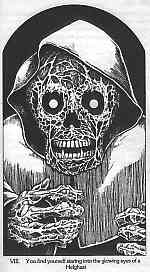
If I looked like that
I'd want to be a
shapeshifter too.
Unfortunately for you, you are being hounded by many monsters including some powerful undead psychic shapeshifters called Helghasts which can only be harmed by magical weapons. 

You may or may not find a magic spear on your journey - it is the only weapon that can harm the helghasts before you get to the Sommerswerd.

Eventually, you and your travelling companion, Lord-lieutenant Rhygar reach a network of tunnels where the noble and brave Lord-lieutenant says that he will hold of the helghasts in order to buy you time.  His sword is not magical which means that he cannot harm them, but if you have the magic spear, you have the option of giving to him so that he can harm them.  My first instinct is to give my brave companion the spear.

A Noodric.
It's Hammerdal time.
However, further on down the tunnel, you may be ambushed by a helghast and if you do not have the magic spear then you are killed.  The only way to get through the tunnels if you do not have the magic spear is if you decide to follow a creature called a Noodnic.  If you have the animal kinship discipline, you can get on with them and they show you through the tunnels.  However, then then steal all of your money, so it's not perfect although it's better than getting killed.

If you do survive and you get to the city of Hammerdal, you are given some bad news.  Lord-lieutenant Rhygar was killed. 

                             You get told the same thing whether you gave him the spear or not. 


You can't touch this.
Until after you really
needed it.
The ironic thing is, we are doing all of this in order to get the Sommerswerd, which is a magical weapon and deals double damage against undead creatures. 

Maybe  Lord-lieutenant Rhygar's sacrifice wasn't even necessary.

It seems that readers were not very happy about this.  The footnotes in the updated Project Aon version of the book state:

"Original version: The choices appear to serve no other purpose other than punishing Lone Wolf with certain death for mercifully handing Rhygar the Spear. The fact that this version was revised and the path that Lone Wolf is given in the Legends of Lone Wolf series also both appear to refute the correctness of this version."


Lord-lieutenant Rhygar can at least
go down in a blaze of glory.
However, I like to imagine that if he did have the spear, he would have taken down a few of the undead monsters with him.  If he didn't have the spear, I imagine that he would have spent the last few minutes of his life as a terrified moving target that can't fight back. 

Giving him the spear still gives me some peace of mind that I have done the right thing, despite the book punishing me for my act. 


This gets on to my point that gamebooks can teach us something about ourselves.  There are some options in gamebooks that, in terms of the game, are completely pointless. 

Maybe it is good to give up items or fight a combat for no reward.  It gives you an insight into your own character.  Sure, there are ways that gamebooks can reward or punish you for behaviours, but does it give you an insight into your character if you do it for a reward or punishment?  It was Dave Morris who gave me that thought in
this interview where he says:

"I remember talking to Joe Dever and he said he’d included a “moral element” in the latest Lone Wolf book. If you failed to rescue some kids from slavery, two or three paragraphs later you were attacked by an unkillable demon. And I was saying, “That’s not morality – that’s just economics! Morality is personal. If you’re swayed by the awareness of punishment then you can’t say it’s a moral choice...”

Dave was referring to the Blood Sword series where 'good' actions aren't necessarily rewarded and 'bad' actions aren't necessarily punished. 

There is a smaller example in Necklace of Skulls, where you can give some children some food, but you get nothing in return. 
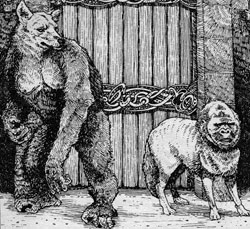
Do you really want these two in  your neighbourhood? 
If they were, you'll end up like the both of them. 
Going a bit ape.
 As well as playing a charitable type who gets a good feeling from helping the needy I also used to play a complete psychopath who wanted to take down as many enemies with me as possible. 

I figured that even if I failed in my mission, my mass murdering will weaken the enemy a bit.  For example, in the Citidel of Chaos, I could attempt to bluff my way past the ape-dog and the dog-ape but then I figured that they would be part of Dire's invasion force and even if I killed him they would still run off and cause trouble, so I made a poor attempt at bluffing and then just attacked them. 

After all, if I don't have a levitation spell at the end of the book, I have to go back the way I came.  So I'm thinking ahead. 


However, some people think that your journey back would not be too successful (the link will make sense if you succed at the gamebook).
Right, I've got everything I
need to go to the loo.
I would also play some gamebooks as a kleptomaniac hero where I would try to get as many items as possible and as much money as possible.  

I would even hang on to items even if they only had one use in the book and I would be severely punished for not using them.  After all, some of the items sound really cool and I would like to hang on to them.  


So there are plenty of choices that we can make in a gamebook that may have no effect on the game or may even punish us but we still make them because we want to role play our character that way or their actions satisfy us more.  However, most of our choices are made with the expectation that they will reward us in the end.  Ultimately, you will want to get to the most victorious paragraph, but you need to make plenty of other choices to get other rewards as a means to that end.  For example, you may need money, better weapons or an ally. 

Some authors give the universe of their gamebook a moral code and they do reward you if you follow it or punish you if you don't.  Here are some ways that this is done.

Leave him alone.
Reward or punish the hero by breaking the fourth wall.

This is when you perform an action and the author decides to give you some kind of bonus or penalty.  In Fighting Fantasy, it usually affects your luck score. 

For example, in City of Thieves, you lose 4 luck points if you kill the blacksmith, who was a 'good man'.  But you gain 1 luck point if you give a beggar a gold piece. 

In some of the earlier books, you could also gain luck in addition to getting some material reward.

This is averted sometimes - the above example from Lone Wolf is one time.  There is also an example from Crypt of the Sorcerer where you have to kill a helpful man and take a luck penalty in order to get an item that is vital for your victory. 

Have different moralities that the hero can follow

Scorpion Swamp lets you choose whether to serve a good, neutral or evil wizard and complete a quest for them.  Different people treat you differently depending on which wizard you work for.  This could also be an example of rewarding or punishing the hero within the story as people treat you much better for following the good wizard and they are far more hostile towards you if you follow the evil wizard.

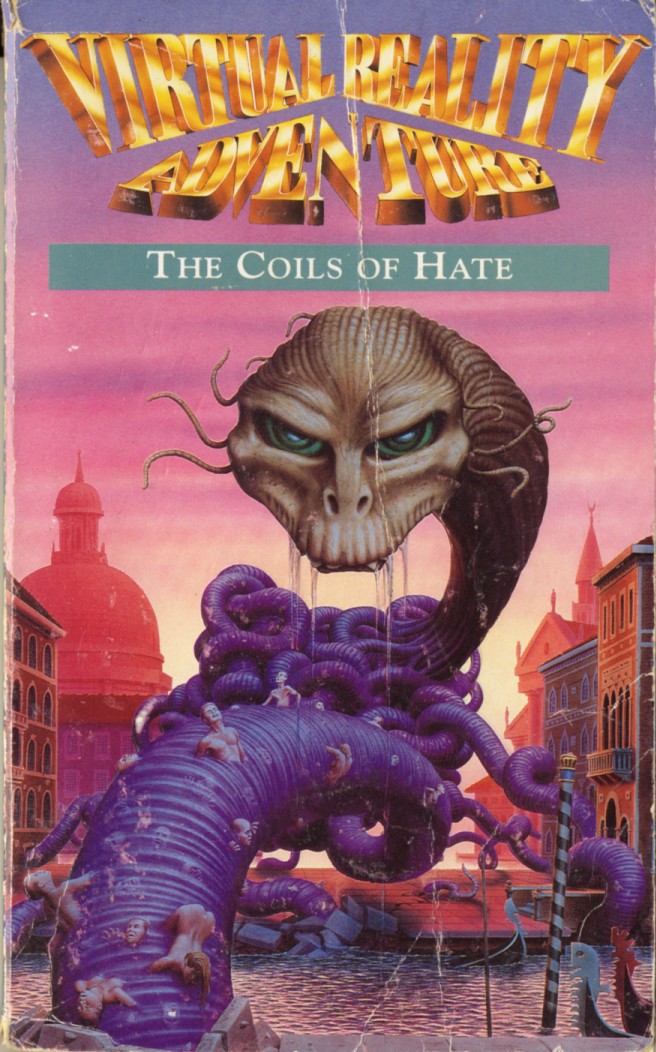
In the Coils of Hate and Down amongst Dead men, certain actions you choose to perform will give you code words to mark what morality you have decided to follow.

In the excellent gamebook Outsider! by Gavin Mitchell you are an assassin in search for your father.  You find three father figures in the book, one is a necromancer (evil), one is a noble (neutral) and one is hero known as Defender (good).  You could choose to give up your life as an assassin and follow one of these three or you could carry one to the 'best' ending which involves learning from all three of them for a while and then leaving them.

Have a score that measures morality and state how it can be increased or decreased.

Your going to be cut
up about annoying
this guy.
This is a subset of the above section.  However, it will seem less arbitrary, you will have been given some guidance on what actions will increase or decrease the score and the score will have an effect on the game in its own right rather than affecting other scores (i.e. in most Fighting Fantasy games where you get a 'moral' bonus or penalty, you change your luck score which has applications beyond the moral).

This makes morality more integral to the game as it has its own score.  It also gives a means to reward or punish players for their actions and lets players know that they will be rewarded or punished for 'moral' or 'immoral' acts.

It also gives the author a chance to give examples of how to increase or decrease the score or at least gives some fairly strong connotations.  For example, Sword of the Samurai does not give an in depth explanation of what is honourable or what is not, but when I was presented with choices in the book, I could point out some choices that would be honourable or not.  It also gave me a bit of education into what samurai found honourable (for example losing your weapon is a big no no).

They're really friends.
Reward or punish the hero within the story.

This is when you perform an action and if it agrees with the morality of the book, your life becomes a lot easier and if it disagrees then your life becomes a lot harder.  However, this is not because the author says so, but because the characters in the book treat you more favourably or following the book's morality just happens to be best for your survival anyway.

In Scorpion Swamp, serving Selator, the good wizard makes your life easy as most of the intelligent denizens of the swamp either help you or are indifferent to you.  If you follow Grimslade, the evil wizard, some of those denizens attack you on sight.

In the Choose Your Own Adventure book, the Race Forever, you can only win one of the races by turning down a bribe and then telling the authorities about it.  If you accept the bribe, you get shot and if you don't tell the authorities, you don't win the race.

Of course, the author may play on this by making it a trap.  After all, heroes would always help the helpless won't they?  One example of this is Portal of Evil.  However, the people who trap you aren't evil and it helps in the long run.

Offer the hero a choice to do something that fits the morality of the book, but do not reward or punish them at all.

You can give money to the beggars or try to save someone, but the only reward is your satisfaction.  Dave Morris does this a lot.  For example, you can give away food in Necklace of Skulls for no gain.  You can also do 'bad' things in the Blood Sword series and not be punished or do 'good' things and not be rewarded.  When Dave was asked about this in an interview, this was his answer: 


I remember talking to Joe Dever and he said he’d included a “moral element” in the latest Lone Wolf book. If you failed to rescue some kids from slavery, two or three paragraphs later you were attacked by an unkillable demon. And I was saying, “That’s not morality – that’s just economics! Morality is personal. If you’re swayed by the awareness of punishment then you can’t say it’s a moral choice.”

To kill the assassin, attack Parsion.
For an easy fight, attack Halvorc.
Although Joe Dever didn't do that in the above quote, he does it a few times in Fire on the Water.  For example, you can give a beggar some money and all that happens is that you get mobbed. 

There is a situation where you are travelling with five people and one of them is trying to kill you.  It does not matter if you choose the assassin or not in game terms.  You could get an easier fight with the merchant with the same consequences.

The only thing stopping you is your desire to play the character as you wish, which for me is important, but super power gamers may play the game just to maximise their stats, not caring what is moral and what is not moral.  They make their choices based on the expectation of the best possible results.  


Moral messages in gamebooks

A lesson in empathy.
There are some gamebooks that contain moral messages woven within the story.  For example, Coils of Hate has a message about persecution.  I've read reviews about it being rather unsubtle about its message (for example, your people are called the Judians).  Also the fact that in this city where persecution is rife, an embodiment of hate arises and threatens to absorb everyone who is hateful (as you can avoid being absorbed if you perform good acts) is a metaphor for the danger of widespread persecution and tyranny.

Considering that, at the time, gamebooks' biggest consumers were young boys, any message had to be unsubtle as it would have been missed.  Even  with all its unsubtlety, when I read Coils of Hate at the age of ten, I was far more interested in how my character with swordplay, spells, charms and cunning would do.  And as a ten year old boy, I think I knew of the persecution of the Jews in Nazi Germany but I had absolutely no way of knowing what it would have been like to have been persecuted.  Coils of hate gave a snapshot into the life of someone who had to suffer persecution.  In that respect, it was a lesson in empathy for me.

Leave them trees alone.
Of course, I never thought about it at the time, but almost everything we learn is not immediately applicable.  A good lesson lies latent in our brains, waiting for such time as it will come in handy.  And if that lesson is for young boys then it has to be unsubtle.

Green Blood is another Virtual Reality Gamebook, this time about saving the environment.  I first read this one in my twenties and thankfully, I caught the message this time.  The same things I have said apply to Green Blood - the message may be unsubtle but it was for younger readers.  There were also messags about coming together in order to face a common enemy (As you had to convince the elves and a dragon to help you save the forest).  If these messages can be woven into gamebooks, then why not?  Every story has a lesson.

Mark had never seen
a production of Hamlet
quite like it.
Jonny really threw
himself into his
Halloween costume.
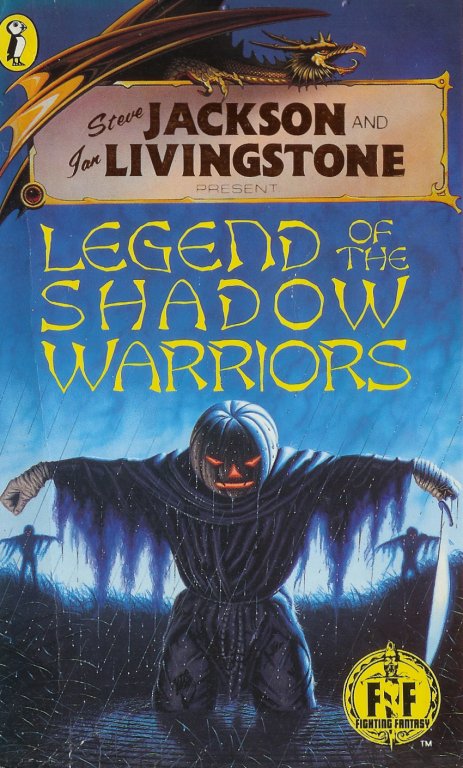
Fighting Fantasy books also have moral messages.  Stephen Hand's Legend of the Shadow Warriors requires you to beat Death, but you cannot kill him.  Instead, you must use The Spear of Life to give him life and therefore forgiving him for his actions.

Moonrunner, also written by Hand, has you bring a war criminal to trial  and justice rather than have you kill him.  These ideas are above the 'kill the sorcerer steal his treasure' ideas in early Fighting Fantasy books.


Gives a whole new meaning to
cracking up.
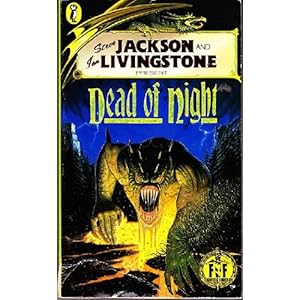
Stephen Hand also wrote Dead of Night, where you have to kill Myurr, a demon prince at the end of the book.  I don't think there is a moral message, but we do learn that demons and other powerful entities usually require some kind of artefact to stop them being sucked back into their plane.  This also applies in other gamebooks.  


Since gamebooks are about choices, they can also be about morality.  Sometimes, the choice is about the reward and according to some, that means that it is no longer about morality.  However, sometimes, making the 'moral' choice has no effect or may be detrimental, but if you still want to do it, then that shows a good sense of morailty.  

Tuesday, April 26, 2011

April A to Z - V is for Vonotar the Traitor

It's a blast.
Appears in:  Fire on the Water (Lone Wolf 2), The Caverns of Kalte (Lone Wolf 3), The Prisoners of Time (Lone Wolf 11) all by Joe Dever.

Background:  Vonotar was a member of the wizards' guild of Toran but he betrayed them for the magical power of the Darklords' wizards.  He then ends up in Kalte, controlling the mind of the ice barbarian chieftain.  You catch him and Vonotar is thrown into the shadow gate which leads to another dimension.  You also get thrown into the shadow gate a few years later where you come across him again.  And he's annoyed.

Prominence:  Vonotar or his servants are not prominent in any of the books, but he is one of the few recurring gamebook villains.  Bonus marks for this.  6/10.

Hardness:  With a power ring he wields, Vonotar has a combat skill of 30 and an endurence of 21.  He is immune to Psi surge and mindblast.  His endurance is quite low, but his combat skill is quite high for an ordinary wizard (I expect the power ring improves it).  He also manages to blast you and damage you for five endurence points before the combat and before you get near to him, you have to fight five notorious criminals from Sommerlund which have a combat skill of 38 and and endurance of 46 together.  Killing him and the five criminals is a pretty tough job even with all of the combat skill raising weapons and skills you have.  7/10.

Ambition:  Vonotar's orginal ambition is more magical power, but then he tries to take over ice barbarian tribes.  His ambition in the Prisoners of Time is to get home.  Ultimately, Vonotar is a lackey to the Darklords and so can't get too high a score in ambition.  4/10

Style:  Quite typical wizard with a typical modus operandi of wizards.  4/10

Diabolical genius:  He manages to get the Kai Lords killed but after his initial betrayal, his genius kind of stops there.  4/10

Total score:  When it comes to Lone Wolf's enemies, Vonotar is a small fish that resurfaces more than once.  25/50.

Sunday, January 23, 2011

Your adventure ends here - in a blaze of glory.

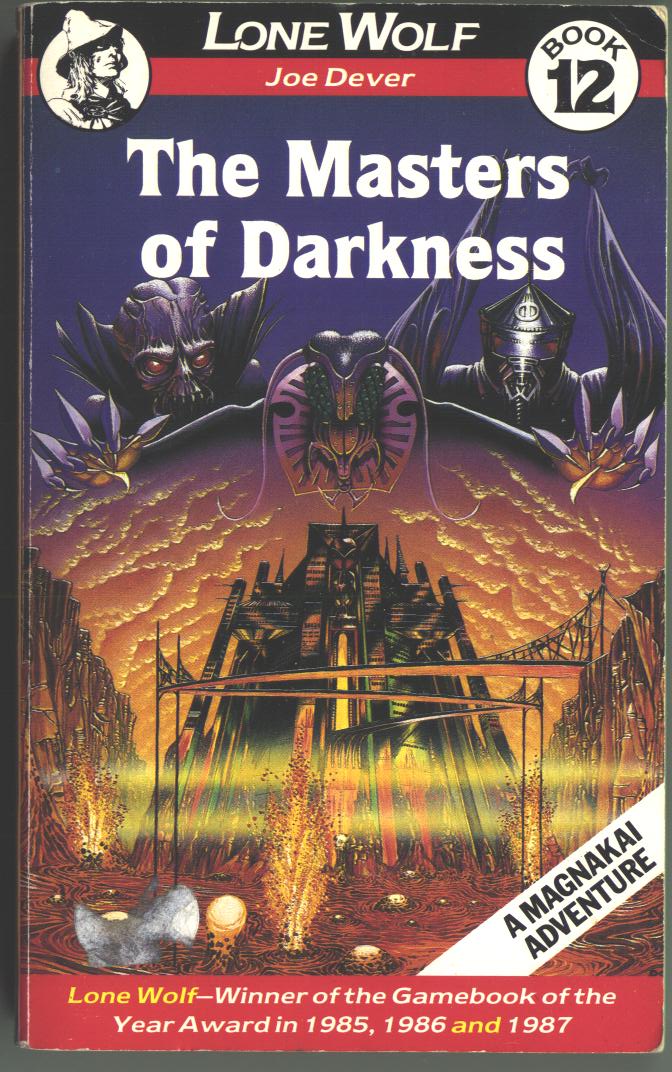
Here is a death paragraph from The Masters of Darkness by Joe Dever.  This is the 12th Lone Wolf book in the series and the last of the Magnakai series with a climax in the city of Lone Wolf's nemesis, Darklord Gnaag.


208

The moment you unsheathe the Sommerswerd, it radiates such godly power that every creature in Helgedad is alerted to your presence.  Within minutes you are surrounded by a nightmare legion of snarling, snapping screaming horrors.  You fight valiantly, and slay many before you are eventually overwhelmed and taken in chains before Darklord Gnaag.  With cruel glee, he orders you to be cast in the Lake of Blood where your endless suffering will feed its unholy flames for all eternity. 

Tragically, your natural life and your mission end here.  

The Sommerswerd is a powerful holy magical weapon.
Helgedad is a city ruled over by your enemies and is best described as a steampunk hell. 
I know it looks ghastly but the rest of the city is disturbingly abominable.

Darklord Gnaag is a powerful insectoid monster with lots of magical power.  He's a bit like the emperor from starwars except he could probably latch on to the side of a shaft if he gets flung down it. 


Can only be killed by weapons of awsome magical power.  Or a really big swat.

The Lake of Blood is not really described in the books, but I think you get the idea of what it's like. 

Why I like this paragraph 

You are doomed in this paragraph but the book throws you a bone and let you slay hordes of mooks before you meet your death.  In this way, you are rewarded as much as you can be in this situation.  Sure, you're going to die but you are going to take down dozens to hundreds of your enemies in the process.  You might die, but you get one last chance to show how badass you are.


Is that the best you've got?

How did I get into this mess

Joe Dever describes your death as a tragedy.  I found a definition of tragdy on the internet.  It goes like this.

Drama or film portraying the doomed struggle and eventual downfall of an admirable but flawed hero. Usually about powerful leaders or extraordinary individuals torn between opposing goals or difficult choices. Examples: Sophocles, Oedipus the King; Shakespeare, Hamlet.

Lone Wolf definately is an admirable but flawed hero in this ending. 

Admirable traits:  Has a powerful magic sword, good at killing his enemies.

Flaw:  Can't follow blindingly obvious avice.


Lets be grateful that Lone Wolf was not working at a nuclear missile silo during the cold war.

At the beginning of this book, I am told that I am going to the city of my greatest enemy, Helgedad, and it will be full of his servants. 

I am also told that using the Sommerswerd will alert all of the inhabitants of Helgedad to my presence and that I should only use it when I am within striking distance of Darklord Gnaag.  In order to hide its powerful magical aura, I am given a scabbard lined with korlinium which makes the sword undetectable.  As long as I do not unsheathe it before I face Gnaag, I will be OK.

The person who gives me this advice is Lord Rimoah, a trusted and experienced ally, so it's not like he's making this up.

Also, if you are given the option of using the Sommerswerd, it tells you to go to 208.  If you face Gnaag and you want to use the Sommerswerd, it tells you to go to 214.  There's a big clue.

It is just like the big red button.  You've been told that doing it is bad.  You rationally know that doing it is bad, but you still want to.  It might be because you want to see what happens or it may because everyone has told you not to but the first thing I want to do ocne I get to Helgedad is to climb to the tallest smoking wreck I can find, unsheathe the Sommerswerd, wave it around and scream 'COME ON THEN YOU FILTHY SCUM.  COME AND HAVE A GO IF YOU THINK YOU'RE HARD ENOUGH!'


What have I learnt from this death

If you're going to go down, go down in a blaze of glory. 

Joe Dever is an evil genius and a master of reverse psychology.