Showing posts with label fighting fantasy. Show all posts

Tuesday, February 2, 2016

The Foundling Saga - A Fighting Fantasy Fizzle


In 2013 Gallimard, one of the biggest publishers in France, invited Steve Jackson to the Salon du Livre, France's huge annual literary trade fair. Gallimard had been publishing Steve's books non-stop for the last 30 years; it was about time he made the guest list. I met Steve there, and pushed a copy of my gamebook Arcana Agency: the Thief of Memories into his hands. I also tried to hustle for a little writing work, even talking about some storylines for wholly original Fighting Fantasy apps. Steve was very polite and professional with me – though in retrospect, I was a bit pushy and over-eager. I'd already had a little email contact with Steve; he very kindly said it would be okay for me to send him a more fully-developed proposal. I got to work.
The proposal I ultimately sent him was for The Foundling Saga, a story taking place in Gallantaria during The War of the Five Kingdoms. I prepared a comprehensive outline, and even went so far as to create a demo of the first part of the game using Inkle's excellent Inklewriter engine. One idea I particularly liked was the notion of an app that could be played in the second person – gamebook-style, recording stats and items – or in the third person, in a more literary style. I still feel there's some merit to that idea, even given all the extra development work it entails.
Steve didn't go for the proposal. In truth, I'm not sure he really even read through it – he mentioned it would have been difficult contractually, so it probably wasn't worth a great deal of attention. Plus I got the impression the idea just didn't grab him, and he was being diplomatic. But he was very cool with me throughout. The guy's a pro, and it's a crying shame he hasn't written any gamebooks for a while now.
So I think I'm never really going to do anything with The Foundling Saga; it is now and forevermore relegated to the status of fan-fiction. Feel free to take a look at the online playable demo I prepared for The Foundling Saga, Part 1: Return to Titan. It's a nice little gamebook in its own right, I feel, copyrighted names and places notwithstanding.
Pfft. You win some, you lose some.

(Post by Paul Gresty)

Saturday, July 4, 2015

The Wondrous Nightmare Begins!

I wonder if, one day, Summer 2015 will be remembered as The Summer of Gamebook Kickstarters. We've recently seen the Kickstarter for the interactive fiction app The Frankenstein Wars - and, as one of the people intimately involved with that project, I'm overjoyed that we (just!) managed to reach our target. Thank you, thank you, thank you, good backers. In just a few days we'll see the start of the Kickstarter for the next Fabled Lands gamebook, The Serpent King's Domain. And in the nearish future (I'll have to check my dates) we'll see a Kickstarter for the Jamie Thomson / Ashton Saylor gamebook The Good, The Bad & The Undead.


But today is the day that Jonathon Green launches his own gamebook Kickstarter for Alice's Nightmare in Wonderland. Have you read a Fighting Fantasy gamebook in the last 20 years? Then you know who Jonathon Green is, and that the quality of his writing is up there with the best.

Alice's Nightmare in Wonderland seems a wonderfully odd bird. Though it's based on a work of classic literature, it seems to place a firm focus on game mechanics and playability - it is both game and book, you might say. Uniquely, the Kickstarter's project page mentions it can be played with three different sets of rules - one using dice, one using playing cards (how flavourful!), and one without any random component at all. Curiouser and curiouser.

Enough shenanigans. Here's JG's press announcement on the book: -

On Saturday 4th July, at 1.00pm BST (which is 8.00am New York time and 10.00pm in Melbourne, Australia), I am launching my latest Kickstarter project, ALICE'S NIGHTMARE IN WONDERLAND.

ALICE'S NIGHTMARE IN WONDERLAND is a brand new nightmarish gamebook - a multi-path book, very much in the style of Choose Your Own Adventure and Fighting Fantasy Gamebooks, in which you choose the course of the story - inspired by the works of Lewis Carroll and the Steampunk genre.

ALICE'S NIGHTMARE IN WONDERLAND is set several years after the events of 'Through the Looking Glass'. Alice finds herself back in Wonderland and called upon to save the realm from the increasingly deranged Queen of Hearts. But all is not as it first appears, and soon Alice is battling to save herself from the nightmare that is rapidly overtaking Wonderland.

If you've ever wondered what would have happened if Alice hadn’t drunk from the bottle labelled ‘Drink Me’, or if she hadn’t joined the Hatter, the March Hare, and the Dormouse for tea, now you can find out. In ALICE'S NIGHTMARE IN WONDERLAND, rather than becoming Alice yourself, YOU guide Alice through the fluctuating dream world, deciding which route she should take, which perils to risk, and which of Wonderland’s strange denizens to fight.

But be warned – whether Alice succeeds in her quest, or meets a dire end as the nightmare escalates, will be down to the choices YOU make.

If you think this project might be for you, please check out the project's preview page here -https://www.kickstarter.com/projects/1412864360/111052384?token=119fa0a4 - and set your alarm for 1.00pm on Saturday to make sure you don't miss out on your ideal reward. After all, there are some limited rewards that gamebook fans and Alice aficionados alike are going to want to get their hands on before anyone else.


(Post by Paul Gresty)

Wednesday, September 24, 2014

Fighting without dice

Post by Paltogue.

I'm currently in the planning stages of writing a gamebook (or even a series of gamebooks) and, as a long-time fan of Fighting Fantasy, my first inclination is to go with the familiar and use FF rules, including plenty of fighting (it is FIGHTING Fantasy after all). But there's a problem, currently being discussed in blogs and on Twitter by people like Dave Morris and Matt Hill, which I want to explore in this post on Lloyd of Gamebooks.

OK, picture the situation. You're lying asleep just before dawn in a first floor bedroom in an inn, on your way to deliver an important secret message to ... well, I'm not going to give the whole game away right now, just assume it's someone important! Test your Skill. If you are successful, you wake up, having heard noise from the floor below, which sounds like someone breaking into the inn. If you fail, you remain asleep. Let's say for now you were successful (which of course depends on what your SKILL score was in the first place, in large part determined by another random roll of the dice before you started your adventure). You bolt awake, realising your enemies are coming to get you before you can deliver your message. So what do you do now? Do you grab your stuff and stand by your door, preparing to attack anyone who tries to come in (this would be the only option if you didn't pass the SKILL test just before by the way), or do you grab the first thing at hand and get the hell out of there, jumping out the window to the back street below? Now, that's a proper choice that you as the reader get to decide, and I like it, as I have no idea who or how many people are coming up the stairs to get me, and as it's near dark outside I fancy my chances with the jump (the inn isn't very tall after all). So you chose which of your possessions to grab and out the window you go. Test your Luck. If you are lucky, you land well and get to your feet. If you are unlucky, you land awkwardly and twist your knee. Lose 2 STAMINA points (and maybe even a SKILL point if I'm being mean). You stand up and see a gaunt REIVER wearing a wide-brimmed hat standing in front of you. He is holding a flaming brand in one hand, and a jagged-edged knife in the other. You must fight him!

REIVER        8            9

After two attack rounds, another REIVER, this one short and waving a sword over his head comes running towards you and joins the fight. You must fight them both at the same time.

2nd REIVER         7           7

If you survive this fight to the death, you head off into the night in the hope of escaping your pursuers.

I don't know about you, but I thought this was quite fun up till the point when I had to fight the Reivers. But suddenly I've got to stop the enjoyment for a bit, while I roll some dice a couple of dozen times (allowing for a re-roll or two, let's be honest!). That was completely BORING (and would have been even more so if you'd chosen or been unlucky enough to have to fight the four Reivers coming up the stairs to your room, each in turn)... And what is it about those bloody dice anyway, especially the one I once filled in the dimples of with a blue pen? Why does it always seem to roll a low number?! I mean, I almost had to stop reading this book I've spent a fiver on and start it all over again just because of some annoying little red cubes that don't want to roll the way I want them to. And don't get me started on the fact that I only had an initial SKILL of 8 in the first place - again the fault of the pesky dice!

Don't get me wrong, I like dice as much as the next person. They are tactile, loaded with history and (a little bit of) mystery, and they make a nice noise and movement when you roll them on the right surface. But I don't want to depend on them for enjoyment of a story. Imagine reading your favourite novel, and not allowing yourself to start each new chapter until you'd rolled equal to or over a random number between 7 and 12 with two dice. Seriously?! As a long-time fan of Fighting Fantasy, you can imagine that this has presented me with a bit of a quandary. Actually, it hasn't really. I decided, pretty much after my first combat in Island of the Lizard King in 1985 that there was no real fun to be had rolling dice to see how good at adventuring you were and then rolling some more (again and again and again and again) to see if you could continue reading the book. Nope, not for me. I loved these books, but from now on I won every fight and succeeded in every roll (and had enough gold too, at least if the amount I started with was arbitrarily decided by the author). I didn't claim to have things I didn't or have done things I hadn't, but I did keep a spare finger or three in previous paragraphs just in case the author was going to kill me off without warning (another problem with the FF approach). And that's still how I play Fighting Fantasy gamebooks, and I don't suppose I'll ever do it differently (I have tried playing by the rules many times, but I just get annoyed; oh, and curse you, Paul Mason, for your subversive ways!). Now maybe some of you are aghast at this, but seriously, how many of you really enjoy playing a book 100 times just to find out what happens if the dice go the right way for you? The internet is littered with gamebook playthroughs which (being generous) 9 times out of 10 don't get very far, even when the person doing them knows the book pretty well.

So what's the alternative for those of us wanting to write gamebooks which include some fighting? And who doesn't want fighting, really? I mean, I'm sure I can't be the only one who gets a shiver down my spine when I turn to a new paragraph and see something like BLOODBEAST plastered across the page! But I don't want that to mean "spend the next five minutes rolling dice in a monotonous fashion, after which you may have to start all over again anyway" or even "flick on to the next page, nothing of interest here YOU BIG CHEAT". Nor do I want to dodge the issue entirely and ask the reader if they want to run away or stay and get eaten/defeat the enemy automatically. That's equally boring and pointless; why include the 'fight' in the first place?

Obviously I'm not the first person to wrestle with this gamebook conundrum, so let's look at some possible solutions. First of all, we could go all Way of the Tiger ninja on the Reiver's ass, and present a range of different fighting moves, some of which will be more effective than others. But WotT still relies upon rolling dice and a lot of guesswork as to the best moves to make. I can imagine though that this is definitely an avenue we could pursue, though we would want to get rid of the dice from it completely (and perhaps simplify the kinds of moves you can make, as we're not all going to be ninjas). The recent Inkle adaptations of Steve Jackson's Sorcery! books go for a trade off between attack strength and energy levels, with textual clues as to the best approach to adopt in each attack round for each opponent. Again, this is an improvement, but it would be hard to do in a paper gamebook without dice, and in any case boils down to a set number of moves which are the same for every combat (and it sometimes feels like the combats are a rather easy formality that are only in there because this is a Fighting Fantasy adaptation). A kind of a half way house between WotT and the run away/get eaten approach is the one used in the Virtual Reality/Critical IF books, where you are presented with a list of possible actions to take, some of which you can only do if you have certain Skills. This works well, as in the example from Heart of Ice where you encounter a huge Fijian bodyguard. You can either run away, try and blag your way out of the situation, brandish your gun at him to make him back off, or fight him. This is a nice variety of options, certainly better than almost anything you'll encounter in Fighting Fantasy, but only one of them really involves you fighting, and the result is a single outcome (you lose some Life Points, then knock him out and make yourself scarce). So not really a fight as such, but let's be honest this is much better than rolling dice till you're sick and being told to turn to paragraph 236 if you win (and it's helped by the evocatively descriptive text of course). A more complex example is furnished by the Hydra in Necklace of Skulls. Here you can try to dodge, parry or attack. Each of these options leads to other similar options, and some may lead to loss of Life Points, but, depending on your Skills and what you chose before, the choices may be subtly different (you can dodge further away; you can now use a spear if you have one), or you may be returned to the original set of choices in a nice take on the repeated attack round. Depending upon your choices in this dangerous fight, you may be killed outright, suffer repeated loss of Life Points, or work out the right combination of choices to survive the fight with minimal or no injury. I think this works really well as a fight against a dangerous opponent - there's certainly a danger of injury and death, but thinking about your choices in light of your equipment and Skills should get you through. Most importantly, it's not boring or arbitrary. There is a danger of death here, but it's not one of those unavoidable Instant Deaths or the result of the author trying to kill off the reader, so I slightly disagree with Dave Morris here, who recently said on Twitter that "If you can fight you'd expect you can die, but that's always a fail for author & reader". After all, there has to be some risk in a gamebook, otherwise it's JUST a story with different ways of reading it (no harm in that of course, but that's a rather different kind of thing I think).

So I think this gives us a decent kind of fighting interaction which doesn't involve dice but which also doesn't constitute a removal of fighting from gamebooks entirely. But it does mean abandoning my nostalgic attachment to the Fighting Fantasy system which, after all, I've personally abandoned using in my own adventures years ago, so why should I inflict it on others?!

With all that in mind, how does the following version of the scenario I started the post sound? Does it capture that essence of fighting and fantasy without recourse to dice and arbitrary decisions?

You're lying asleep just before dawn in a first floor bedroom in an inn, on your way to deliver an important secret message to ... Suddenly you wake up, having heard noise from the floor below, which sounds like someone breaking into the inn. (Let's be honest, as an author we want to give the reader the chance to make decisions, not have them forced on them, so there's no value in randomly having it decided if they wake up or not.) You bolt upright, realising your enemies are coming to get you before you can deliver your message. So what do you do now? Do you grab your stuff and stand by your door, preparing to attack anyone who tries to come in, or do you grab what you can and get the hell out of there, jumping out the window to the back street below? As before, I like the idea of jumping out the window, as I have no idea who or how many people are coming up the stairs to get me, and as it's near dark outside I fancy my chances with the jump. So out the window you go. You land with an umph on the ground, but you aren't hurt. (Let's not make the reader's life a misery here by deducting Life Points - punishing them for doing the wise thing and escaping when the other option was fighting a bunch of Reivers in a bedroom is just mean.) You stand up and see a surprised, gaunt REIVER wearing a wide-brimmed hat standing in front of you. He is holding a flaming brand in one hand, and a jagged-edged knife in the other. Which of the following will you do?
  • Try to talk to him? (He will stick his fingers in his mouth and whistle loudly, and shout "He's ower here" at the top of his voice. Not good, but really, what did you think was going to happen? Another Reiver joins him for the fight.)
  • Charge right at him to try knocking him out of your way? (Good idea. He's as shocked as you are, and he's gaunt, i.e. not a big meaty bloke. You knock him off his feet and, with the stink of his beery breath oomphing out all over you, you leap over him and run off into the night.)
  • Attack him?
Of course, this last option is where it gets interesting. There's a couple of things to remember though. As an author, my job isn't (or at least shouldn't be) being the reader's enemy. I don't want my reader to die here, as I want them to enjoy the adventure and I've put them in this fix (and being down here on the street is a lot better than being upstairs with the Reivers). So I want the reader to work out what the best thing to do here is and to only get badly harmed if they do something stupid (this is a dangerous and important situation after all; you can be damned sure that this is a life-and-death situation for the person in the adventure, and I want the reader to feel a bit of that too). First things first. I neglected to tell you that you could play this adventure either as a soldier (fighting is good!) or as a friar (fighting not so good!). Also, following the lead of VR/CI, you have a list of Skills and some equipment. If you are going to get into a fight with an armed Reiver, you want to make sure you have a combat Skill, otherwise this isn't going to go so well for you. Why would you fight someone with a knife in their hand if you didn't?! (The friar may not have any combat skills.) You also want to make sure you have a weapon, otherwise it's fists against knives, and we all know how that can end (the friar has a staff and can use it for combat). So a number of variables that you already know about should dictate your actions and, if you decide to do something where the odds are very much stacked against you, don't expect it to go well. So the friar without any combat Skill who has left his staff sitting by the bed is only asking for trouble if they select the option to fight the Reiver. Better to run right at him, don't you think (especially if like me you imagine yourself as a portly and still-slightly-drunk-from-the-night-before kind of friar)? The soldier on the other hand might see combat as a reasonable option - they should have had the sense to pick up their sword from the bedside and will have a combat Skill. A quick lunge at the gaunt Reiver sends him reeling back with a cry as you thrust your sword into his shoulder. Now you can either stop to finish him off, or just run off and leave him (come on, the place is crawling with enemies, get the hell out of there unless you want another Reiver to come running at you from behind and slash at you with his sword!). If you end up having two Reivers to fight, you can't expect things to go quite as well, but unless you stand in the street shouting "Come on all of you if you think you're hard enough", it should be possible to get away from this situation with your life at least. The short Reiver comes running slashing his sword around. The gaunt one is just standing there surprised. Which do you attack first? If you go for the gaunt one, you'll certainly injure him, but the other one is already on the attack and will wound you before you can have a go back at him (if you are still alive of course). If you go for the short Reiver first, you can swipe his attack aside, perhaps even unbalancing him or disarming him, before turning to the gaunt Reiver who, by now has his defences up, but who shouldn't be too much of a problem (let's settle for a little bit of damage, not as much as if the short Reiver got a whack at you first). You knock him out off his feet and can run off into the night (again, if you are daft enough to hang around after that, you're going to have more Reivers to deal with and things aren't going to be pretty, but I should have given you enough hints by now that the name of the game is getting out of here as quickly as possible). Oh, and if you are still fighting Reivers in the bedroom, you have my sympathies. You should by now have stuck the first one to appear, shoved something against the door and dived out the window.

So I think it is possible, using a combination of textual hints, descriptions of your opponent's strengths and weaknesses, Skills, equipment, the possibility of returning to the same sets of choices, good judgement, as well as carefully graded Life Point penalties, to include an element of combat in gamebooks without belabouring it or relying on the vagaries of dice. The VR/CI system, maybe with some adaptations depending upon the kinds of Skills you offer and combats you want, seems like the best way forward. I think this can be entertaining and productive. What do you think?

Wednesday, June 4, 2014

Haiku gamebook reviews!

There are already quite a few sites offering gamebook reviews, or gamebook playthroughs, and most of them are more interesting and entertaining than anything I could offer. One of my own favourites just now is Malthus Dire's Fighting Fantasy page.


Few gamebook review sites offer reviews in the format of centuries-old Japanese poetry, however. I intend to remedy that. And so, here are my three haiku gamebook reviews of the day.

THE WARLOCK OF FIRETOP MOUNTAIN, by Steve Jackson and Ian Livingstone

Psycho treasure hunt.
North, south, east, west - frustrating.
Sit on chest and weep.

ROBOT COMMANDO, by the other Steve Jackson

Robots in disguise
Fight enemies of the state.
Wake up, sleepyheads!

NIGHT OF THE NECROMANCER, by Jonathon Green

Ghost adventurer -
Patrick Swayze with a sword.
Choose a new body.


(Post by Paul Gresty, cross-posted at his blog.)

Sunday, August 11, 2013

Why I consider Shadowcaster a failure and what I can take from it

Shadowmage. 
From here.
I consider Shadowcaster a failure which is why I do not have it on my gamebooks page.  It is very sparse on description and has some mistakes with the paragraph numbers so I do not really talk about it much.  However, looking back on it, I think that there are some good ideas and lessons to take from it and it was a necessary (if painful) step in my development.  Let's see why.

The original idea

The idea of mages known as shadowcasters came from a unit in the free strategy game Battle for Wesnoth.  The level 1 version of the unit is called a Rogue Mage.  It then levels up to a Shadow Mage and finally a Shadow Lord.  The idea behind these units is that although they practice evil magic, tehy are not evil themselves.  They are pragmatic about magic.  They just see that evil magic is useful and want to use it for whatever ends they wish.

Shadow Lord from Wesnoth
I then came up with the idea of a mage who wanted to harness all kinds of magic - both the 'good' type of magic with blessings and healing and the 'evil' type of magic that involved harming others and raising the undead.  I did not want a clear cut good and evil in this world, so I called the factions, the factions of light and darkness.  Between them lay the faction of shadow which could use both light and darkness but not be beholden to either. 

I wanted the shadowcasters to be the good guys, so I created the faction of light as the way that white magic in Magic the Gathering can go wrong - a totalitarian regime where those out of line are brutally punished as heretics and evil doers. 

As Mark Rosewater says in his article, The Great White Way:

Many humans share some global beliefs (the taking of a human life is wrong, for example). Some of white’s tenets line up with some of these universal human beliefs. Therefore white is sometimes seen as the color of “good.” Ah, but white is neither inherently good nor evil. White, as well as every other color in Magic, will do things that can be labeled both “good” and “evil,” and even that might not be consistent from person to person. Preservation of life is very white. Most of you would probably classify that as “good.” Fascism is also very white. Most of you would probably classify that as “evil.”

However, the shadowcaster had to be very careful to make sure that their actions didn't advance the causes of light or darkness too much, otherwise they would lose their powers.  Also, they couldn't use their powers of light or darkness too much or they will stray onto the path of light or darkness. 

I quantified this with the morality score.  It started at 15.  The shadowcaster could use neutral powers at all times, shadow powers as long as their morality stayed between 11 and 19, darkness powers as long as their morality stayed below 20 and light powers as long as it stayed above 10.  So a shadowcaster could use all powers when their morality was between 11 and 19 and they were most powerful when their morality was 15 as it was smack bang in the middle.  Shadow powers and neutral powers did not affect morality but light powers increased it and darkness powers decreased it so you couldn't use them too often.

I orignially had Shadowcaster as a prequel to Beneath Nightmare Castle, a gamebook I loved.  I wanted it to be about how Xakhaz returned and how the southerners managed to take over Neuberg.  The story starts when you are teleported to the deserts in Khul to investigate what appears to be a huge army of southerners accompanied by undead.  However, the shadow portal you use is under the control of the faction of darkness and you get thrown into a cell.  You manage to escape and run into the Baron of Neuberg who helps you and tells you that he will hold off the army with negotiations (we see him later in BNC as a brainwashed pawn).  You have to travel north to try to warn your order. 

The book ends with you fighting a battle against the armies of darkness, having a quick combat with an enthralling female enchantress and failing to defend a town. You escape with one of your mentors who is posing as a priest of the ligtht faction. 


The book intended to be a trilogy.  In the second book, you gain wisdom from the head of your order, the Shadowmaster, infiltrate a town ruled with an iron fist by the light faction and flee once again as the army crushes them too.

In the third book, you now know from the Shadowmaster that the leader of this army is a Lich in the town of Neuberg so you head there to kill him.  Success depends on actions from the previous book and on keeping your morality score in that happy medium.  You once again encounter the female enchantress who escapes through a mirror with a tin box (what could that be all about?) but you have other things to think about.  You can also get the Talisman of Loth but you aren't very good at using it if your morality is below 20.  I won't go into how I imagined the final epic battle to go, but if you win, you find the lich's crystal which animates and controls all the undead.  If your morality is below 11, you take it for yoruself.  If your morality is above 19, you destroy it but then the southerners attack the weakened area and win.  If your morality is between 11 and 19, you use the crystal to turn the undead upon the southerners, decimating both armies and leaving the area safe. 

A few weeks later, you hear that Baron Tholdur has returned with some southern soldiers and you are sent to investigate.  However, you are ordered not to get involved as the Shadowmaster has noticed another who is more suited to the task.  Instead, you mission is to simply distract this warrior and lead him into a trap in order to set events off...

The problems with Shadowcaster


I tried to make it too big

I took this idea and tried to shove every other idea into the book and make it a trilogy of epic proportions.  For this reason, it felt a little unwieldy and I felt very tired with it after the first book.

I didn't know Lovecraft at the time

When I wrote Shadowcaster, I did not know about H.P. Lovecraft and his influence of Beneath Nightmare Castle.  It is for this reason that Shadowcaster is more like heroic fantasy than cosmic horror.  It does not fit the flavour of the book it was trying to prequel.

Too many ideas

I was trying to tie in a trilogy of books and use my own system and use spells and many other things.  Looking back, none of the ideas were particularly well executed.  I actively prevented morality from being explored, simply killing of players if their morality was not 11-19 later on in the book.  What was the point of the concept if I was just going to railroad people?


Paragraph errors

I was manaully trying to randomise the paragraphs and so made a few mistakes.  This has probably made the book unplayable.

Not much description

Just like a lot of my early gamebooks, I was a bit minimalist on the description  front.

What I can take from Shadowcaster

I think that the concept of morality and the shadowcaster character can still be reused in a more open ended book where you are allowed to have whatever morality you want and also I can account for how people will treat you for having a different morality instead of killing the player for not walking the path of shadow.  I would not try to tie it into any other gamebook and may not even use a Fighting Fantasy system. 

If I ever try to do a tie in to any other book, I'll keep it withing the flavour of the book.  So if I do ever do a Beneath Nightmare Castle prequel, it will involve Lovecraftian monsters, a willpower score and lots of horror.

Sunday, May 15, 2011

Zagor - misunderstood hero?

Zagor gets a bad reputation for being a big bad villain, even though he hasn't actually done anything to deserve that reputation.

There's a case that Darth Vader is
the real hero of Star Wars.
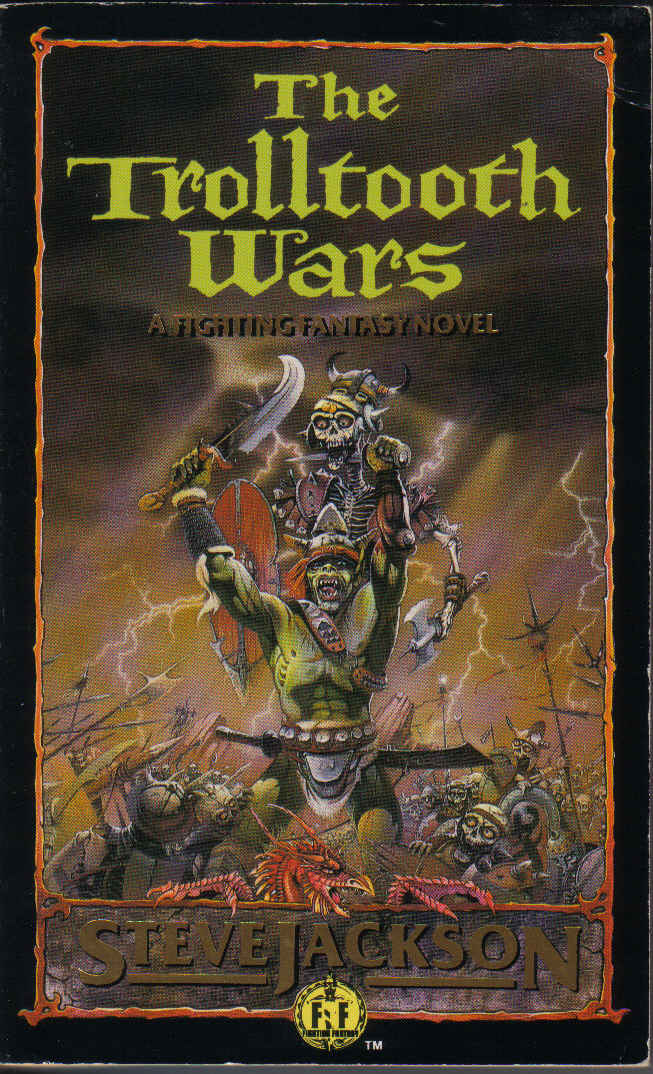
I'm taking all of the information given to me from the source material - The Warlock of Firetop Mountain, Return to Firetop Mountain, Legend of Zagor, Creature of Havoc, Titan, The Trolltooth wars and The Zagor Chronicles (however, I do not have the Zagor Chronicles for reference but I am going by my memory).

I will be giving an alternative character interpretation of Zagor's actions from the source material. 

Although the books describe Zagor as completely evil - and not even all of them do as the Warlock of Firetop Mountain does not state Zagor as being evil or doing evil deeds at all - it can be put down to propaganda from the so called Lawful side or people making snap judegements about powerful sorcerers who own their own mountains without looking for the details.  

Chadda Darkmane -
captain of Salamonis
and Zagor's biggest fan?
The writers of Titan obviously have no love for Zagor as well as Yaztromo and the people who try to slay him.  These are the people who wrote or influenced the accounts of the three gamebooks - Warlock of Firetop Mountain, Return to Firetop Mountain and Legend of Zagor. 

The account of Zagor in the Trolltooth wars was from Chadda Darkmane, who, although he is an officer in Salamonis, he is a man of his word and would not badmouth someone just because they have a bad reputation. 


Let's look at the facts:

How does he write battle   
plans wearing  bracelets
like those?
How does he write battle plans with
all those animals in his library?
Admittedly, Zagor's formative years don't make a good start for my case.  Zagor became an apprentice to the unapologetically evil and chaotic Volgera Darkstorm along with two other obviously evil characters. 

However, I'm sure that good teachers of magic are hard to find and that Zagor, as a gifted student did not want to squander his talent, so he picked the best teacher he could find.  Accounts say that he and his friends used to terrorise nomads.

How Volgera Darkstorm's
life ended.  Zagor seems to
get a bad reputation for
killing an evil wizard.
However, this is a classic case of peer pressure and, desperate to fit in, Zagor had to go along with these sadistic jokes.  However, he had the greater good in mind. 

It is then stated that the 'Demonic Three' as they now became known, slew their master, looted his library and went their separate ways.  Most people would put it down to their evil ways and the need for them to usurp their master, but although this might be true for Balthus Dire and Zharradan Marr, Zagor did this in order to rid the world of a powerful evil sorcerer.  A clever strategist, he planted the seeds of dissent in his co-pupils' minds in order to turn evil upon evil.  It also shows that Zagor was obviously the cleverest of the three. 

However, despite being a formidable and driven sorcerer his early associations and practice of magic gave Zagor a bad reputation with pretty much everyone.

Zagor's home

Some monument, as seen in my dreams.
Zagor then went on to Firetop Mountain, inspired by demon sent dreams, apparently.  I find this doubtful considering that Firetop Mountain is the only mountain for miles around that has a red top.  If you need demons to tell you about one of the most unique landmarks on Titan then you must have had a pretty sheltered life and Zagor had not had a sheltered life despite learning magic in the Flatlands.

The 'official' story states that Zagor led an army of chaotics and undead to wipe out the dwarves in Firetop Mountain and took their treasure.  Sounds bad, but I bet that's not the whole story.  I think that behind this story is the story of how Zagor discovered just how judgemental these 'good' types are. 

Here is what really happened.

Zagor is an enthusiastic protector
of Allansia's heratige sites.
Wanting to do some sightseeing, Zagor headed to Firetop Mountain, asking the dwarves if he could lend them a hand.  After seeing a demonstration of his magic, Zgor earned the dwarves' immediate distrust and inspired a great level of hostility in them.  A confused and hurt Zagor was chased out of the mountain by an army of angry dwarves. 

The only creatures that Zagor felt welcome amongst were the undead who don't really think or say very much and orcs and other monsters who also don't really think or say very much.  Determined to beat the bullies, Zagor went to the mountain and demanded a tour of the world famous attraction.  It was his right a s a fully paid up member of the national trust. 

The dwarves once again refused since they were a snobbish and elitist lot, so Zagor set his friends on them.  After a long and bloody battle, Zagor decided that he would remain in Firetop Mountain to protect it and make sure that all could visit it.

Firetop Mountain, which although looks a bit strange, is certainly not an evil place.  The red on the top of the mountain is not due to anything sinister or destructive like a volcano but rather it is due to some lovely flowers.  How many evil sorcerers do you know of whose criteria for a base of operations include a lovely range of flora?  I know of none. 
He doesn't want you
harming the wildlife.

These flowers, as well as being sleep inducing are also an integral part of the ritual that cures one of a powerful death spell, which afflicted Nicodemus and the hero of Caverns of the Snow witch.  If Zagor was such an evil person, surely he would have got rid of the flowers once he had realised that one of Allansia's greatest forces for good had cheated death on the top of his mountain?  No - he let a vampire slaying hero become cured of the same affliction.  Thanks for protecting the mountain, Zagor. 


It's just a hobby. 
In Warlock of Firetop Mountain, there is no allusion to Zagor doing anything evil.  All he does is sit in his mountain and play with his cards, surrounded by guardians, who, yes, let's face it, aren't the most savoury types.
Now the fact that he uses orcs instead of humans may make some people think that he's evil, but which superstisious uneducated soldiers are going to work in a freaky mountain for a sorcerer?  I bet magic has a bad reputation in the area as well.  It seems that orcs, however, are far more accepting of activities which veer from the mainstream. 


If they're both enjoying it in the
privacy of their own home
then who are you to judge?
And are the orcs performing evil acts?  It seems all they are doing is sleeping, getting drunk and engaging in some activities which although you may not agree with, they seem to like.  Sure, they may be lousy employees, but that doesn't make them evil.  For example, if you try to save this orc servant from being whipped, he still fights against you.  What does that say?

Zagor also has a few nice characters in his mountain such as the dwarves and the old shopkeeper who are a bit tired of all of these chaotic types, but maybe they see tham as a necessary evil as they don't go out and kill them all.  They don't want the bad old days where a bunch of snobbish dwarves kept out all visitors.


No, old man, I don't know
about the Long Dark Night
because I don't live in a place
where there's hundreds of
metres of solid rock between
myself and the Sun.
The only allusion to sinister goings on are the long dark nights the old man in the giftshop refers to.  But who is to say that Zagor is causing them or that he is trying to protect people from them.  Lastly, you have to question the credibility of a man who talks about the length of the night when he lives inside a mountain. Especially when he's using it as an excuse to charge an extortionate TWENTY gold pieces per candle. 

What about the hero's motive?  Are the villagers worried that Zagor is about to do something nasty to them?  No.  Does the hero want to do some sightseeing?  No.  I doubt the hero is even a member of the National Trust.  The 'hero's' motive is pure greed.  In the end, Zagor does get slain by a greedy adventurer who takes his treasure  and then may or may not use Zagor's spellbook to rule over Firetop Mountain and maybe do a whole lot a crazy stuff. 

After all, this sword swinging thief probably has less ability to handle all the powerful magic in the book.  Who is to say that they do not get corrupted by the power and try something nefarious?  Even sorcery for the cause of good is dangerous and shouldn't be used by the wrong people.  Zagor obviously had the inner strength to not go crazy with it, but most people don't.  Maybe its best that Zagor was in charge of the book.

However, if this adventurer does use the book, then they get their comeuppance a decade later when Zagor returns to claim what is rightfully his and may even save the area from this lunatic. 

I mean, how would you feel if someone broke into your house and started trashing it and the area where you  live?
Now you've annoyed him.
This could explain Zagor's behaviour in Return to Firetop Mountain. 

Sure it says in the background that casting a spell on yourself so you come back from the dead makes you evil but maybe that's superstitious peasants again.  Or maybe this book is written by the adventurer who slew him the first time and later got ejected from Firetop Mountain by the powerful sorcerer when he returned to claim what was rightfully his. 
And you can explain all of Zagor's behaviour (getting body parts, wanting to take over Allansia) as being hacked off (no pun intended) about being killed for no reason the first time.  After all, if hordes of fortune seekers kept marching into my home to kill me and take my treasure, I would give my right arm (once again, no pun intended) to take every precaution to stop it happening. 
Maybe he wanted to take over Allansia because he thought that sorcerers were getting a bad reputation and wanted to build more schools for sorcery and educate the young Allansians to show its useful side too.  Or maybe he just wanted to purge it of treasure seeking rascals.

However, once again, he is slain by another treasure seeking rascal, this time with the blessing of Yaztromo and the citizens of Kaad.  However, thankfully, the 'hero' or Yaztromo can do nothing about Zagor's resurrection magic.   
Then we get to Legend of Zagor - now Zagor wants to take over the world of Amarilla.  Or does he?
Zagor before...
He managed to get there when the Bone Demon was banished from that world.  Maybe he saw the portal as an opportunity to go to a more accepting world instead of a place where people kill him every ten years. 

and after.  He's obviously
had a change for the worse.
He's not looking after his
fingernails for a start.
However, as Yaztromo says, Zagor became mixed up with the demon, so it is not Zagor you are trying to kill, but a Zagor/demon hybrid. 

Maybe that's what made Zagor so evil in Legend of Zagor.  If it was just Zagor, then he would have just sat in Castle Argent like he did in Firetop Mountain.

In the book, Zagor performs a heroic sacrifice.  He has been fused with an evil demon who wants to destroy the world, but he does small things to help the hero.  The crystal ball that Yaztromo uses gets destroyed, but maybe Zagor was buying time by distracting the demon.  If it wasn't for him, Yaztromo may not have been able to get through at all.  Yaztromo sends gold talismans and silver daggers.  Maybe when Zagor was in the portal and he could feel himself being fused with the demon, he kept it open for a bit longer so that the talismans and daggers could get through. 

And when you are carrying the demon to the Heartfires, maybe Zagor is struggling to keep the demon unconscious so that you can complete your task, even though he knows that he will be destroyed in the process.
Zagor isn't actually
in two of these books
because he's not the
real villain - the
demon is.

I know he gets very angry because he is being faced by a 'wretch like you.', but of course he's angry.  Having his hobbies interrupted by being slain by some sword wielding vagabond is the story or Zagor's life.  It's already happened twice.  Now he's sharing his soul with a demon and although he knows he has to sacrifice himself to destroy this demon, he is bitter that the person who will slay the demon is not so different from the rogues who killed him before. 

Zagor has put all this work into being a powerful sorcerer.  All he wants is to face someone of legendary reputation.  He must feel very insulted that the people selected to slay him are basically bums of the street.  He must feel that no one respects him enough to send someone with a good reputation to slay him.  Or at least an army.

I think this all applies to the Zagor Chronicles too.  I have not read them for a while, but if I remember correctly, Zagor is not in book 1, book 2 is basically the novel version of Legend of Zagor, book 3 is set on Titan, sans Zagor and in book 4, they face the Zagor/demon hybrid again. 

Not a warlock in sight
Zagor was also in the Trolltooth Wars, where, once again, he was not trying to do anything malevolent.  In fact, he helps Darkmane to stop Marr from taking over Allansia.  Sure he's not too welcoming at first, but Darkmane and his gang have killed a few of his servants and Mantrapper tried to kill him straight away (but I'm not revealing why - read the book). 
He's not going to teach
you magic. He's tallying
you bill. 
In fact, once they are all on the same page, Zagor is a very helpful a courteous host. 
He does not demand any money for his services whereas the seemingly good Yaztromo takes 40 gold pieces for an enchanted dagger he gives to Darkmane, even though he is going to use it to save Allansia.  What a greedy so and so. 
So Zagor has helped to save Allansia once from his ex 'friends' who probably annoyed him with all their evil talk and the fact that they were giving him a bad name.  He has protected a place that was used to save the lives of Nicodemus and the slayer of the Snow Witch and when he unfortunately became fused with an evil demon he weakened it so that someone could slay it. 

So Zagor has killed an evil sorcerer, helped save the lives of two champions of good, helped save Allansia once and sacrificed himself in order to save the world of Amarilla.  He has performed more heroic acts than most protagonists in Fighting Fantasy books.   

Zagor has been widely misunderstood, partly because of peoples' distrust of sorcery and partly because he kept bad company when he was young (Balthus Dire and Zharradon Marr, who both tried something Malevolent in their gamebooks). 
Any hostile act he performed could be seen as justified anger at being socially excluded by dwarves, being constantly attacked by lowly fortune hunters or by being fused with an evil demon. 

He just wants a hug.
I think Zagor needs to be vindicated and be in a gamebook where he is allowed to let his true heroic colours show.  How about a book when Zagor comes back from the dead to find that his slayer is forcing the creatures of Firetop Mountain to invade Allansia and only he can stop it as he knows the mountain better than anyone.  However, even if he succeeds, he is still treated as the villain just because he's a sorcerer.  Which then leads to Return to Firetop Mountain...

Poor Zagor's had a hard life.  I suggest we start a 'Clear Zagor's Name' campaign where we put an end to his bad reputation.   

Saturday, February 12, 2011

All my gamebooks are now on this blog.

Hi all,

Just a quick note to say I've linked to all of my gamebooks on the sidebar of this blog.  Also, check out http://www.arborell.com/ - the site that hosts the Windhammer Gamebook Competition.

Enjoy the books!

Wednesday, February 9, 2011

My Fighting Fantasy gamebooks

Hi all,

Below is a link to the fighting Fantasy gamebooks I have written with my comments on how I feel about them.  Take a read of them and tell me what you think.  I feel that they were a good education for me in how to write gamebooks.

Here is the link. 

May Titan be with you.

Saturday, January 8, 2011

Happy new year!

Happy new year!

I have been neglecting the blog recently - december is both a hectic and a tiring time for me at work and  then there are all the holidays.  However, I am now refreshed and relaxed.  You could say that my stamina has been replenished. 

However, I have been working quietly away and keeping my finger on the pulse. 

First of all, there is a new gamebook blog, written by Andrew Wright who has also written tons of great gamebooks which you can find on http://www.ffproject.com/download.htm.

The blog can be found on:

http://fantasygamebook.blogspot.com/

http://fantasygamebook.wordpress.com/

http://fantasygamebook.livejournal.com/

It has only been active for a short time, but it already contians several well written posts with references for further reading.  In fact, it was Andrew's post about gamebook blogs that has inspired this post as it showed me that people are taking notice that I haven't updated yet. 

So read it - it is really informative.  Andrew's latest posts contain a great review of Heart of Ice, a gamebook by Dave Morris.  You can find it on his blog for free (it is half way down the page).  I'm ashamed to say that I haven't read it yet, but I am putting it on the top of my list.

Secondly, it was announced that Advanced Fighting Fantasy (AFF) is being revised, re-written and reorganised by Arion games.  It is due to be released in Spring 2011.  The website for the new Advanced Fighting Fantasy is here:  http://www.arion-games.com/AFF.html.

I am looking forward to it.  I have the AFF gamebooks and I enjoyed the unique way in which it was presented.  Adventures were presented as films with scenes, characters and props.  The approach did not take itself too seriously, either, which I enjoyed.  It made the book an entertaining read for the director while they were planning an adventure.

The side of me that was all about games mechanics noticed a few things though (and when I was younger, I went through a phase that was all about games mechanics.  Sometimes I would scan gamebook paragraphs to see if I needed to changed stats or gain an item and jsut ignored all the lovely description that the author had gone to lots of trouble to write - sorry!).

First of all the old problem of having a skill range between 7 and 12 was exacerbated by the rule that every point in skill you had allowed you to pick a point in a special skill. 

The value of that special skill was your skill + the number of points you had allocated to that skill (maximum 4).

This means that a skill 7 character had 7 points to use and the maximum value they could have was 11.

A skill 12 person had 12 points to use and the maximum value they could have was 16.  The minumum value they could have was 13.

So a skill 12 character could have 12 special skills with a value of 13, while a skill 7 character could have a value of 11 for their best skill and only 3 points left to spend. 

I also think that there needs to be clarification on what the skills do and how balanced the skills are.  Some skills overlap with others.

The scouting skill allowed you to sneak and hide outdoors.  However, there was already a sneak and hide skill.

The heavy armoured combat skill which allowed you to fight in heavy armour.  However, there were no rules for what heavy armour did.

There was a battle combat skill and siege combat skill which allowed the character to fight well in a mass battle and siege.  What did that mean exactly? 

Excellent vision and excellent hearing are both  self explanatory, but there is also an awareness skill which allows the character to detect anything. 

The strength skill allowed you to increase the damage you inflict in combat by 1 - I'll have that one!  Heal allowed you to restore other peoples' stamina. 

The magic system also needs tidying up.  There was a priest magic list and a sorcerer magic list.  However, they were too similar.  Priests had offensive spells and sorcerers had healing spells.  Priests had to follow a moral code of their god or be excommunicated and lose the chance to learn more spells. They only had a few spells that sorcerers did not have.  Sorcerers, on the other hand, could do what they liked and had lots of spells that priests could not access.

I just read what I wrote and realised that I was sounding a bit down on AFF.  I enjoyed reading the books immensly.  I was never able to find a group to play with, but I'm sure I would have liked it.  These issues are easily tidied up and I look forward to the new releases!

I am working on my post about endings in gamebooks which are a result of bad choices (I really wanted to say bad endings there, but that would be ambiguous).  However, I am getting sucked in to reading a lot of endings.  A lot of them are very entertaining.