Showing posts with label magic. Show all posts

Wednesday, March 2, 2016

Limiting magic items that are too awesome

It looks fun now
but wait until
book 11.
This is for those of you who want to give people cool items but who don't want any 'Sommerswerd problems'.

This is what I mean.  A recap...

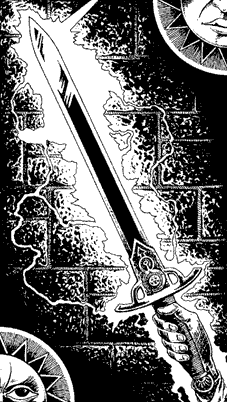
In Lone Wolf 2, you get the uber Kai weapon the Sommerswerd.  This weapon gives you +8 to combat skill, absorbs all hostile magic used against you and deals double damage against undead creatures.  It means that you go from a the scared prey of the helghasts who spent all their time up until now skulking in the countryside, running from overwhelming opposition and having people sacrifice themselves for you to a super warrior who kicks major butt in the final battle and then obliterates a darklord, one of the most powerful creatures on Magnamund.

However, since you don't have to do book 2 to do the other books, in every book after that, you may or may not have the Sommerswerd and its huge bonus.  This led to balance problems.


'Joe Dever has said that the sword's bonus made it difficult to create balanced statstics for enemies that would challenge someone with the blade but would not make the book too difficult for someone without it.
Some attempt was made at balance. Beginning in the Magnakai series, some battles turn out to be more difficult if the Sommerswerd is used, which is reasoned either by its divine presence alerting Lone Wolf's foes, or having them use high-powered weapons which cancel out the advantages the sword offers.'
Everyone likes cool stuff, but it is important that it does not completely unbalance the game either by making it too easy or by making it impossible for the player who isn't lucky enough to get the item (and if you can't do that, just do the decent thing and kill them off early as to not waste their time).
The magic items in Advanced Fighting Fantasy are pretty good at not being too powerful, so you could have a look at that.  Other ways of making cool magic items that aren't too powerful:
A ring of fire would
go down well here too.
Give them one specific use in the gamebook (one of Ian Livingstone's favourites) - such as the Ring of Fire in City of Thieves, the cyclop's eye in Warlock of Firetop Mountain or any item that Yaztromo sells in Forest of Doom.
Make them versatile but not very powerful - the pocket myriad in Citadel of Chaos is a good version of this.  You can use it in several situations but it is rarely the best option.  You can do this one of two ways - either it has a lesser effect than a better item or it has the same effect but only on a certain die roll.
Limit their uses - give an item charges or make it one use.  The ring of communication in Keep of the Lich Lord has only 3 uses.
Put a cost on the use of the item - similar to limiting their uses.  You can use the item as many times as you like but it will drain one of your stats such as crushing the herbs and using the sleep and invisibility spells in Daggers of Darkness.
The item only works on a certain die roll - either the roll is completely random or you need to succeed in an ability check to use it.  There's a scene in Fabled Lands where you try to resurrect someone but the spell requires two ability checks.
The item comes with a penalty - the ring of confusion in Island of the Lizard king comes with a -2 skill penalty which balances out its ability to let you see through illusions.
The item could have beneficial or baneful effects - either you roll a die each time or the situation does not match the item, sometimes it works like a charm and sometimes it spells destruction.  The deck of many things is a classic example.
The item can only be used by certain people - There's some restriction based on race, alignment, ability score or pretty much anything that means that it can only be used by certain people.  The Singing Death in Sword of the Samurai gets more awesome if your honour is high.

Sunday, September 8, 2013

Why it's difficult to do magic in gamebooks

When I was younger, I was annoyed that most of the gamebook characters I played were warriors.  They picked up the odd spell here and there but for the most part, they just had to fight their way out of situations.  I loved books such as Citadel of Chaos, Vault of the Vampire Scorpion Swamp and Stealer of Souls where you could get some spells.  I also enjoyed the Lone Wolf books where you could get psychich abilities or the Heroquest gamebooks where you could play a wizard or an elf (I liked the elf best because I had a thing for warrior-wizards at the time).

This is because most of my enemies (and a lot of my allies) in gamebooks were magic users who could produce cool spells that I had to endure, dodge or have an item to protect me from.  I got a bit of magic envy, wishing that I could fireball my way out of a combat once in a while.

Fast forward a few years and I realised that integrating magic into a gamebook is a difficult thing to do.  The main reason being that gamebooks can only offer a limited number of options and having lots of spells at your disposal gives a player more options.  This means that the gamebook author needs to look at each of their encounters and think about how each spell might affect that encounter.  This is a lot of work and might lead to a long series of options saying 'If you wish to cast x spell, turn to...'

What has emerged are several different ways of approaching magic in gamebooks, all with their own advantages and disadvantages. 

A spell is basically an item that is use once in a specific situation in a book

Think of the dragonfire spell in Warlock of Firetop Mountain, the North gate spell in Khare or the insect repellant spell in Crypt of the Sorcerer.  These spells have no rules associated with them - you just learn them and use them as the text demands.  It means that you get to learn spells but for me, I don't get the feeling that I am a proper wizard as these spells could just have easily been replaced by items and they do not give you more options - they are usually there as a victory requirement or to make a difficult combat easier.

The hero has a list of spells that they can use

This is the case for Heroquest, Citadel of Chaos or Scorpion Swamp.  Now we're getting closer to wizardhood as you have a list of spells.  the limit with this system involve not being able to use all spells in a given situation to avoid having huge numbers of paragraphs.  Also, for flavour reasons, would you expect a proper wizard to know about ten spells?  In Scorpion Swamp, you are not a proper wizard, I'll admit, but what about Heroquest and Citadel of Chaos.  I suppose you could say that it's Vancian magic and the book has only selected relevant spells, but it is a bit limiting (and for good reason.  No gamebook author is going to want to write the consequences for using 12 different spells in each situation).


The hero knows a lot of spells but only certain spells could be used at a particular point

I'm thinking the Sorcery! series which also throws in some dud spells along  the way (those of you who know Sorcery! know I've just done a pun).  Here you get a cool long list of spells but you just don't get the option to use all of them when given the option of using magic.  Doing so would be unworkable for the reasons mentioned above, but it is not realistic and I always used to get frustrated when I just wanted to fireball an opponent and couldn't.


The hero has the ability to cast spells but their actual list of spells is not known

I'm thinking the Virtual Reality series (most of the time - see below) where you can get the magic skill but your list of spells is unknown to you.  Basically, you sometimes have the option of using the magic skill and if you do, the spell you use is described.  This is more realistic for your character - they can produce a wide array of effects and you get to read about the cool spells you use, but this option reduces magic to yet another skill and only allows the player to use magic when the text demands it.

The hero has the ability to cast spells and is given a list of spells depending on the situation

This happens in some cases in the Virtual Reality series and also in the Warlock's way.  This method is slightly better than the two methods above.  It is better than just asking if you have the magic skill, because you feel like you have some control over the spell you could cast.  It also lets you weigh up the options and decide which spell is best from the information provided about the spell and the situation.

For example, in The Warlock's Way (bought from the superb Billiam Babble) you have to get across a lake.  You have the option of casting a jump spell (1 magic point), a fly spell (3 magic points), a walk on water spell (2 magic points) or make the good for nothing boatman tell the truth about the lake (1 magic point).  If you have more info, you will know that the lake is inhabited by invisible poisonous fish and so any spell that involves going into the water (jump, which does not go far enough) gets you killed.

This method only works if you can work out the consequences of using a particular spell.  If you have no way of knowing which spell is better then it really defeats the object of this method.

The hero has a list of spells that can be used in certain situations

In this method, some spells may never be mentioned in the text but their descriptions may tell you that you can use them in particular situations.  For example, a lot of the Heroquest spells can be used during combat.  Bloodbones has a list of three spells that you can use, two of which allow you to avoid encounters with certain creatures.  This system works well and can allow a wide range of spells but only if the language in the book makes it clear when the situations arise.  For example Bloodbones is clear that you can use the spells against zombies or insects and it is pretty obvious when you come across a zombie or an insect.  Legend of Zagor does this too and also has a non magic  example - Stubble gets a bonus to attack strength against any opponent with stone in its name.


A fan solution

A while back, someone known as Larni on the official Fighting Fantasy forum (now closed) posted a list of spells that you could use in Fighting Fantasy books.  Many of them were combat spells but there were others such as spells that restored your stats, created a non magical item or let you reroll die rolls.  There were about 20 spells and all of them could be used independantly of the book you were playing.  It inspired me to make my own list for an article in Fighting Fantazine.  I'd like to thank Larni for the inspiration. 

If a little effort is made with being clear with my language in a gamebook, I could come up with a similar system which could incorporate about two dozen spells that don't require a single paragraph in the book and that leaves more room for juicy storylines and wierd monsters and we can all say that's a good thing.

Saturday, March 2, 2013

How items can be useful and unmagical

I've done a post on how you can give out cool magical items that won't completely unbalance the game but you can also have cool and powerful non magical items.  Here are some ideas:


How can items be powerful and unmagical?

Fire powder - blow stuff up!  Also leads to...

Firearms - a powerful (even perceived as magical?) weapon.

Acid - corrode stuff away!

Telescope - see things from far away!

High energy rations - a days food that weighs very little.

Compass - help your navigation check!

Clothes and jewellery that indicate high status - pass for the mayor!

Signet of a particular organisation - show the Seal of Hammerdal to anyone in Durenor and you get anything you want.

Ancient relic of a particular people.

Tomes of knowledge – maps to places, records of historical events, manuals, star charts.

Skulls/bones of powerful animals - a sign of strength and status amongst hunters/warriors as they think you killed them.

Trophies/awards from tournaments - will give you a reputation for skill at arms.

Keys - they don't have to be key shaped.  They can be gems or strange stone shapes.

Silver weapons - harms powerful undead.

Herbs - have many healing and other effects.

A lost relic - it puts you in good standing with a particular religion or country.

Special material – mithril, adamantite, darkwood, cold iron.  If it is rare enough, people will want it!

Musical instruments that can calm animals (ape pipes, snake charmer flute).

Any more, people?