Showing posts with label fighting fantazine. Show all posts

Wednesday, March 23, 2011

Titan - the Fighting Fantazine blog

Hi all!

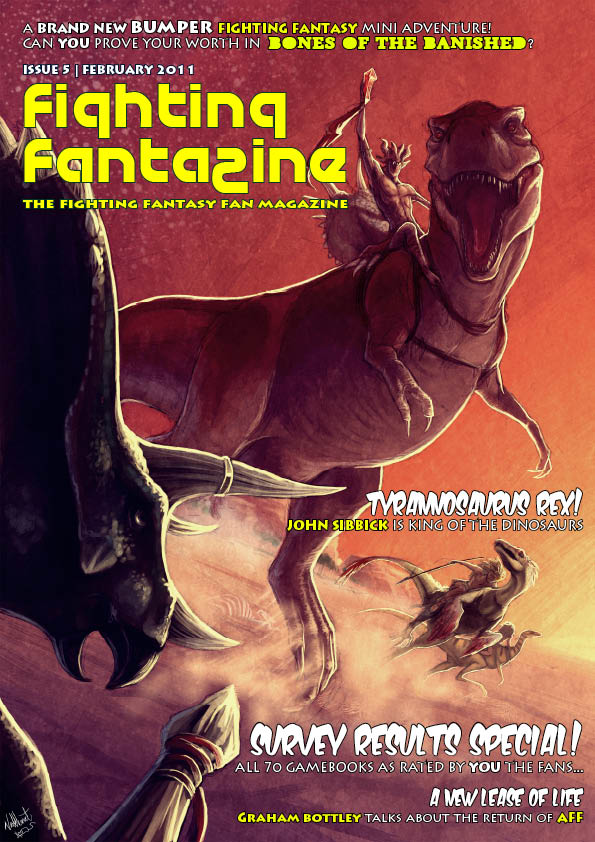
Poor Triceratops felt left out from the
dinosaur races.
Just a quick note to say that the Fighting Fantazine magazine has now got its own blog.

Each issue has a Fighting Fantasy adventure, a post from the Fighting Dantasy blog, an editorial and many other great features.  The last issue had a ranking of all of the Fighitng Fantasy books with essays on the top ten.

Take a look at it as well as all of the issues so far.  The next issue is accepting letters too, if you would like to pen one and email it to them.

Wednesday, February 16, 2011

Fighting Fantazine issue 5 is out!

If you have not seen Andrew Wrights blog,

1)  Why not?
2)  You may have missed the news that Fighting Fantazine issue 5 is out! 

Below is Andrew's post describing what is in this great issue.


Editor Alex Ballingall has really been burning the midnight oil putting this incredible package together! Among the many amazing features included inside its bumper 104 pages:
  • An astounding cover by Natalie Roberts.
  • An interview with John Sibbick, illustrator for Fighting Fantasy, Games Workshop, and many excellent dinosaur and extinct prehistoric animal books. Includes never-before-seen pencil roughs of some classic FF book covers.
  • Bones of the Banished - a 274 paragraph Fighting Fantasy adventure written and illustrated by Brett "Jediboyy" Schofield. Brilliant stuff!
  • Results from the previous Fighting Fantazine survey, including extensive essays on the ten best Fighting Fantasy gamebooks. (I've contributed a piece on Steve Jackson's Creature of Havoc).
  • An interview with Graham Bottley, writer of the revised Advanced Fighting Fantasy RPG system, due for publication soon by Arion Games.
  • Guillermo Paredes' Omens and Auguries, featuring all the latest gamebook news.
  • Jamie Fry gatecrashes the lair of notorious Fighting Fantasy author Ian Livingstone.
  • Dan Satherly attempts the infamous Sky Lord by Martin Allen - the final science-fiction adventure in the Fighting Fantasy series.
  • Part 2 of the Adventure Game series, where yours truly talks about how to plan the structure of your own Fighting Fantasy adventure.
I have written one of the essays - I wrote about Moonrunner.  I liked it from the start but after going through it in depth in order to write the essay about it, I liked it a whole lot more.  I love the atmosphere of the book and I think that Karam Gruul is a great villain.

You can download issue 5 from here. The main website can be found here.

Enjoy!

Coming soon - What writing 25 paragraph microadventures has taught me.

Thursday, January 27, 2011

Future projects

They say that imitation is the highest form of flattery, and I am flattering Andrew Wright by making a post about future projects on this blog. 

Telling you all about it will motivate me to do these posts as well. 

Please please give me feedback in the comments section.  I would love to hear from my followers about what you want to read about.

You Adventure ends here

I intend to finish this series off with a post about how death paragraphs reveal information, a few of my personal favourite failures and then a conclusion.  So three more posts of this.

Codewords

When shoud we use them?

What should they be?

Do we have any neat tricks we can do with codewords?  (I'm looking at you, Crimson Tide)

Handling stupid decisions in gamebooks

What constitutes a stupid decision, why you should offer them and what the consequences of them should be.

Wounds and healing

How deadly should your wounds be?  Should food and water provide healing or should it be a long hard process to recover?  How deadly should combat be? 

Mass battles in gamebooks

What systems have been used and how should they be handled?

Gods and priests in gamebooks

What are your gods like?  What role do priests play in your world?  How are they different from sorcerers with a sense of morality?

Money and shopping in gamebooks

How important should it be?  What can be bought and sold in gamebooks?  What other things can money buy?  How many currencies should you have?  Should you have it so they hero never has enough money?

Food and water in gamebooks

Should it heal?

Should hunger and thirst cause damage?

Generic meals or named food?

Revealed information in gamebooks

What are the good points and bad points of showing a reader that something different will happen if they have an item or codeword? 

How are programs which don't reveal this information play differently?

Should gamebooks tell you how you feel?

Description or emotions?  How does it affect your character?  How does it affect the game?

Skills and abilities in gamebooks

What skills and abilities add to a gamebook.  What they take away.  How to make sure you have a balance of character creation choices vs choices in the book.

The level of magic in gamebooks

What magic items are available?  Can you buy them like food or are they rare and well hidden?  How many magical monsters or magic wielders do you come across in the book?  Does your level of magic fit the leevl of the rest of the book?    What kind of spell systems could you have?

Items in gamebooks

How items can be used.  How they shouldn't be used.  When do you have too many items?  Would an encumbrance system help?

Morality in gamebooks

What does having a sense of morality in gamebooks add to the gamebook?  How can you enforce that morality?

What writing microadventures taught me

It's amazing what a 25 paragraph gamebook can do.

Amateur gamebooks, gamebook programs and games that read like gamebooks

A list of wonderful things I have found online. 

So there you go.  Please leave feedback about the blog as a comment so far and tell your friends!

Something to look out for.

Fighting Fantazine issue 5 will be out soon.  Don't miss it!

And finally...

I like cats.  I also found this blog about a cat, which has 180 followers.  So here is a picture of a cute cat. 


If you like cats and H.P. Lovecraft, I recommend The Cats of Ulthar, a short story by Lovecraft which I enjoyed.

Thursday, October 14, 2010

A table of probabilities

Hi all!

Just a quick post to give the percentage probabilities of winning, drawing or losing an attack round depending on the difference between your skill and the skill of your opponents.

If you want more info on how I calculated this, look at the explanation under the table.

The headings mean:

Skill difference: If you subtracted your opponent's skill from your skill, this is the skill difference. I have done it from +6 to -6. any bigger than that and I wouldn't bother rolling dice.

% chance to win, draw or lose: Self explanatory.

If the probabilities do not add up to 100, it is because of rounding.

Of course, these values do not take into account special combat rules.

For example, in Slaves of the Abyss, you automatically kill an opponent if you roll a double 6 (you have a 1/36 chance of winning automatically).

In Creature of Havoc, you automatically kill your opponent if you roll a double (that equivalent of a 1/6 chance of killing your opponent. It is interesting that although Creature of Havoc is one of the hardest FF books, it has the easiest combats)

I also haven't calculated the probabilities of rolling 3 dice and taking the best 2 which occurs in Legend of Zagor.


It appears that if you face an opponent with a skill 3 or more higher than yours, then you are stuffed. You could just about survive an opponent with a skill 3 higher than yours if you are very lucky, but it seems that if my gamebook has an opponent whose skill is 3 higher than the possible initial skill of the hero and the hero has not had a chance to make a choice to avoid the combat or find a way to increase his or her attack strength, then my gamebook has ended there probably with a lot of frustration.

Hope this helps in some way. In the next few days, I'll post about the good points of having dice in gamebooks.

Have a look at Fighting Fantazine (http://fightingfantazine.bravehost.com/Fighting%20Fantazine.html). Issue 4 is coming out soon and I am writing an essay for issue 5 on a particular Fighting Fantasy book on why it is so great. However, I acn't say which one. You will have to wait until issue 5!

How did I work it out?

The way I calculated the % chance to win was to take the sum of the probabilites of rolling a number on 2 six sided dice that has a chance of winning you the attack round and multiplying by the probability of your opponent rolling a number on 2 six sided dice which would mean their attack strength would be lower than yours.

Quick maths lesson - to express something as a probabiliy, you put it in square brackets. For example, the probability of rolling a 2 can be written as [rolling 2]

For example, if your skill difference is 0, the sum is:

([rolling 3] x [rolling 2]) + ([rolling 4] x [rolling 2 or 3]) + ([rolling 5] x [rolling 2-4]) + ([rolling 6] x [rolling 2-5]) + ([rolling 7] x [rolling 2-6]) + ([rolling 8] x [rolling 2-7]) + ([rolling 9] x [rolling 2-8]) + ([rolling 10] x [rolling 2-9]) + ([rolling 11] x [rolling 2-10]) + ([rolling 12] x [rolling 2-11])

If your skill difference is -6, the sum is:

([rolling 9] x [rolling 2]) + ([rolling 10] x [rolling 2 or 3]) + ([rolling 11] x [rolling 2-4]) + ([rolling 12] x [rolling 2-5])


To get a draw I took the sum of the probabilities of rolling numbers where the attack strength was equal.

Once I had calculated the % probabilities of getting a win or a draw, I did the sum 100-[win or draw] to get the probability of losing in %.