Showing posts with label death. Show all posts

Thursday, January 27, 2011

Your adventure ends here - a quick ending

Here is an ending from The Screaming Spectre by Dave Morris.


30

You cower in the bottom of the boat under a tarpaulin and pray they'll miss you.

They don't.

Why I like this ending

Some death paragraphs, particularly ones by Peter Darvill-Evans are great because they into loads of disgusting detail of how you meet your end.  This paragraph is great because it doesn't.  All it tells you is that your plan doesn't work and that the result of your choice ends in your death, but it is left to your imagination of just how the phantoms suck out your soul. 

The paragraph is almost written like a joke.  It describes your "plan" as a build up.  The punchline, 'They don't' is a commentary on how lame your plan was. 

I think this is Dave Morris's way of saying 'YOU'RE A FREAKING WIZARD.  I GAVE YOU 9 SPELLS AT THE BEGINNING OF THE BOOK AND THE BEST YOU CAN DO IS HIDE IN A BOAT.  GET STUFFED.'

How did I get into this mess?

I'm a wizard trying to get across a swamp.  I meet a ferryman who says that phantoms live in the swamp and eat people's souls, but his boat is blessed and will protect you if you pay him 2 items to get across.  That's half the things I can carry.  I decide to take another boat for free, but then realise that there are phantoms on the swamp and they want to eat my soul.  I have the option of hiding or casting a spell.  Casting a spell is the best option.

What have I learnt from this?

A lot of the death endings you read will be because of really stupid choices.  There is more than one way of telling someone that they have made a stupid choice than just telling them that their choice was stupid. 


Thursday, January 20, 2011

Your adventure ends here...go to 14. What?

Here's a death paragraph from The Den of Dragons by J.H Brennan.  It is the second Grailquest book.


48

You enter the cottage and the entire place caves in on top of you.  It's no fun being an adventurere sometimes, Pip. 

Go to 14.

Why I like this paragraph

This death paragraph breaks the fourth wall.  If a gamebook breaks the fourth wall, it is usually in a death paragraph or to tell you that you are a cheat.  However, Grailquest does this a lot.

The main reason why I like this death paragraph is that it reminds you that death is not the end.  In all Grailquest books, 14 is the paragraph that you go to when you are dead, which sounds a bit wierd.  What do you need to do when you are dead?  A lot, it turns out.

On paragraph 14, you wake up in Merlin's home.  In the Den of Dragons, it's a crystal cave.  He then tells
 you to reroll and enter the village again.  Here we have a lot more personable death than a full stop.

How did I get into this mess?

I started the game in a village where I turn to a paragraph if I want to enter a particular building.  I enter this building and it collpases on me.  On my head be it.

What have I learnt from this

Death is not the end.  It can be very useful.  I'm not sure, but in this case I think I get to keep equipment and I'm also forewarned.

Another useful feature of haveing death not being the end is that you can have 'save points' in the book.  Talisman of Death by Jamie Thomson and Mark Smith allows you to restart the book at a particular point depending on where you were killed.  If you were killed in the Greyguilds (a city), you go back to (Almost) the beginning.  If you were killed outside the Greyguids, then you return to the point where you have just left the Greyguilds.  This doesn't happen in all cases, such as dying in combat or if you die as a result of one of Death's minions, but it helps in this situation.


292

A spray of brightly coloured light speeds from Thaum's hands into your eyes, dazzling you.  Cassandra stabs you neatly in the heart as Tyutchev cleaves your head from your shoulders.  Turn to 109.

This is the first death paragraph that a seven year old me read.  It seems apparent that Thaum, Cassandra and Tyutchev do a pretty good job of killing you, so I was quite surprised to be able to turn to another paragraph.  Paragraph 109 tells you that as your spirit floats gently towards the Valley of Death, the gods that summoned you offer you the chance to be returned to life and try again. 

Other death paragraphs

My death paragraph collection is not a completely original idea.  I remember reading several death paragraphs on a website.  I couldn't remember what it was, so I fired a message on the Titan Rebuilding Yahoo Group.  Andrew Wright, who has a great gamebook blog provided me with the answer. 

The page is on the Black Tower website, archived at http://www.ffproject.com/download.htm.  It can also be found here.


Wednesday, January 19, 2011

Your adventure ends here - no second prize?


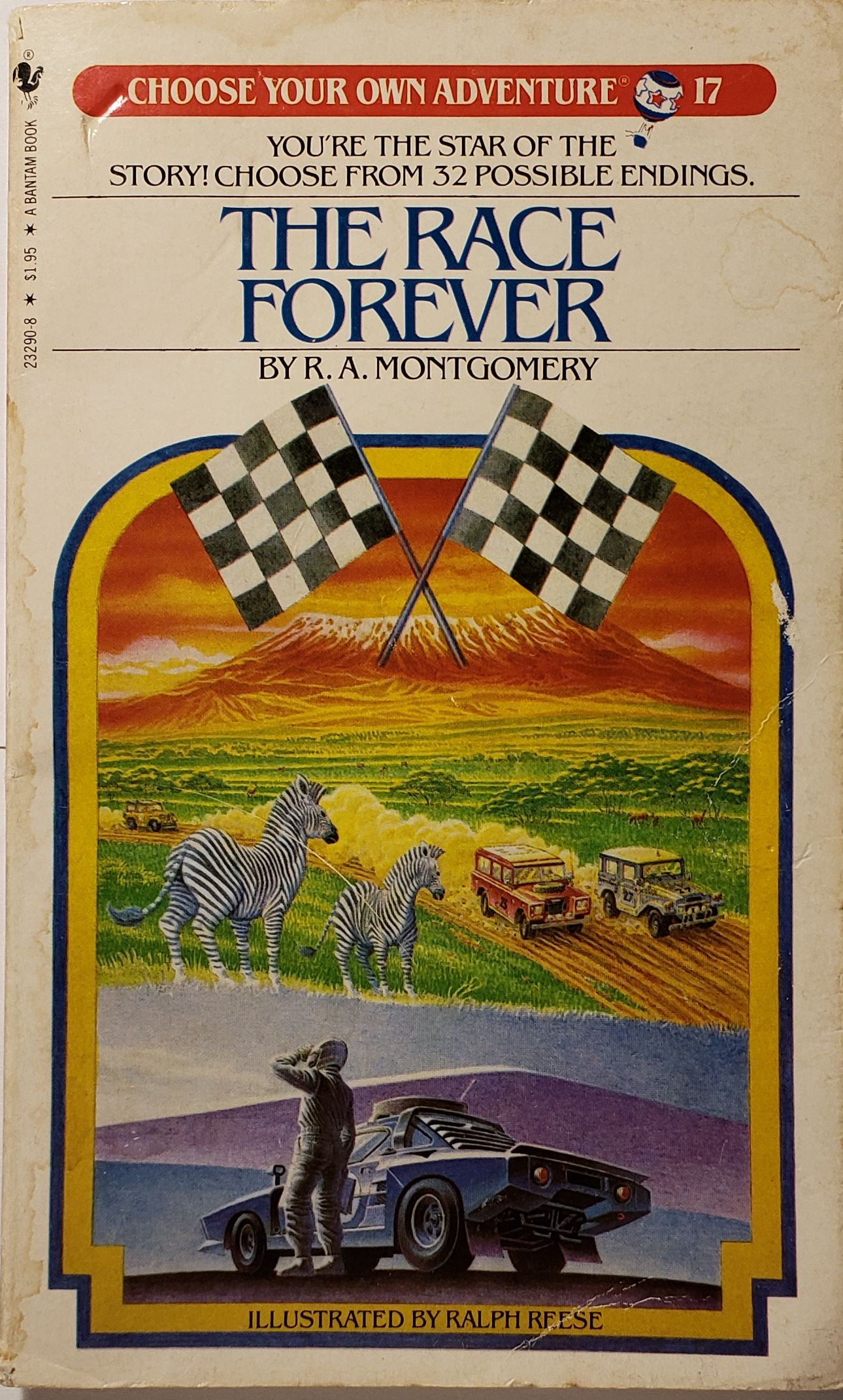
Here is an ending from The Race Forever, the 17th Choose Your Own Adventure Book (and the first one I read) by R. A. Montgomery.  In this book, you are a rally driver who has entered a race in Kenya.  You can choose between the speed race and the rough road race.  You then choose a vehicle and meet your navigator/co-driver. The book is not as long as it sounds, but if you finish one race alive then you are offered the chance to enter the other race.  So therefore you can literally race forever.

102

Even though Eduardo is sure that the soldiers' repair is more than strong enough, you feel that it will be safest not to pull out all the stops.
Each time you stop at a checkpoint you examine the repair for signs of weakening.  The welded axle holds perfectly, though, even when you bottom out in a particularly bad gully in the Olduvai Gorge.  Eduardo spends an hour dragging, jacking, and pushing while you stand on top of the car and watch for puff adder snakes and other dangers.
Dusty, tired, and happy, you finally cross the finish line two days after you start.  You finish third overall.  "Not as good as first," you think, "but at least we made it.  That's better than many others."

Why I like this paragraph.

AsI like this paragraph because it is an example of a failure where you don't actually die.  The Race Forever is an example of a group of gamebooks where there is a sliding scale of success.  Too many gamebooks, usually ones that involve killing some evil wizard and saving the world, have two types of endings - you kill the wizard and save the world or you die horribly.  If for some reason, you don't kill the wizard but you do survive, you have to endure some crushing sense of shame and guilt for the rest of your life. 

Choose Your Own Adventure books have a different approach.  In the Race Forever, you could die, but you could finish in a particular place number, you could win, you could get injured, you could lose your car and have to walk back or you could find gold and become extremely rich. 

In this case, there you would expect finishing first to be the most successful ending.  However, you may then stumble across the gold paragraph and realise that you have wasted your life trying to finish first in some poxy race. 

How did I get into this mess?

 As I mentioned above, I couldn't really consider it a mess.  Coming third in a tough off road race across Kenya is no mean feat. 

I didn't win because I chose the British Land Rover instead of the Japanese Toyota to do the rough road race.  Seriously.  You can't win the race in the Land Rover.  What a gyp.

You come across some refugees on your route and decide not to help them.  Then my axle cracked and some friendly soldiers repair it.  I finished third because I decided to go easy on the car.  If I would have decided to go flat out, however, I would have finished fourth, also in two days.  How does that work?  I guess this book runs on the moral of slow and steady wins the race. 

 What I have learnt from this paragraph

Gamebooks don't have to be about victory or death.  Having a sliding scale of success means that I will want to explore the other areas more.  If I get to the victory paragraph of a gamebook with two endings - victory or death - then no route I will take will have a better ending, so what's the point?

People who wrote Choose Your Own Adventure books knew this.  The books tell you how many endings there are on the front cover to show you how much variety they have.  It was also one way to make these books replayable, since Choose Your Own Adventure books had no stats, no equipment lists and no points system.  It was all based on your choices.  If Choose Your Own Adventure books had one victory ending with all the others involving you dying, then they would be a lot less playable.

If I have a sliding scale of success, then I can get to an ending that isn't great but at least I survive to try again.  It will make a difference to having to die every time you 'lose'.  I could also put in a better ending where I can achieve the original objective AND get a bonus.  That will give a point to exploration because then there may be a way to get to a better ending. 


Some gamebooks go even further where there is no measurement of success between endings.  In Outlaws of Sherwood Forest (Choose Your Own Adventure 47, by Ellen Kushner), you travel back to Sherwood Forest from the present day.  Your objective is to make sure Robin Hood does not get captured.  You can achieve this and return home or you can acive this and stay in Sherwood Forest.  Both have their up and down sides, but only the reader can decide which one is better.

So instead of having victory or death, we can have several endings on a sliding scale of achievement.  Maybe we can have some surprise bonus endings that have nothing to do with your original aim but are great endings as well.  And maybe we can have some endings that aren't necessarily better but that different people would prefer.  This increases  replayability of books and provides pleasant surprises.

Monday, January 17, 2011

Your adventure ends here - who you gonna call now?

Here is an ending from Night of the Necromancer by Jonathan Green.

'Quick, Streng,' Van Richten calls to his companion, 'deploy the spirit snare!' His henchman responds at once, hurling the modified trap towards you.

Your first reaction is the trap will pass straight through you but then it snaps shut, its silvered teech snagging your ethereal form.  You let out a blood curdling scream of agony as pain like you have known only once before - when you died - shoots through you.

'I have a suitable receptacle ready,' the Ghost Hunter says.

As you struggle to free yourself from the spirir snare , Van Richten unstoppers a silver flask and mutters something incomprehensible under his breath.  You suddenly feel the world around you is swelling in size beyond all reason and there is a pop and you hear the squeak of the bung being pushed back into the neck of the bottle.

Van Richten holds the flask up to his face and peers at you with undisguised disgust.  'That's another one dealt with,' you hear him say before he stows the flask in the strongbox.  There is no way out of the ghost trap and so yor adventure must end here.

Why I like this paragraph

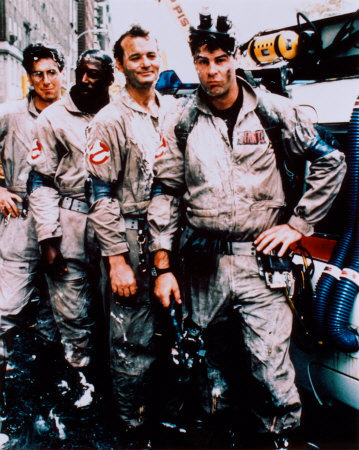
You know what I thought when I read this?  Titan has its own version of the Ghostbusters. 


Sure there's only two of them and they're darker, a lot less comical and they're not prepared to have a friendly ghost for a pet as you have just found out.  Instead they set upon you before you have a chance to tell them of your plight. 

These two versions of the ghostbusters do have similarities.  Both of them have their own versions of ghost traps.


Functional but not very elegent.


Far more classy.  And glassy.

I love the description you get of being left in a bottle trap - hearing the squeak of the bung and seeing your opponent's face from inside the bottle.
You might end up in one of these traps if Van Richten and his companion, Streng both get hits on you in two consecutive combat rounds.  

How did I get into this mess?

In Night of the Necromancer, you spend most of your time as a ghost.  When you see Van Richten, you get the idea that he may be able to help you.  However, if you do reveal yourself to him, you realise that he really can't see past the fact that you're a ghost.  You don't have much time to think about how judgemental and exclusive he is as he and his companion are attacking you with silver weapons.

What have I learnt from this?

In gamebooks, even death paragraphs can be entertaining and have pop culture references.

In Night of the Necromancer, being beaten in combat or being banished is usually not the end, as you are then whisked off the Earthly plane and may be able to to return to another place to continue your adventure. 

 However, it sometimes I should have an actual deadly combat or situation to make sure that the hero does not become complacent and it still gives the reader a sense of danger.

Thursday, January 13, 2011

Your adventure ends here - the not quite Hero Quest

The gamebook endings I'm quoting have something special beyond the standard 'Your adventure ends here.' and I would like to make sure that any of my future gamebook endings should have one of these special features.

Here is an ending from The Fellowship of Four, a Heroquest multiplayer gamebook by Dave Morris. 

Some adventurers you are! If you have not even got the gumption to get involved when you see there's something wrong, how do you ever expect to be heroes?  Obviously, you would rather just stay by the comfort of the hearth with your beer.  Perhaps later on in the evening, you would be as so daring as to risk a game or two of darts?  It is clear that you are not cut out for swashbuckling, and so your adventure ends here before it's even begun.

Why I like this paragraph

This ending breaks from the norm of failure paragraphs in many ways and I like breaking from the norm. 

First of all, you don't die.  In most gamebooks, all of the failure endings end in your death.  Although you are on a dangerous quest, the non death failure is underused.  Multiple non failure endings are underused even more?  What's so bad about a good ending, a better ending and the best ending?  It will allow you to 'score' your adventure and may even provide a pleasant surprise when you try a different route and realise that there was a better way.

Second, the book berates you for behaving inappropriately.  Some gamebook authors have a set of rules based on morality, logic or common sense that the reader can work out in order to make it easier for them to make more successful choices.  Morris wants the reader to behave like action seeking, heroic characters and tells them this in the paragraph.

Third, you can get to this paragraph from paragraph 1.  Yes, you've turned to one other paragarph and you've failed.  Why such an early failure?  It's a possible choice - no one makes you go on quests.  Maybe Morris was screening his readers for characteristics such as curiosity and a desire to help others.

Fourth, Morris speaks to the reader.  Unless you are playing Grailquest, gamebook paragraphs rarely give you more than a description of your surroundings and dialogue and only break the fourth wall in failure paragraphs or when they tell you that you are a big cheat.  Morris really lays into the reader for making such an obvious mistake even to the point of sarcasm.  If you are being dissed by a gamebook, then you really know you've gone wrong.  Speaking to the reader is another underused feature in gamebooks.

 How did I get into this mess?

You are in a tavern when a worried looking man walks in and says something to the elders who shake their heads.  He then stands by the fire, looking chilled and concerned.  You decide to ignore him and carry on drinking beer. 

What have I learnt from this?

Failure endings do not just have to be a grim description of how you die.  They can still contain useful information for your next read through.  Morris is reawarding characters who want to help people in need.  If you do not do that then your adventure will be a lot harder.  A lot of gamebooks contian rules that the author has made.  He or she may make them obvious or not, but if you work them out then you will be much more successful.

Failure endings can contain useful bits of advice, so that when the reader starts again, they now feel more knowledgeable about what is expected of them.  This is something failure endings can provide - clues and hints for the reader in order to help then succeed on thier next attempt.

There is also much more to endings than just 'You die.'.  You do not have to die.  You can fail right at the beginning.  You can fail and still be told something useful.  You can have the author talk to you and tell you what an idiot you are.  All of these things are tools for writing a memorable failure ending.