Showing posts with label Dave Morris. Show all posts

Monday, December 21, 2015

Corporate Treachery Meets Otherworldly Forces in MetaHuman, Inc.


Damn. I promised myself I wouldn't do this.

It's been a while since I posted anything on Lloyd of Gamebooks. The last few posts I wrote were back in the 2015 Summer of Gamebook Kickstarters (remember those heady days?), and each one of them was to promote various interactive fiction books or apps. Oh, they were all in earnest – I really was excited about those projects. But they all came down to selling something, nonetheless.

And yet, what has always most appealed to me about this excellent blog that Stuart Lloyd has created is its, and his, honest adoration of gamebooks – the geeky fanboy element, if you will, a category under which I would also class myself. When Stuart first asked if I'd be interested in contributing to this blog, I wanted to respect that honesty – I intended my posts on Lloyd of Gamebooks to be first and foremost about discussing the gamebooks that I loved, old and new, and not merely a means of hawking my own wares. And yet, by the end of Summer 2015, I'd used this blog to do a lot of promo. It was about time I returned to my starry-eyed fanboy roots, and got back to talking about apps and gamebooks that I loved on their own merits, rather than because I had a dog in that particular race.

With that proviso in mind, I'm about to tell you how amazing my newest gamebook app is, and then I'm going to tell you where you can buy it.

It helps that I can be sincerely effusive – that I am enormously invested in this app I've been working on for about two years, which is probably the best thing I've ever written. Is it distasteful, even vulgar, for a writer to so brazenly market his or her own work? It shouldn't be. Particularly in this growing climate of ebookery and self-publishing. Particularly too in the interactive fiction sphere, which is still a niche domain, peopled by indie publishers and even indie-er writers. Oh, you can find a few giants who are still republishing Fighting Fantasy books, if you step outside the English language. But even they show no interest in breaking new ground. If we, as emerging writers, aren't prepared to market our own work, who will?

Dave Morris addressed this point in detail in an article he wrote for The Bookseller in February. Take a look. For gamebook writers especially, there are far worse people to consult for advice.

Bref, as the French say when they want to change the subject. Let's talk about MetaHuman, Inc.

MetaHuman, Inc. is an interactive fiction story in which you play as CEO of a nebulous corporation that specialises in creating Enhancements – superhuman abilities, for sale to the highest bidder. You must navigate the tribulations of the business world – recruiting and managing staff, say; prioritising Enhancement projects and building the resources necessary to handle them – while striving to raise your company's share price as high as possible. Because, should it fall too low by the end of the year, MetaHuman's shareholders won't be pleased. And they aren't the kind of preternatural beings that you want to have displeased with you.

Yes, MetaHuman, Inc. is a tale of corporate dealings and treachery. But it is also a tale of sorcerous powers and bleeding-edge technologies – and the consequences and responsibilities of integrating such modern-day miracles into your own body. As you govern the fortunes of MetaHuman Incorporated, you'll face mercenary psychics, and fiery creatures out of Arabian myth. Worst of all, when the extraterrestrial parasites known as the Surgeons attempt to gain dominion over the planet Earth, you must decide what role MetaHuman will play in repelling this incursion – or whether you wish to help the aliens, in the hope of gaining immense power.

In terms of game mechanics, Choice of Games, this app's publisher, has a track record of steering away from the clean-cut 'skills' that you would find in RPGs – 'You're good at this skill, you aren't so good at this...' – and preferring variables that reflect a degree of nuance on the player's part. And so, here you can play as a CEO displaying Ruthlessness or Compassion, one who shows a great deal of Candor or Guile. Publicly misbehave, and your company's Image will suffer, unless you can put a good spin on things. You can try to keep morale high amongst your staff – or you can bully and intimidate them into good behaviour. As mentioned, your company's Share Price is paramount, and it's a good idea to build up the Resources necessary to develop the really high-level Enhancements.

Ah yes, the Enhancements, the bread and butter of MetaHuman Incorporated. These are, essentially, superpowers-for-sale, and the key to building up a good company profile. You can direct your company towards focusing on magical or hi-tech research, Witchery or Superscience; most Enhancements fall within one domain or the other, though a few walk the line between the two extremes. In writing this game, I wanted to shy away from including 'classic' superpowers – and so you won't find super-strength, or the ability to fly listed amongst MetaHuman's potential projects. Instead, you may be able to develop Heightened Legerity, Hex of the Arc Savant, Technopathy, Psi-activator, Probability Filter, and a bunch of others. And, yes, if your company develops these abilities, you, as CEO, get first taste of the finished product.

And the game is big. It's about 260,000 words long, in total. Word count in apps can be a bit misleading – maybe 15% of that word count is coding rather than content. Plus, when comparing an app and a dead-tree book, in an app it's far easier to copy and paste a chunk of text, editing for continuity; do that, and that's a big brick of words that you have to count twice. Still, you've got maybe the equivalent of three Fighting Fantasy books crammed into this app. When you buy MetaHuman, Inc. you get your money's worth, any way you look at it.

It's an added bonus that I love, love, love the game's cover art, by Paul Guinan. My one-line brief for that was along the lines of, 'I think the app's cover should be MetaHuman's company logo – something suitably sinister.' The final cover, up at the top of this page, is really fantastic. Thanks for that, CoG, and Paul Guinan in particular.

So, I'm really proud of this game, and I wholeheartedly recommend that you take a look at it. You can play the first three chapters of the game for free right now, on the Choice of Games website. If you want to buy the game now, it's currently on sale until 4th January 2016. You'll get 40% off the regular price.

I hope you enjoy it. And, once again, please excuse me for using this space to sell my stuff.

(Post by Paul Gresty)

Wednesday, July 29, 2015

Summer of gamebook kickstarters

It is an exciting time, gamebook friends, with no less than five gamebook kickstarters this summer. So have a look at them and get your pledges ready!

I've listed the kickstarters in reverse order of finishing date because I wanted some kind of order, but couldn't decide on what would be best, so I just went with this one. Enjoy!


The Good, the Bad and the Undead

Deadline: End of August

Status: Soft launch page up.

Ashton Saylor volunteered himself to write this western based gamebook which was an idea from Dave Morris. Dave lost hope on getting it done, but now that Ashton is on board, it looks like it will LIVE! (mwahahaha). The kickstarter will launch at he beginning of August, so keep an eye on the Facebook page for the time being. You can read a demo story for it here.

There is now a soft launch page up.


The Midnight Legion: Operation Deep Sleep

Deadline: 29th August

Status: Almost $3000 backed (out of $14500)

Aaron Emmel is a writer who is producing this sci-fi gamebook series. In this book, you wake up with no memories of your previous mission, but they gradually return to you as the story unfolds. Aaron has clearly done his groundwork, using the bits he wants from Lone Wolf and Fighting Fantasy to enhance the experience. $28 gets you one book and $50 gets you three. Have a look at his fabulous book!


Alice's Nightmare in Wonderland

Deadline: 3rd August

Status: Backed

This is a project by Jonathan Green of Fighting Fantasy fame (but he has done a lot more!). In this gamebook, you guide Alice as she returns to Wonderland and you help her explore the fantastic place. £15 gets you the ebook and £20 gets you a paperback.


Fabled Lands: The Serpent King's Domain


Deadline: 3rd August

Status: Backed (a lot!)

This is Paul Gresty's second gamebook that he is writing, has put on Kickstarter and is working with the Fabled Lands crew on. If you are new to gamebooks, the Fabled Lands series was a wide open sandbox gamebook series that was originally planned to be 12 gamebooks long. Unfortunately, it only reached 6 gamebooks before being cancelled in the mid 90s (the time when gamebooks went into hibernation for almost two decades).

This project was funded in around 45 minutes, so you will be guaranteed anything you back for. A lovely book is 35 Euros (around £25), but it will be a high quality hardback. I'm looking forward to this one!

The Frankenstein Wars

Status: Finished and backed.

I am looking forward to this one. Paul Gresty (Arcana Agency) and Dave Morris (everything) have teamed up with Cubus Games to create an interactive app that is fabulous in every way - the look, the story, the sound. The original idea is Dave's - Victor Frankenstein's technology has been stolen and it has been used to create an (almost) unstoppable army. Your job is to stop it.


The project raised its target on Kickstarter in a campaign with almost as many highs and lows as the book is going to have. I've never been as gripped as I was since I watched Distrcit 9 (good film). If you did not back it, keep an eye on the project for when it comes out.

Thursday, June 25, 2015

The Frankenstein Wars - The Hard Part Is History

You could make a solid argument that it's more challenging to write good interactive fiction than good literary fiction. In a gamebook, say, all of the requirements of high-quality literature must be present - such as plot, pacing, character; those old chestnuts. And yet you have to work within a very specific form, one that emphasises the meaningful choices within the text. This creates a great big decision tree, and for practical reasons of space, you can't spend a lot of time exploring the nuances of every specific route within that tree. Sadly, that means you can't devote a lot of words to dialogue, say, or inner monologue, or exploring complex socio-political situations. Out they go.


Oh, the consequences of complex socio-political situations can stay. The great big, bloody battles, and soldiers getting smashed to smithereens - all of that stuff can make the final edit.

Fantasy settings work great in gamebooks. In a really strong fantasy setting, everything can be expressed in such a beautifully shorthand way that you have a ton of room left over for the really important stuff, such as telling a great story. Don't misunderstand me - I'm not saying that the worlds themselves are simple; far from it. A handful of gamebooks have been set in Tolkien's Middle-Earth, and that's mind-blowingly rich. In more purist gamebook terms, Joe Dever's Magnamund isn't so far behind when it comes to sheer detail. But these worlds are inspired by legends that tap into the familiar, satisfying tropes of absolute light and dark. When it comes down to it, there are guys who worship good gods, and guys who worship evil gods. A sword is a sword, a big metal helmet will stop you getting bonked on the head, and wizards are mysterious and difficult to trust.

You know which setting is even more realistic than Magnamund, or Middle-Earth?

That's right. Reality.

The Frankenstein Wars gamebook app is an ambitious project in several ways. Dave Morris's concept of the reanimated lazarans as intelligent, feeling beings is a dramatic step beyond the majority of interactive fiction that currently exists. And the guys at Cubus Games are performing technical miracles with the game - I think, in terms of visuals and gameplay, we'll be able to create something that's right up there with the Sorcery! apps, or the best of the Tin Man adaptations.

But, perhaps most challenging of all, the game will be rooted in real-life history. We hope to successfully capture the discontentment of France during the reign of Charles X, the incompetent king. This is a game that will feature a host of characters who really, truly existed - such as Marshall Ney, Ada Lovelace, Lord Blakeney, and a certain deceased (and somewhat petit) former emperor of France.

And yet this is no documentary. Make no mistake - the star of the show here is Victor Frankenstein's resurrection technology, and the world-shattering power it grants to those who possess it. The game focuses on the schism between brothers Tom and Anton Clerval, yes - but it focuses too on the schism between Britain and France, and between the living and the once-dead.

Let the big, bloody battles commence. Let the soldiers get smashed to smithereens - and let Frankenstein's technology stick them back together again afterwards.

Sound interesting? At the time of writing, The Frankenstein Wars Kickstarter is hovering at around 54%, with just a few days to go. Why not click on over that way and back the project right now?


(Post by Paul Gresty)

Sunday, June 7, 2015

Weaponising Frankenstein's Monster


The military gets to play with all the best technology before it filters down to the general public. The ironing board in your cupboard is made from heat-resistant materials originally developed for the engines of the Mirage 2000C jet fighter. Your toaster only knows when to pop up because its timer is based on the guidance system of Reagan-era Hawk anti-tank missiles. Or maybe not. I haven't done a lot of fact-checking on this. 

In the forthcoming gamebook app The Frankenstein Wars, Victor Frankenstein's resurrection technology emerges in France, in the early nineteenth century. And it is immediately seized upon for its military potential. It makes sense - what fighting force is more durable than soldiers who can be blown apart, then reassembled and resurrected, and thrown back into combat once more? The options are better yet for a general willing to mix and match the living raw materials under his command. A soldier with four arms, and two brains, will likely slaughter twice as many enemies as a regular soldier. A soldier with enlarged lungs, and three hearts, will be able to run far faster than a normal human, and shrug off injuries that might cripple or kill a lesser man. These resurrected soldiers - these lazarans - are living weapons.


There is one potential drawback: the lazarans are not mindless zombies. They are living, feeling people. Imagine yourself in the place of such a lazaran for a moment, dear reader. Perhaps you love your job, or perhaps you don't. Regardless, one morning you wake to learn that your boss has grafted an extra head to your shoulders, and given you one extra arm. He's severed your own scrawny legs, and replaced them with the brawny limbs of a champion sprinter. Not just one champion sprinter, mind - they are quite clearly mismatched in colour. All because he feels it will make you more effective in your work. How would you fight the wave of madness that such a change would surely engender? Could your husband or wife understand this transformation? How could you explain it to your parents, or your children?

The Frankenstein Wars is a tale of revolutionaries who believe that the ends justify the means - and of those who suffer for such fanaticism. In this world of murky morals, you can play as exploiter and exploited. The revolutionary Zeroistes use Frankenstein's technology to wage war against the French government and its British allies. The conflict threatens to tear apart the heart of Europe. And yet the damage to humanity's soul may be far greater still.

Sound epic? Check out The Frankenstein Wars Kickstarter project page. At the time of writing, we've just passed the 33% mark - a strong start, but still with some distance to go.


(Post by Paul Gresty)

Friday, November 21, 2014

Necklace of Skulls

Necklace of Skulls was first published as a part of the Virtual Reality Adventure series in 1993, and has lately been given new life as a smartphone/tablet application by Cubus Games. Dave Morris recently mentioned that he began writing Necklace of Skulls shortly after a visit to Central America. And, man alive, it shows. In this story, you take the part of Evening Star, whose journey across the world to save his twin brother is a trip through Mayan legend, and even through the fearful, dark parts of the Mesoamerican psyche that give birth to such legends.


In short, it's an extremely distinctive, evocative story. You won't find any battleaxe-wielding dwarves here. And what Cubus Games have done right is to precisely match the tone of the app to the atmosphere of that story. Visually, the artwork and overall feel here have their roots in the contemporary art of the period, and so the blend of story and artwork comes across as wholly natural. The app's sound effects are apt, as well. Sound is something I'll rarely pay much attention to in an IF app - incessant bleeping or sword-swishing noises usually just get on my nerves. But Cubus have done a great job here in terms of ambient sounds, and with the dull drum beats or tambourine rattles that greet you whenever you tap options or commands. It all adds to the story experience, and that's a tricky thing to pull off.

(Evoking a certain ambiance is really a strong point for Cubus, in fact. The same was true for their previous apps The Sinister Fairground and Heavy Metal Thunder.)


We have a strategic, diceless combat system, here. Each round, you get to choose three actions - attacking, defending or resting. If you attack when your opponent is defending, he'll take very little damage. If your opponent attacks while you're resting, he'll gut you pretty quickly. If you try to attack-attack-attack, you'll get tired out pretty quickly. Anticipating your opponents' strategies is a little tricky, but you get the hang of it soon enough. There isn't an excessive amount of combat, either. My first playthrough, I only fought two opponents.


Any real criticisms? Considering the app by itself, no. It's a solid contender against the other gamebooks-as-apps that are out there just now. Comparing this app version of Necklace of Skulls to the dead-tree gamebook of yesteryear, however, I see the app is a bit less flexible in allowing you to choose or create your character (maybe I want the AGILITY and SPELLS skills, dammit!). This is, I suspect, a choice on the part of Cubus to prune out any rules-lawyering, and to present this app as a streamlined, 'one-tap-does-all' experience. And that's no bad thing - frankly, if interactive fiction is to make any headway as a mainstream medium, I think that's the right way to go.


So, another strong entry from Cubus Games. Now I start counting the weeks and days until their next app, the sci-fi Sol Invictus...

(Post by Paul Gresty)

Wednesday, September 24, 2014

Fighting without dice

Post by Paltogue.

I'm currently in the planning stages of writing a gamebook (or even a series of gamebooks) and, as a long-time fan of Fighting Fantasy, my first inclination is to go with the familiar and use FF rules, including plenty of fighting (it is FIGHTING Fantasy after all). But there's a problem, currently being discussed in blogs and on Twitter by people like Dave Morris and Matt Hill, which I want to explore in this post on Lloyd of Gamebooks.

OK, picture the situation. You're lying asleep just before dawn in a first floor bedroom in an inn, on your way to deliver an important secret message to ... well, I'm not going to give the whole game away right now, just assume it's someone important! Test your Skill. If you are successful, you wake up, having heard noise from the floor below, which sounds like someone breaking into the inn. If you fail, you remain asleep. Let's say for now you were successful (which of course depends on what your SKILL score was in the first place, in large part determined by another random roll of the dice before you started your adventure). You bolt awake, realising your enemies are coming to get you before you can deliver your message. So what do you do now? Do you grab your stuff and stand by your door, preparing to attack anyone who tries to come in (this would be the only option if you didn't pass the SKILL test just before by the way), or do you grab the first thing at hand and get the hell out of there, jumping out the window to the back street below? Now, that's a proper choice that you as the reader get to decide, and I like it, as I have no idea who or how many people are coming up the stairs to get me, and as it's near dark outside I fancy my chances with the jump (the inn isn't very tall after all). So you chose which of your possessions to grab and out the window you go. Test your Luck. If you are lucky, you land well and get to your feet. If you are unlucky, you land awkwardly and twist your knee. Lose 2 STAMINA points (and maybe even a SKILL point if I'm being mean). You stand up and see a gaunt REIVER wearing a wide-brimmed hat standing in front of you. He is holding a flaming brand in one hand, and a jagged-edged knife in the other. You must fight him!

REIVER        8            9

After two attack rounds, another REIVER, this one short and waving a sword over his head comes running towards you and joins the fight. You must fight them both at the same time.

2nd REIVER         7           7

If you survive this fight to the death, you head off into the night in the hope of escaping your pursuers.

I don't know about you, but I thought this was quite fun up till the point when I had to fight the Reivers. But suddenly I've got to stop the enjoyment for a bit, while I roll some dice a couple of dozen times (allowing for a re-roll or two, let's be honest!). That was completely BORING (and would have been even more so if you'd chosen or been unlucky enough to have to fight the four Reivers coming up the stairs to your room, each in turn)... And what is it about those bloody dice anyway, especially the one I once filled in the dimples of with a blue pen? Why does it always seem to roll a low number?! I mean, I almost had to stop reading this book I've spent a fiver on and start it all over again just because of some annoying little red cubes that don't want to roll the way I want them to. And don't get me started on the fact that I only had an initial SKILL of 8 in the first place - again the fault of the pesky dice!

Don't get me wrong, I like dice as much as the next person. They are tactile, loaded with history and (a little bit of) mystery, and they make a nice noise and movement when you roll them on the right surface. But I don't want to depend on them for enjoyment of a story. Imagine reading your favourite novel, and not allowing yourself to start each new chapter until you'd rolled equal to or over a random number between 7 and 12 with two dice. Seriously?! As a long-time fan of Fighting Fantasy, you can imagine that this has presented me with a bit of a quandary. Actually, it hasn't really. I decided, pretty much after my first combat in Island of the Lizard King in 1985 that there was no real fun to be had rolling dice to see how good at adventuring you were and then rolling some more (again and again and again and again) to see if you could continue reading the book. Nope, not for me. I loved these books, but from now on I won every fight and succeeded in every roll (and had enough gold too, at least if the amount I started with was arbitrarily decided by the author). I didn't claim to have things I didn't or have done things I hadn't, but I did keep a spare finger or three in previous paragraphs just in case the author was going to kill me off without warning (another problem with the FF approach). And that's still how I play Fighting Fantasy gamebooks, and I don't suppose I'll ever do it differently (I have tried playing by the rules many times, but I just get annoyed; oh, and curse you, Paul Mason, for your subversive ways!). Now maybe some of you are aghast at this, but seriously, how many of you really enjoy playing a book 100 times just to find out what happens if the dice go the right way for you? The internet is littered with gamebook playthroughs which (being generous) 9 times out of 10 don't get very far, even when the person doing them knows the book pretty well.

So what's the alternative for those of us wanting to write gamebooks which include some fighting? And who doesn't want fighting, really? I mean, I'm sure I can't be the only one who gets a shiver down my spine when I turn to a new paragraph and see something like BLOODBEAST plastered across the page! But I don't want that to mean "spend the next five minutes rolling dice in a monotonous fashion, after which you may have to start all over again anyway" or even "flick on to the next page, nothing of interest here YOU BIG CHEAT". Nor do I want to dodge the issue entirely and ask the reader if they want to run away or stay and get eaten/defeat the enemy automatically. That's equally boring and pointless; why include the 'fight' in the first place?

Obviously I'm not the first person to wrestle with this gamebook conundrum, so let's look at some possible solutions. First of all, we could go all Way of the Tiger ninja on the Reiver's ass, and present a range of different fighting moves, some of which will be more effective than others. But WotT still relies upon rolling dice and a lot of guesswork as to the best moves to make. I can imagine though that this is definitely an avenue we could pursue, though we would want to get rid of the dice from it completely (and perhaps simplify the kinds of moves you can make, as we're not all going to be ninjas). The recent Inkle adaptations of Steve Jackson's Sorcery! books go for a trade off between attack strength and energy levels, with textual clues as to the best approach to adopt in each attack round for each opponent. Again, this is an improvement, but it would be hard to do in a paper gamebook without dice, and in any case boils down to a set number of moves which are the same for every combat (and it sometimes feels like the combats are a rather easy formality that are only in there because this is a Fighting Fantasy adaptation). A kind of a half way house between WotT and the run away/get eaten approach is the one used in the Virtual Reality/Critical IF books, where you are presented with a list of possible actions to take, some of which you can only do if you have certain Skills. This works well, as in the example from Heart of Ice where you encounter a huge Fijian bodyguard. You can either run away, try and blag your way out of the situation, brandish your gun at him to make him back off, or fight him. This is a nice variety of options, certainly better than almost anything you'll encounter in Fighting Fantasy, but only one of them really involves you fighting, and the result is a single outcome (you lose some Life Points, then knock him out and make yourself scarce). So not really a fight as such, but let's be honest this is much better than rolling dice till you're sick and being told to turn to paragraph 236 if you win (and it's helped by the evocatively descriptive text of course). A more complex example is furnished by the Hydra in Necklace of Skulls. Here you can try to dodge, parry or attack. Each of these options leads to other similar options, and some may lead to loss of Life Points, but, depending on your Skills and what you chose before, the choices may be subtly different (you can dodge further away; you can now use a spear if you have one), or you may be returned to the original set of choices in a nice take on the repeated attack round. Depending upon your choices in this dangerous fight, you may be killed outright, suffer repeated loss of Life Points, or work out the right combination of choices to survive the fight with minimal or no injury. I think this works really well as a fight against a dangerous opponent - there's certainly a danger of injury and death, but thinking about your choices in light of your equipment and Skills should get you through. Most importantly, it's not boring or arbitrary. There is a danger of death here, but it's not one of those unavoidable Instant Deaths or the result of the author trying to kill off the reader, so I slightly disagree with Dave Morris here, who recently said on Twitter that "If you can fight you'd expect you can die, but that's always a fail for author & reader". After all, there has to be some risk in a gamebook, otherwise it's JUST a story with different ways of reading it (no harm in that of course, but that's a rather different kind of thing I think).

So I think this gives us a decent kind of fighting interaction which doesn't involve dice but which also doesn't constitute a removal of fighting from gamebooks entirely. But it does mean abandoning my nostalgic attachment to the Fighting Fantasy system which, after all, I've personally abandoned using in my own adventures years ago, so why should I inflict it on others?!

With all that in mind, how does the following version of the scenario I started the post sound? Does it capture that essence of fighting and fantasy without recourse to dice and arbitrary decisions?

You're lying asleep just before dawn in a first floor bedroom in an inn, on your way to deliver an important secret message to ... Suddenly you wake up, having heard noise from the floor below, which sounds like someone breaking into the inn. (Let's be honest, as an author we want to give the reader the chance to make decisions, not have them forced on them, so there's no value in randomly having it decided if they wake up or not.) You bolt upright, realising your enemies are coming to get you before you can deliver your message. So what do you do now? Do you grab your stuff and stand by your door, preparing to attack anyone who tries to come in, or do you grab what you can and get the hell out of there, jumping out the window to the back street below? As before, I like the idea of jumping out the window, as I have no idea who or how many people are coming up the stairs to get me, and as it's near dark outside I fancy my chances with the jump. So out the window you go. You land with an umph on the ground, but you aren't hurt. (Let's not make the reader's life a misery here by deducting Life Points - punishing them for doing the wise thing and escaping when the other option was fighting a bunch of Reivers in a bedroom is just mean.) You stand up and see a surprised, gaunt REIVER wearing a wide-brimmed hat standing in front of you. He is holding a flaming brand in one hand, and a jagged-edged knife in the other. Which of the following will you do?
  • Try to talk to him? (He will stick his fingers in his mouth and whistle loudly, and shout "He's ower here" at the top of his voice. Not good, but really, what did you think was going to happen? Another Reiver joins him for the fight.)
  • Charge right at him to try knocking him out of your way? (Good idea. He's as shocked as you are, and he's gaunt, i.e. not a big meaty bloke. You knock him off his feet and, with the stink of his beery breath oomphing out all over you, you leap over him and run off into the night.)
  • Attack him?
Of course, this last option is where it gets interesting. There's a couple of things to remember though. As an author, my job isn't (or at least shouldn't be) being the reader's enemy. I don't want my reader to die here, as I want them to enjoy the adventure and I've put them in this fix (and being down here on the street is a lot better than being upstairs with the Reivers). So I want the reader to work out what the best thing to do here is and to only get badly harmed if they do something stupid (this is a dangerous and important situation after all; you can be damned sure that this is a life-and-death situation for the person in the adventure, and I want the reader to feel a bit of that too). First things first. I neglected to tell you that you could play this adventure either as a soldier (fighting is good!) or as a friar (fighting not so good!). Also, following the lead of VR/CI, you have a list of Skills and some equipment. If you are going to get into a fight with an armed Reiver, you want to make sure you have a combat Skill, otherwise this isn't going to go so well for you. Why would you fight someone with a knife in their hand if you didn't?! (The friar may not have any combat skills.) You also want to make sure you have a weapon, otherwise it's fists against knives, and we all know how that can end (the friar has a staff and can use it for combat). So a number of variables that you already know about should dictate your actions and, if you decide to do something where the odds are very much stacked against you, don't expect it to go well. So the friar without any combat Skill who has left his staff sitting by the bed is only asking for trouble if they select the option to fight the Reiver. Better to run right at him, don't you think (especially if like me you imagine yourself as a portly and still-slightly-drunk-from-the-night-before kind of friar)? The soldier on the other hand might see combat as a reasonable option - they should have had the sense to pick up their sword from the bedside and will have a combat Skill. A quick lunge at the gaunt Reiver sends him reeling back with a cry as you thrust your sword into his shoulder. Now you can either stop to finish him off, or just run off and leave him (come on, the place is crawling with enemies, get the hell out of there unless you want another Reiver to come running at you from behind and slash at you with his sword!). If you end up having two Reivers to fight, you can't expect things to go quite as well, but unless you stand in the street shouting "Come on all of you if you think you're hard enough", it should be possible to get away from this situation with your life at least. The short Reiver comes running slashing his sword around. The gaunt one is just standing there surprised. Which do you attack first? If you go for the gaunt one, you'll certainly injure him, but the other one is already on the attack and will wound you before you can have a go back at him (if you are still alive of course). If you go for the short Reiver first, you can swipe his attack aside, perhaps even unbalancing him or disarming him, before turning to the gaunt Reiver who, by now has his defences up, but who shouldn't be too much of a problem (let's settle for a little bit of damage, not as much as if the short Reiver got a whack at you first). You knock him out off his feet and can run off into the night (again, if you are daft enough to hang around after that, you're going to have more Reivers to deal with and things aren't going to be pretty, but I should have given you enough hints by now that the name of the game is getting out of here as quickly as possible). Oh, and if you are still fighting Reivers in the bedroom, you have my sympathies. You should by now have stuck the first one to appear, shoved something against the door and dived out the window.

So I think it is possible, using a combination of textual hints, descriptions of your opponent's strengths and weaknesses, Skills, equipment, the possibility of returning to the same sets of choices, good judgement, as well as carefully graded Life Point penalties, to include an element of combat in gamebooks without belabouring it or relying on the vagaries of dice. The VR/CI system, maybe with some adaptations depending upon the kinds of Skills you offer and combats you want, seems like the best way forward. I think this can be entertaining and productive. What do you think?

Monday, September 22, 2014

Down Among the Dead Men 2014 - the App

Down Among the Dead Men has been floating around on the seas of fiction since 1993, when Dave Morris wrote it as book number 2 in the Virtual Reality Adventures series. The story is excellent, a seafaring tale of revenge against a truly despicable pirate foe, the black-hearted bastard Skarvench. In game terms, it allows you a wide variety of character builds, and presents a ton of different routes to explore, particularly in the early parts of the story. And that equates to a gamebook you can reread again and again. And indeed I have; my own copy of Down Among the Dead Men is a battered, ex-library copy. I've battered it quite a bit more in the years that I've owned it.

cover

When I learned that Inkle had converted this book to app format, my first thought was that it was an excellent choice - containing no randomness, no dice-rolling combat, it seemed a fine candidate for conversion into a gamebook app with a fairly literary tone. My second, contrasting thought was to wonder if it would hold up against the interactive fiction of the last few years. Y'see, the challenge to 'beat the book' is quite out of vogue, these days. Story is all-important; you can complete the story well, or complete the story badly, but death or truly miserable defeat are increasingly rare.

I needn't have worried. One of the first choices you get to make in Down Among the Dead Men is about the nature of the world in which you live - is it an optimistic land of high adventure, a grim world of harsh realism, or somewhere in between these two extremes? For those learned in the lore of interactive fiction, it's quickly apparent that you're choosing your difficulty level - or, if you prefer, the type of reading experience you're about to have. Will you read the book as originally written some twenty-plus years ago, or do you prefer to read a story where you need not fear the protagonist's sudden death, and any unfulfilling lack of dramatic resolution that results from such a fate?

This update to the original book by the guys at Inkle is a lovely touch, and an example of the sort of flexibility that allows stories told through the Inkle motor a great deal more nuance than those in the classic gamebook format. Difficulty levels aside, other nuances crop up throughout. When I played as a changeling sorcerer, who knew nothing about my origins, I passed mysterious buildings that seemed oddly familiar, and I wondered whether I might once have lived there, once. When I played as a pirate queen, disguised as a man, I struggled with the difficulty of hiding my sex during my travels with my fellow pirate escapees. Like DM's previous Inkle project, Frankenstein, Down Among the Dead Men keeps the game mechanics - your character's skills, and so on - hidden away 'under the hood'. And so much the better - if the game does your bookkeeping for you, why bother with them? If you've never read 1993's Down Among the Dead Men, you'll have little Inkling of the variables at play here. I came away from this story kind of wishing that I didn't know the original so well, in fact - I'd have loved to approach this app with no knowledge of the gamebook elements at work.

Another point worth mentioning is the price of this app. Just now it costs 0.89 euros for iPhone/iPad, or whatever that is in your local currency. That's super-cheap. And probably a bit less than I paid for my battered ex-library copy of the book back in the day.


(Review by Paul Gresty)

Saturday, April 16, 2011

April A to Z - N is for Necklace of Skulls

He's definately not 'armless.
Appears in:  Necklace of Skulls (Virtual Reality 4) by Dave Morris.

Background:  Your twin brother, on a mission to the great city, found it almost deserted, having being attacked by werewolves.  After a journey across the desert, he comes to the palace of the Necklace of Skulls but does not return.  It is up to you to find out what happened.

Prominence:  Until you get to his city, your encounters have nothing to do with Necklace of Skulls himself.  4/10.

Hardness:  Necklace of Skulls is a powerful sorcerer.  If you don't win the game with the hydra blood ball, he makes your partner disappear in a shower of sparks with a thought.  He can do the same to you if you do not act quickly.  He can be killed after a punishing combat but  if you have your brother with you, defeating him becomes a lot easier.  Killing Necklace of Skulls is not the hardest part of the book.  The hardest part is killing the sorcerer and leaving with your brother.  7/10

Ambition:  When you get closer to the Necklace of Skulls' home, people talk of strange beasts attacking their cities, but I'm not sure if that is down to him.  From what's explicitly stated, it seems that he just likes to hang out in the desert with his doggy friends which makes me wonder why people visit him so much.  3/10

Style:  Necklace of Skulls certainly has a unique look, a unique name and a unique place to live.  His servants are also brilliantly devious and enjoy revelling in your suffering.  9/10.

Diabolical genius:  Each of the Necklace of Skulls' challenges are diabolical, especially the end of the sacred game, where if you didn't win by throwing the hydra blood ball through the top hoop, he blows up your partner.  His rooms do not kill you but weaken you and terrify you, prolonging your suffering.  Necklace of Skulls really has some sadistic genius about him.  8/10

Total score:  A brilliant villain who just needs to get out more and something to aim for.  31/50

Saturday, April 9, 2011

April A to Z - H is for Hate

Hate's first target was
the nudist colony.
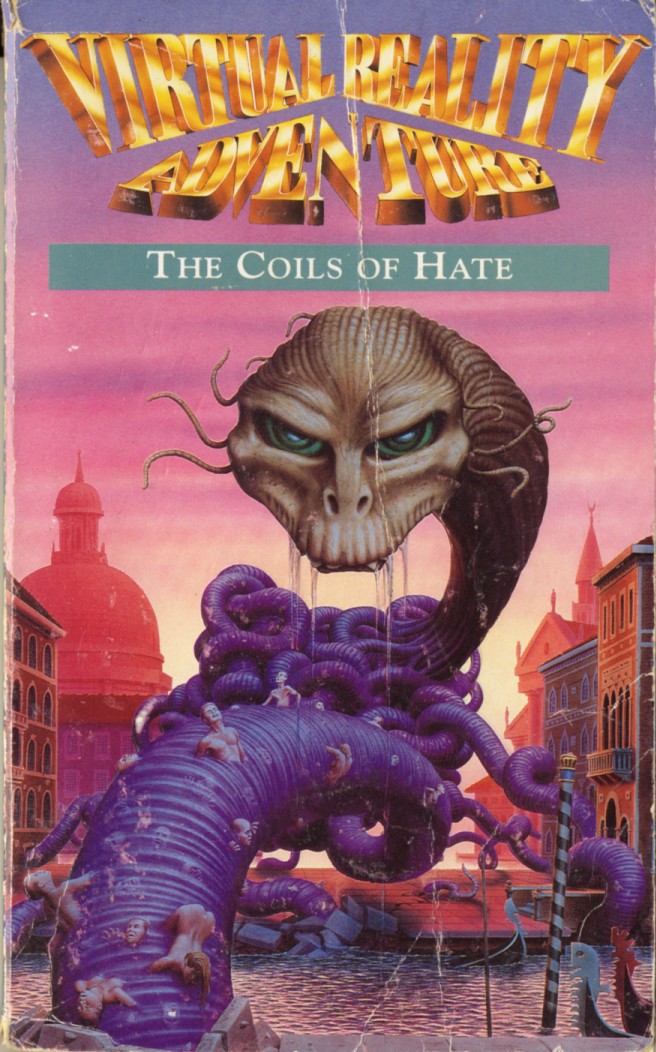
Appears in:  The Coils of Hate (Virtual Reality 3) by Mark Smith.

Background:  It is the physical manifestation of all the hate in the city of Godorno.  The people there are hateful due to their ruler, the Overlord, persecuting pretty much everyone.

Prominence:  As well as coming into contact with Hate before the grand confrontation at the end, you may encounter it several times before the end of the book.  Also anyone who is hateful starts to show physical signs of their hatefulness such as purple pustules on their body.  So hate is pretty much everywhere.  10/10.

Hardness:  There are three ways to defeat Hate.  One is to be pure of heart and get into its mouth, which also kills you in the process.  The other is to chain it to a church and either cut it up with a magical jade sword or blast it with a magical jewel.  All of these items are hard to find and fighting Hate will kill you if you don't have something that can reduce the damage you sustain.  8/10.

Ambition:  Total destruction of a city.  6/10.

Style:  It works by absorbing hateful people into it (quite original) and smashing things up (not very original).  Bonus marks for being the physical manifestation of an emotion.  There aren't many of those in gamebooks.  7/10.

Diabolical genius:  I'm unsure as to whether Hate is sentient.  It just absorbs and smashes.  1/10.

Total score:  You need to keep your eyes peeled for Hate is everywhere in Godorno.  However, it is just a big dumb monster, so as long as you have the right tools, you will be able to kill it.  32/50

Sunday, March 27, 2011

Fabled Lands - War Torn Kingdom Review


Wouldn't this have been a better title screen for The Plains
of 'Owilng Darkness?  (Thankyou, I'm here all week).

After my first journey into Fabled Lands in which I took advantage of being a merchant and killing pirates to get lots of money and go up in rank faster, I was left feeling a little empty.  There were no challenges any more - all my ability scores were high for the books, I was of a very high rank (and therefore had a very high defence score making me extremely difficult to hit in combat) and I had several tens of thousands of shards.

Feeling left without a challenge, I decided to play Fabled Lands properly in order to enjoy it fully for what it is - a big world to explore and create your own narrative in - and to review it for this blog.  

It is a little known fact that
The War Torn Kingdom has
a yellow sub theme.
I'm only reviewing the War Torn Kingdom today, so, with that and my previous rampage in mind, I decided to make some rules for myself.

1)  I will not take advantage of any infinite loops in the book.

2)  I will stay in Sokara (i.e. book 1) as I am just reviewing book 1 and I do not want to take advantage of any of the things in the other books, even if there are some tasks that you cannot complete unless you get information or items from other books.  I want to see how far a starting character can go in just one book.


So, how did my journey go?

I decided to be a wayfarer.  While not having the broken levelling up ability a warrior has, I would still be a good combatant while still being able to look after myself in the wilds.  I was also quite a decent thief.  However, anything involving magic, the supernatural or charming people would not go well.

What's yellow and above
our heads? The sky. 
The War Torn Kingdom starts with me in a small boat, drifting through the sea on brink of death.  You have your map, an heirloom, which you have already memorised.  I'm on the brink of death, but eventually, I crash into the shore of Isle of Druids and meet a crazy old man who tells me to follow him where he will show me the gates of the world...

It's Ok, old man.  I'll take a look around here first.  


I checked out the village near the coast and went to the temple of Lacuna, the nature Goddess.  However, becoming an initiate costed 30 shards and I only had 16, so I entered the forests, thinking that I would be right at home there.

It required a scouting roll of 10 to not get lost.  With a scouting score of 6, all I needed to do was roll a 5 or more.

I got lost twice and lost 4 stamina points each time.  Not wanting to die prematurely, I went to the inn and spent 4 shards to restore them both times.

What's yellow, smelly and busy?
Yellowport.
Yes, barkeep, I got lost again.  Why don't you try it rather than swilling that bilge water you call ale?


I succeeded a third time, met a tree who liked me because I was a wayfarer.  I then found another city where a druid gave me a staff to deliver to another forest, because I was a wayfarer.  It was time to leave the isle of druids.  I left through the Yellowport arch an was greeted by the disgusting smell of the sulphur saturated stinking river.


Exploring the city at night, I was confronted by a thug who I easily killed and took 15 shards from.  That was the only time I did that.  

I then went to the tavern where I bought a round of drinks in order to glean some rumours.

Here you go, friend.  I hear this is a nice place to visit.


What's yellow and should be thrown
into the blessed srings?  A vial of
yellow dust.
I was told by a scholar that it certainly was not a nice place to visit and that he was annoyed because the scorpion people had stolen the Book of Seven Sages.  If I return it to him, he'll reward me.  With a quest to complete and an insatiable curiosity, I decided to leave Yellowport and explore the countryside.  I headed to the Forest of Larun in order to deliver the staff.  After passing a sanctity test of 9, I handed the staff to a druid who handed me another staff and told me to take it back to the Isle of Druids.  I returned to Yellowport, hitched a lift on a boat and gave the druid a staff.  In return, he let me train with the best druids and wayfarers.

I'm no longer an outcast.  I have reached the heady rank of commoner.  


I had many other adventures.  I got beaten into submission by a group of rat men.  I tracked some ghosts down only to find out that they were people.  I took the book from the Scorpion Men.  I fought some knights.  And much much more...


The verdict


From a gameplay view, The War Torn Kingdom is second to none.  In my other posts, I have already talked about the huge variety of things to do and the many rewards, but there are other subtle touches that makes the game balanced and playable.

What's yellow and doesn't
appear in this book?
The Yellow Dragon Knight.
First of all, the difficulties for the tasks are calculated well.  The first tasks that you will face will have a difficulty of 9 or 10.  Even if you have a 2 in the required characteristic, investing in a stat boosting potion and a blessing should make them doable.

The book is not too lethal either.  A lot of tasks are not combat based and you have the chance of escaping many combats.  For example, you can avoid combat with the thug if you make a charisma roll at a difficulty of 8.  Some combats are not lethal even if you lose them.  For example, if you lose a combat against rat men in the sewers, they just beat you and take all of your items and money rather than kill you.  The dragon knights in the dragon castle challenge you to non lethal combat for a wager of your weapons and armour.

This is all good as at the beginning of the book, you will not have enough resources or knowledge to buy things such as stat boosting equipment and potions, blessings and resurrection deals and so your life might be painfully short if failing all of your challenges had lethal consequences.

The game will also never grind to a halt if it all goes wrong.  If you need money for passage on a ship to complete a quest, you can sell most of your items.  If you sell an item and realise that you need it later, you can probably buy it from elsewhere.  If you get all of your possessions stolen, you can store a spare set of equipment in a house or cache so that you can start out again.  If you are terrible at combat, then you can find other ways of getting money other than combat.

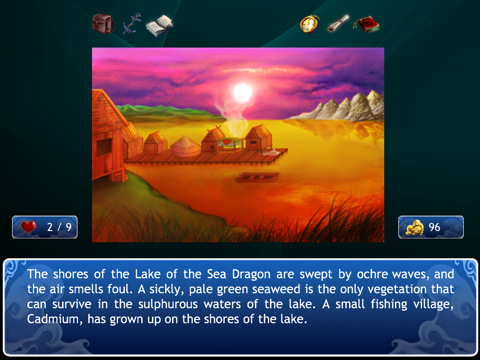
What's yellow and wet?  The Lake of the Sea Dragon.
For example, after I had been beaten to within an inch of my life (my stamina was reduced to 1) and had all of my possessions stolen by the rat people, I left Yellowport and headed north where I came across the ghosts taking an offering.  Not wanting to fight them, I tracked them with my scouting skill, where I discovered that they were people.  The villagers gave me 80 shards.  I also managed to catch a smolder fish which I sold in the village by the lake of the Sea Dragon.  I used the money to buy an ordinary weapon and some leather armour.  I then went to the castle of the dragon knights where I beat two of them in combat in order
to get two suits of heavy plate mail, one of which I sold for
1440 shards.  I had recovered from that set back.

The Yellow Dragon Knight in
another role.
The game is hugely replayable.  Once you get used to the area, you could try it as another character.  However, as soon as you incorporate it with the other books then the potential for different adventures increases exponentially.  Playing this book along with the other books opens up new areas in all books.  For example, there is a door in the Forest of Larun in book 1 which can only be entered if you learn the password in book 3.


Since all of the books are made up of several small quests, there is little chance for characterisation or an overarching storyline, but as I have said before, thinking of your own story adds an extra dimension to the gameplay.

I would recommend that you buy all of the Fabled Lands books and enjoy being immersed in the world that Fabled Lands has to offer.  For more  information about Fabled Lands, go here.  To buy Fabled Lands from Amazon, go here.


BONUS


More profession rules


I was just thinking of how to add more dimension to gaining a profession.  Here is another way of doing it.

How about a rule where you can gain a profession every x levels if you have an ability score which allows it.

The abilities linked to the professions are:

Charisma - Troubadour
Combat - Warrior
Magic - Mage
Sanctity - Priest
Scouting - Wayfarer
Thievery - Rogue

For example, you can gain an extra profession at level 5 and then at level 9 but you can only gain a profession if the ability linked to that profession is 6 or higher without any items to boost it. This means that the player does not have to make a difficult decision between losing a level and gaining a profession, which some people may not like.  This idea is for all of the people who don't want to take a penalty.

You can change the rank number, the ability requirements and also limit the number of professions if you wish.

This also opens up the optional rule that if your unmodified ability score for your profession drops below 6, you are not allowed to count as having that profession until it has increased again.

Or for every ability score you have at 6 or more, you can count as having the related profession.  Or maybe, for your second profession, the score has to be 7, for your third, it has to be 8 etc.

The dimension for extra challenges and rewards are limitless.

Finally, just for flavour, here are some profession titles for characters with dual professions.

Priest/Mage:  Miracle worker                  
Priest/Rogue:  Inquisitor
Priest/Troubadour:  Preacher
Priest/Warrior:  Paladin
Priest/Wayfarer:  Druid.
Mage/Rogue:  Trickster
Mage/Troubadour:  Bard
Mage/Warrior:  Warlock
Mage/Wayfarer: Wiseman/Wisewoman
Rogue/Troubadour:  Spy
Rogue/Warrior:  Bandit
Rogue/Wayfarer:  Vagrant
Troubadour/Warrior:  Spreader of sagas.
Troubadour/Wayfarer:  Keeper of folklore.
Warrior/Wayfarer:  Ranger