Wednesday, February 16, 2011

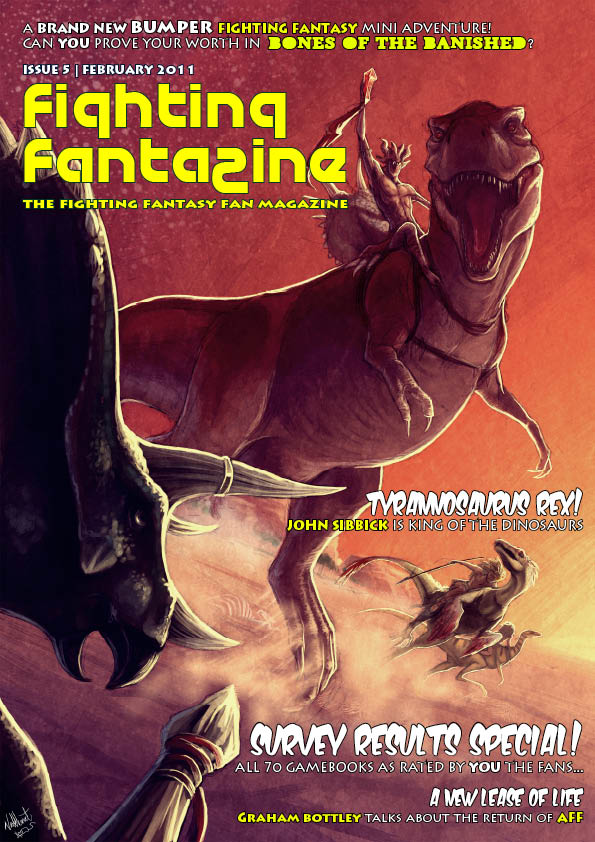
Fighting Fantazine issue 5 is out!

If you have not seen Andrew Wrights blog,

1)  Why not?
2)  You may have missed the news that Fighting Fantazine issue 5 is out! 

Below is Andrew's post describing what is in this great issue.


Editor Alex Ballingall has really been burning the midnight oil putting this incredible package together! Among the many amazing features included inside its bumper 104 pages:
  • An astounding cover by Natalie Roberts.
  • An interview with John Sibbick, illustrator for Fighting Fantasy, Games Workshop, and many excellent dinosaur and extinct prehistoric animal books. Includes never-before-seen pencil roughs of some classic FF book covers.
  • Bones of the Banished - a 274 paragraph Fighting Fantasy adventure written and illustrated by Brett "Jediboyy" Schofield. Brilliant stuff!
  • Results from the previous Fighting Fantazine survey, including extensive essays on the ten best Fighting Fantasy gamebooks. (I've contributed a piece on Steve Jackson's Creature of Havoc).
  • An interview with Graham Bottley, writer of the revised Advanced Fighting Fantasy RPG system, due for publication soon by Arion Games.
  • Guillermo Paredes' Omens and Auguries, featuring all the latest gamebook news.
  • Jamie Fry gatecrashes the lair of notorious Fighting Fantasy author Ian Livingstone.
  • Dan Satherly attempts the infamous Sky Lord by Martin Allen - the final science-fiction adventure in the Fighting Fantasy series.
  • Part 2 of the Adventure Game series, where yours truly talks about how to plan the structure of your own Fighting Fantasy adventure.
I have written one of the essays - I wrote about Moonrunner.  I liked it from the start but after going through it in depth in order to write the essay about it, I liked it a whole lot more.  I love the atmosphere of the book and I think that Karam Gruul is a great villain.

You can download issue 5 from here. The main website can be found here.

Enjoy!

Coming soon - What writing 25 paragraph microadventures has taught me.

Saturday, February 12, 2011

All my gamebooks are now on this blog.

Hi all,

Just a quick note to say I've linked to all of my gamebooks on the sidebar of this blog.  Also, check out http://www.arborell.com/ - the site that hosts the Windhammer Gamebook Competition.

Enjoy the books!

Wednesday, February 9, 2011

My Fighting Fantasy gamebooks

Hi all,

Below is a link to the fighting Fantasy gamebooks I have written with my comments on how I feel about them.  Take a read of them and tell me what you think.  I feel that they were a good education for me in how to write gamebooks.

Here is the link. 

May Titan be with you.

Tuesday, February 8, 2011

Your adventure ends here ends here

This is the conclusion to my analysis on what makes good endings in gamebooks.  Before I started going through all these endings to analyse, I had forgotten about the wide range of endings that we have available to us. 

In the past, I didn't pay much attention to bad endings - I would just go back to the last paragraph and try another choice.  You heard me; I admitted it.  I wasn't going to go back to the beginning again after all my hard work just because I had opened door x instead of door y. 

Next post:  I admit that I skipped combats too.  And 'rerolled' dice if I failed a roll.  And maybe sometimes, certain items would 'fall' into my backpack when I needed them.  Go on.  Who can honestly say they never did those things?

Anyway, I realised that I was missing out on a lot of creativity and entertainment by not reading the failure paragraphs.  Most of the ones I read went into great detail on how you died horribly or they had some other clever way of describing your death. 

Some of them gave you useful information which may help me in future play throughs and some of them gave you an idea of the moral tone of the book which gave me clues on how I should behave in future. 

A lot of death paragraphs are also a chance for humour or allow the authour to break the fourth wall; something which usually doesn't happen in the rest of the book.  Also, failure does not necessarily mean death. 

Books can have different endings with different levels of success or failure.  This increases replayability as there may be a better ending out there.

Failure paragraphs are a chance to do something new with little chance of annoying the reader.  After all, since they're dead, what have you got to lose?  I certainly was not bothered if I came across a two line failure ending saying 'You got shot.  Your adventure ends here.'  I just started again.  However, an entertaining or different failure paragraph is a good bonus. 

Victory paragraphs need a different approach.  They need to be entertaining and fulfilling.  The player needs to be rewarded as well as the character.  The two can go hand in hand. 

I'm sure players feel satisfied if their character gets tons of gold and fame.  However, they don't necessarily have to.  Some books have the character fulfilling a mission as part of their job and not getting some big reward at the end.  However, that does not necessarily mean that you can get away with a 'Congratulations.  A good day at the office.'  It does not reward the reader.

There are other ways of rewarding the reader besides having their character showered with glory and gold.  Stephen Hand's three Fighting Fantasy books, Moonrunner, Dead of Night and Legend of the Shadow Warriors do not have any gold and glory as part of the ending.  However, he makes the ending satisfying by making the personal motivations of the hero clear and fulfilling them at the end. 

Another great writer of successful endings is Joe Dever, who wrote the Lone Wolf series.  All of his books ahve very long successful endings which include characters you have come across and what your next challenge is.  Here is the ending of Flight from the Dark.

You enter the Chamber of State, a magnificent hall decorated lavishly in white and gold. The King and his closest advisers are studying a large map spread upon a marble plinth in the centre of the chamber. Their faces are lined with worry and concentration. A silence fills the hall as you tell of the death of your kinsmen and of your perilous journey to the citadel. As you finish your story, the King approaches and takes your right hand in his.

‘Lone Wolf, you have selfless courage: the quality of a true Kai Lord. Your journey here has been one of great peril and although your news comes as a grievous blow, the spirit of your determination is like a beacon of hope to us all in this dark hour. You have brought great honour to the memory of your Masters, and for that we praise you.’

You receive the praise and heartfelt thanks of the entire hall—an honour that brings a certain redness to your young face. The King raises his hand and all the voices cease.
‘You have done all that Sommerlund could have asked of a loyal son, but she is greatly in need of you still. The Darklords are powerful once more and their ambition knows no bounds. Our only hope lies within Durenor with the power that once defeated the Darklords an age ago. Lone Wolf, you are the last of the Kai—you have the skills. Will you journey to Durenor and return with the Sommerswerd, the sword of the sun? Only with that gift of the gods may we crush this evil and save our land.’
If you wish to accept the quest of the Sommerswerd, begin your adventure with Book 2 of the Lone Wolf adventures:
Fire on the Water.

So in conclusion, victory paragraphs have to be fulfilling - they have to reward the reader by showing them that their character has obtained something wonderful and of value.  It may be money and glory or it may be some other kind of fulfilment.  People don't like it if their victory paragraphs are short.  For example, there is a review of Space Assassin that can be found at this page which says that the ending is disappointing.  Space Assassin's ending basically just says congratulations.  I've never read of any Lone Wolf victory endings being disappointing.

Failure paragraphs are an opportunity to go a bit crazy and try something new.  After all, the worst that can happen is that the reader will not really read it and go back to the start.  Those that do read it will appreciate  your efforts.

Coming soon:  I'll be putting my gamebooks on the blog for people to downloadfor free.
Sunday, February 6, 2011

Your adventure ends here - Some I like

Here's some failure paragraphs which I like for some reason.  Enjoy!


The first one is from Space Assassin by Steve Jackson and Ian Livingstone.
 
An orange glow pervades the room, reflecting off everything except the spheres which remain implacably black. Little doors materailize in front of each sphere and swallow them as they droft over their thesholds; within seconds the entire room is bereft of the spheres. The doors evaporate, leaving you easy eaccess to the other side of the room. Before you can stroll across, however, the room vanishes and you find yourself floating in a starry void, light years from anywhere. A stone tablet drifts slowly into view. It is engraved: "We eliminated seventy-seven spheres of annihilation on your account. As you do not have the means of paying your bill for this service we have taken the liberty of foreclosing and transporting you to this place. Sorry."
 
The tablet drifts away, leaving you to spin in the void. You have failed.

Why I like this ending

It's all about the 'sorry' at the end.  It adds a touch of humour to floating in eternal blackness.

This ending is from Moonrunner by Stephen Hand.


You have leaned the hard way that there is no escape from Karam Gruul's infamous wire tunic.  Your hunt for the fiend ends in a most grisly fashion.

Why I like this ending

This ending highlights what an evil genius Karam Gruul is. Anyone who has invented their own grisly infamous trap deserves respect.

The next ending is from the Citidel of Chaos (no, not that one) by Jamie Thompson.


You ave no way of entering e Overlord's World and none of the thinkers among the Champions can come up with a solution either...and time is running out.  After ten minutes or so, the double doors crash open and a veritable army of Enforcers and Cybermarines come boiling in.  The battle is epic in scale and you will go down i the annals of the Resistance forever.  But the outcome is never in doubt.  Eventually, you are all overwhelmed.  It is all over.

Why I like this ending

It is a great example of a blaze of glory ending. 

This ending is from Deathtrap Dungeon by Ian Livingstone.

You step up to the mirror and are amused by your distorted reflection. Your head looks as large as a pumpkin and your face is exceedingly strange. Suddenly, without warning, a terrible pain pounds through your head and you try to look away from the mirror but are unable to. Some evil force is keeping your eyes glued to your own reflection. You grip your head with your hands and realize with horror that it is expanding. You can withstand it no longer and, blacking out with the pain, you fall unconscious to the floor, never to wake.

Why I like this paragraph

It has an element of horror to it.  It starts off with you looking at a funny image of yourself in a mirror and ends up with you dying horribly.

The last one is from Necklace of Skulls by Dave Morris.


No expression shows on the hard ma-like face as you make your genuflection.  There is no roar of rage to show he is affronted nor flash of sullen anger in his eye.  He only raises his sceptre slowly as though to emphasize the point he is about to make.  Then, before you have a chance to move, he brings the sceptre swishing down to split your skull open like a melon.  Your adventure ends suddenly and horribly.  

Why I like this ending

This paragraph really drives home how stuffed you are and hopeless your situation is against your foe.  First of all, it contains the word genuflection.  I have no idea what it means and so my situation also becomes hopeless in a literary way. 

Then he does nothing to show off his power which is a clear indication that he has so much power that he does not need to show it off.  Oh dear.  All he does is slowly raise his sceptre.  However, even that is too quick for me and he then splits my skull open like a melon.  Which means he didn't find that too difficult. 

Next time...

A summary of what I have learnt from all these death paragraphs.

I will also post about my own writing.  Something I have done very little of during the winter, but I think I need to do it more regularly.

Tuesday, February 1, 2011

Your adventure ends here - make sure you learn something from it.

Here's an ending from Deathtrap Dungeon by Ian Livingstone.

An old cover, showing the bloodbeast.
An alternative title.  You can find more of these here.


3

The gnome shakes his head and says 'I'm afraid you have failed the Trial of the Champions.  Baron Sukumvit's Deathtrap Dungeon will keep its secrets for another year, as you will not be allowed to leave here. You are appointed my servant for the rest of your days, to prepare and modify the dungeon for future contestants.  Perhaps in another life, you will succeed...'

Why I like this paragraph

It refers to you having another life.  Is that a nod to the reader, implying that each attempt is a different life that they lead?  Or is every separate reading of a gamebook like another dimension?  That is an interesting concept to follow.

The most informative thing about this paragraph is how you get here.  The gnome asks you if you have certain gemstones and you end up here if you don't.  So you may lose, but in a future reading, you will know which gemstones to look for.  This should make things easier. 

How did I get into this mess?

I got all the way through the dungeon to come to a huge door guarded by a small gnome.  The door has three sockets in it which only take three types of gems.  You need to get the correct gems in the correct order.

What have I learnt from this?

Just because you die, it does not mean that the paragraph is useless.  You can glean some information on what to do next time.  All death paragraphs give you some information, which is 'Don't choose this paragraph again.'  However, as in this case, you can get more information on what you can do.

Your adventure ends here - for being naughty

Ok, I'm going to post two 'Your adventure ends here' posts, do my favourites at a later time and then wrap up after that. 

The first gruesome death comes from Ian Livingstone's Crypt of the Sorcerer. 

Razaak, with backing vocalists,                                 A bit less scary here and going
looking distinctly scary.                                              solo, but still buzzing.

149

You are mesmerised by the beauty of the sparkling diamonds, but picking one up is the last thing that you will ever do.  Your body immediately crystallises and you sparkle as if you were a diamond yourself.  You have saved Allansia from eternal doom, but you have paid for your greed with your life.

Why I like this paragraph 

First of all, although you die, you turn into a giant diamond.  You may be dead but you are a very rich corpse.

Second of all, you die because you were greedy and should have been more concerned with saving your own life rather than grabbing treasure.  You have violated the moral code set by the book and so you have paid the penalty.  Maybe the fact that you turn into a diamond is an example of death by irony for your greed. 

How did I get into this mess?

I got this far by cheating.  Seriously, I'm not going to play Crypt of the Sorcerer fairly.  The book is extremely punishing.

This is almost the end of the book.  I've survived Razaak's magical onslaught and beaten him in combat.  Not too easy considering he's a skill 12 stamina 20 opponent who automatically kills you if he wins two consecutive attack rounds.

Now that he's finally dead, I could flee the collapsing cavern or I could look at the treasure.  I'm given another chance to flee, but I still decide to take it.  I am killed for my greed and the inability to take a hint.

What have I learnt from this paragraph?

Some gamebooks have a moral code and if you work out what it is and follow it, your life would be much easier.  Crypt of the Sorcerer is not too overt about what it wants as a moral code but it does punish you for being greedy, saying you serve chaos and attacking non hostile people.  However, in the last case, you still have to attack someone and take a luck penalty to get an essential item for victory. 

Sword of the Samurai by Mark Smith and Jamie Thompson also has a moral code which is measured by your Honour score.  They do not go into too much detail about what is honourable and what is not honourable, but the word honour has certain connotations which if you folow, you can't go too wrong.  If your honour reaches 0, you commit seppuku.

He's not here for the fishing.

Some books have other rules that are not moral but you need to follow them to survive.  For example in Phantoms of Fear, by Robin Waterfield, you reach a point where you can enter the dream world and become invisible but you will not become immaterial.  There is a point where you come across a bunch of lizard men who kill you.  If you decide to become invisible, they still kill you because you are not immaterial as the book told you earlier. 


The phantoms often suffer from sinus problems.


So if a gamebook (not necessarily a person in a gamebook as they may be a lying traitor) tells you something, it is probably good to follow that rule or you will end up dead.