Sunday, August 11, 2013

Why I consider Shadowcaster a failure and what I can take from it

Shadowmage. 
From here.
I consider Shadowcaster a failure which is why I do not have it on my gamebooks page.  It is very sparse on description and has some mistakes with the paragraph numbers so I do not really talk about it much.  However, looking back on it, I think that there are some good ideas and lessons to take from it and it was a necessary (if painful) step in my development.  Let's see why.

The original idea

The idea of mages known as shadowcasters came from a unit in the free strategy game Battle for Wesnoth.  The level 1 version of the unit is called a Rogue Mage.  It then levels up to a Shadow Mage and finally a Shadow Lord.  The idea behind these units is that although they practice evil magic, tehy are not evil themselves.  They are pragmatic about magic.  They just see that evil magic is useful and want to use it for whatever ends they wish.

Shadow Lord from Wesnoth
I then came up with the idea of a mage who wanted to harness all kinds of magic - both the 'good' type of magic with blessings and healing and the 'evil' type of magic that involved harming others and raising the undead.  I did not want a clear cut good and evil in this world, so I called the factions, the factions of light and darkness.  Between them lay the faction of shadow which could use both light and darkness but not be beholden to either. 

I wanted the shadowcasters to be the good guys, so I created the faction of light as the way that white magic in Magic the Gathering can go wrong - a totalitarian regime where those out of line are brutally punished as heretics and evil doers. 

As Mark Rosewater says in his article, The Great White Way:

Many humans share some global beliefs (the taking of a human life is wrong, for example). Some of white’s tenets line up with some of these universal human beliefs. Therefore white is sometimes seen as the color of “good.” Ah, but white is neither inherently good nor evil. White, as well as every other color in Magic, will do things that can be labeled both “good” and “evil,” and even that might not be consistent from person to person. Preservation of life is very white. Most of you would probably classify that as “good.” Fascism is also very white. Most of you would probably classify that as “evil.”

However, the shadowcaster had to be very careful to make sure that their actions didn't advance the causes of light or darkness too much, otherwise they would lose their powers.  Also, they couldn't use their powers of light or darkness too much or they will stray onto the path of light or darkness. 

I quantified this with the morality score.  It started at 15.  The shadowcaster could use neutral powers at all times, shadow powers as long as their morality stayed between 11 and 19, darkness powers as long as their morality stayed below 20 and light powers as long as it stayed above 10.  So a shadowcaster could use all powers when their morality was between 11 and 19 and they were most powerful when their morality was 15 as it was smack bang in the middle.  Shadow powers and neutral powers did not affect morality but light powers increased it and darkness powers decreased it so you couldn't use them too often.

I orignially had Shadowcaster as a prequel to Beneath Nightmare Castle, a gamebook I loved.  I wanted it to be about how Xakhaz returned and how the southerners managed to take over Neuberg.  The story starts when you are teleported to the deserts in Khul to investigate what appears to be a huge army of southerners accompanied by undead.  However, the shadow portal you use is under the control of the faction of darkness and you get thrown into a cell.  You manage to escape and run into the Baron of Neuberg who helps you and tells you that he will hold off the army with negotiations (we see him later in BNC as a brainwashed pawn).  You have to travel north to try to warn your order. 

The book ends with you fighting a battle against the armies of darkness, having a quick combat with an enthralling female enchantress and failing to defend a town. You escape with one of your mentors who is posing as a priest of the ligtht faction. 


The book intended to be a trilogy.  In the second book, you gain wisdom from the head of your order, the Shadowmaster, infiltrate a town ruled with an iron fist by the light faction and flee once again as the army crushes them too.

In the third book, you now know from the Shadowmaster that the leader of this army is a Lich in the town of Neuberg so you head there to kill him.  Success depends on actions from the previous book and on keeping your morality score in that happy medium.  You once again encounter the female enchantress who escapes through a mirror with a tin box (what could that be all about?) but you have other things to think about.  You can also get the Talisman of Loth but you aren't very good at using it if your morality is below 20.  I won't go into how I imagined the final epic battle to go, but if you win, you find the lich's crystal which animates and controls all the undead.  If your morality is below 11, you take it for yoruself.  If your morality is above 19, you destroy it but then the southerners attack the weakened area and win.  If your morality is between 11 and 19, you use the crystal to turn the undead upon the southerners, decimating both armies and leaving the area safe. 

A few weeks later, you hear that Baron Tholdur has returned with some southern soldiers and you are sent to investigate.  However, you are ordered not to get involved as the Shadowmaster has noticed another who is more suited to the task.  Instead, you mission is to simply distract this warrior and lead him into a trap in order to set events off...

The problems with Shadowcaster


I tried to make it too big

I took this idea and tried to shove every other idea into the book and make it a trilogy of epic proportions.  For this reason, it felt a little unwieldy and I felt very tired with it after the first book.

I didn't know Lovecraft at the time

When I wrote Shadowcaster, I did not know about H.P. Lovecraft and his influence of Beneath Nightmare Castle.  It is for this reason that Shadowcaster is more like heroic fantasy than cosmic horror.  It does not fit the flavour of the book it was trying to prequel.

Too many ideas

I was trying to tie in a trilogy of books and use my own system and use spells and many other things.  Looking back, none of the ideas were particularly well executed.  I actively prevented morality from being explored, simply killing of players if their morality was not 11-19 later on in the book.  What was the point of the concept if I was just going to railroad people?


Paragraph errors

I was manaully trying to randomise the paragraphs and so made a few mistakes.  This has probably made the book unplayable.

Not much description

Just like a lot of my early gamebooks, I was a bit minimalist on the description  front.

What I can take from Shadowcaster

I think that the concept of morality and the shadowcaster character can still be reused in a more open ended book where you are allowed to have whatever morality you want and also I can account for how people will treat you for having a different morality instead of killing the player for not walking the path of shadow.  I would not try to tie it into any other gamebook and may not even use a Fighting Fantasy system. 

If I ever try to do a tie in to any other book, I'll keep it withing the flavour of the book.  So if I do ever do a Beneath Nightmare Castle prequel, it will involve Lovecraftian monsters, a willpower score and lots of horror.

Sunday, August 4, 2013

Summer of gamebook!

Good day to you all, gamebookers!  I am hoping that you are having an enjoyable summer (or winter
if you live in the Southern hemisphere).

Today, I've got some exciting snippets of news that I came across whilst getting then news together for issue 12 of Fighting Fantazine out later this month, but there are some things that just can't wait that long, so I might tell you about them now.

Interactive radio story on Kickstarter!

It seems that gamebooks and interactive fiction are doing very well on Kickstarter, with most projects being funded, some well above their targets.  Well, there is currently one project running, called Codename Cygnus where you play as a secret agent, where instead of reading about your choices, you listen to them in old style radio fashion.  As of posting, there are 7 days left on the kickstarter and the team have raised almost $8000 of their $11000 target, so it is reachable.  Why don't you have a look at their lovely Kickstarter page?


New gamebook series out!

There is a new gamebook series out entitled Your Adventure Begins Here.  There are currently two books in the series, The Renegade Wizard and Dragon's Deep, written by Ashley P. Martin.  You can buy them both as paperback or for Kindle, so why don't you have a look at his lovely website?


EDIT:  How could I forget the Windhammer competition?


Windhammer competition!

The entries for the 2013 Windhammer competition are now open!  Glory and renown are available for the winners, who could win 100 Australian dollars and have their gamebook published by Tin Man Games.  The two runners up will also be published by Tin Man Games and 50 Australian dollars.  There will also be three winners of a commendation award. 

You only need to write a gamebook with a maximum of 100 paragraphs (so anything less is also valid), so even if you have not thought of one yet, you still have time to plan and write a short gamebook.  You  can have a look at the guidance I wrote last year. 

Since I wrote that post, there is a new gamebook creation program around, the Gamebook authoring Tool from Crumbly Head Games.  This program allows you to write your gamebook as a flow diagram before randomising the paragraphs and then publishing it.  The free version allows you to write a maximum of 100 paragraphs and turn it into a rich text format gamebook (tailor made for entry to the Windhammer competition) and if you love it so much, you can use some of your winnings to pay £39 for the pro version and write an even bigger gamebook to publish and earn yourself tons of money (it's a little known secret that interactive fiction is probably the most lucrative way to make a living since the beginning of time).

Even if you don't win, the feedback you get from the Windhammer community, made up of writers, gamers and gamebookers, is extremely valuable and it is well worth entering just to get the feedback for your entry.

So enter.  There is still time.

Way of the Tiger set to return!!!!!!!!
 
Yes, gamebookers, it's true.  Those lovely people at Megara Entertainment who produced the fantastic and gorgeously produced Arcana Agency are now going to make some gorgeously produced Way of the Tiger books!  But that is not all, no, no, no.  The series will expand with a prequel written by awesome writer and knower of all things ninja, David Walters.  Also, if the stretch goals are reached, we will also get book 7, which will finally resolve the cliffhanger which left Avenger in a sticky situation. 

Megara will be launching a kickstarter in October so start saving up your pennies for something I'm sure we can all get behind.  If you want to see what they have planned for the series, you can go to this page where you can download a 100 page preview of Avenger and also take a look at the Kickstarter page that they plan to release here.

Thursday, August 1, 2013

Knightmare Live - A guest post by David Walters


Knightmare Live


From the BBC
On Friday afternoons at school I would sit in class watching the clock slowly tick and waiting for the final bell to go, but my eagerness to rush home was not to start the weekend: instead it was to catch Knightmare on TV. The show featured a contestant in a helmet (that effectively blindfolded them) being guided through a fantasy dungeon. It was the nearest

thing at the time to watching Fighting Fantasy gamebooks on TV, and the nearest thing at the time to making fantasy a mainstream TV phenomenon.

Now, though, a live version of the show was coming to my home city of Edinburgh for the International Festival, and I had to go. Last year I had surfed the wave of nostalgia by attending Ian Livingstone’s Blood of the Zombie’s tour, could Knightmare Live up to the same high standard?

As I stood waiting to enter the theatre, I wondered if the TV show should be reborn in this way. Sure it was technically ground-breaking for its time, and sure it gave me great pleasure to shout at the kids on the TV who could not navigate their dungeoneer left instead of right, but having watched the TV show again recently (it is on Challenge TV in the UK) I wondered if the theatre version would be similarly dated. Could it be relevant to a modern audience?

I was admitted into a darkened theatre, so spooky that few people dared to sit in the front row which bordered directly onto the dungeon set. The dungeon was represented by some dungeon walls on a small stage, and I began to realise the constraints that such a live performance had to deal with compared with the TV show. Another constraint was the timing of the show itself, wedged in between two other Edinburgh International festival shows, late in starting and having to finish before the next show was due despite its contest format.

How could such a venture hope to succeed? The theatre version soon showed that it could do things that the original show could never dream of. Firstly, it could interact with the audience. You can be heard when you call out to help the beleaguered team trying to master the dungeon, you can help them answer a riddle (instead of shouting at the TV), you can cheer or boo the characters, or even ask Treguard a question during one of the pauses whilst the scenery is changed when they reach a new level of the dungeon.

Secondly, the show works in the live format as it has an abundance of humour. The TV show was in many ways unintentionally funny, laughing at kids who could not tell their left from their right, but the live version boasts a different style of humour. The actors are comedians in their own right, and the dungeoneer is guided by a comedian, which lends itself to parodying the original series and making it feel new and fresh. For Knightmare Live you have to be 14 or over to watch, and the humour is geared towards the child of the 90s who is now a thirty-something: Knightmare Live is Knightmare’s older, cooler, streetwise brother who will go into those fun areas that you wish the TV series could have.

The third reason the live version works better is that you have more improvisation. The tripartite relationship of actors, contestants and audience leads to more ad-libbing and a more free-form experience. The dungeoneer started an impromptu conversation with the rock demon in the wall, much to the hilarity of all. In another scene, the contestant did not have the right item to progress but through interaction with the actor he was able to provide an improvised solution. This was more the interaction of role-playing than the gamebook mechanic of ‘have the right item or fail’ which was prevalent in the TV series.

The acting throughout was generally excellent. Paul Flannery plays a young Treguard with humour and guile. He is joined by Tom Bell who plays Lord Fear (amongst others) and Amee Smith who plays several beloved female characters from the series. There is also a hapless goblin character (I didn’t catch the actor’s name), who adds much comic relief throughout.

A quick poll from Treguard during a scene change indicated that pretty much all the audience had watched the original show, and most recognised lines and characters from the original series. What was interesting was that of all the audience, most indicated that they would prefer to be the main character in the helmet rather than someone guiding them, essentially blind to the show and its performance. Perhaps nostalgia is the biggest prop of all in this live show?

For Paul Flannery, who produced the stage performance, this whole enterprise was clearly a labour of love. He had a tremendous knowledge of the Knightmare world, and even had on stage the original chest and shield from the TV show. He was able to spout numerous lines from the original series, although the audience were desperate to hear in particular that infamous phrase ‘oohhh nasty’. You can read more about Paul’s genesis of Knightmare Live here: http://www.knightmare.com/news/knightmare/1512-knightmare-live-what-where-and-how

After the show if you wait outside you get a chance to wear the famous Knightmare helmet and get your photo taken. Unfortunately for me I had to dash before they emerged (it took a while for them to pack up to vacate the stage for the next show), but I did get to stand alongside our dungeoneer (the self-proclaimed ‘Euan of legend’) for the evening who had met an untimely demise in the room of blades.

It had been a victory for Lord Fear that night, but the shows would continue with new contestants and audiences, never quite the same. Just like its dungeoneer contestant in the famous helmet, the Knightmare franchise is asking ‘Where am I now?’ having just arrived at somewhere new. The answer is sure to be an interesting one.

Knightmare Live is running from the 1st to the 25th August at the Edinburgh International Festival, and if successful is hoping to do a UK tour.

Also look out for the special new episode of Knightmare being featured on YouTube for geek week from the 4th August, featuring the Treguard from the original series and adult contestants!


Sunday, July 28, 2013

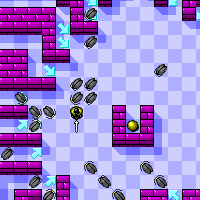
Computer Games - Deadly Rooms of Death, Architects' edition

Our hero, Beethro Budkin
This game is a gem and what's more it's free and it is only an early version of a huge collection of Deadly Rooms of Death (DROD) games.

What makes DROD so great?  It is an exploration and puzzle game with simple rules but infinite variety.

The premise is simple.  You are Beethro Budkin, a dungeon exterminator who has been hired by the king to clear his dungeons of all the monsters infesting them so that his prisoners can be tortured in conditions that pass health and safety checks.

With your specialist equipment (A really big sword), you delve into the dungeon.

Each dungeon is made up of rooms, each room being a different puzzle.  The aim of each room is to kill all of the monsters and leave the room.  Once you have completed the level, you can move on to the next one.

A room full of cockroaches.  The
yellow circle is a switch which
will open or close one or more doors.
The arrows are one way squares.
This game is not what it sounds like, however.  It is far far better.  It is a turn based game and combat is resolved by sticking your sword in a square where there's a monster.  You do this by moving or turning.  The trick to winning a combat is planning your movements and understanding the strategy of the particular monster so that they end up falling on your sword.

Cockroaches, for example, have no intelligence and head straight for you.  They will just walk into your sword.  However, goblins flee if they can see that you are close to being able to impale them and so they are more tricky monsters to kill.

The aim of each room is to kill all
of the monsters and open the
green door (bottom left).
There are other special tiles which have certain effects.  For example, there are  one way tiles, switches which open, close or toggle certain doors when you hit them with your sword (you have to experiment in order to work out the combinations of doors to open) and potions which allow you to make a mimic of Beethro which can get to places that you cannot.

Actually, there aren't too many different special objects, but they present infinite combinations and so you could make thousands of possible puzzles from these simple rules.  The Architects' edition allows you to build your own dungeons and rooms which allows you to spend several hours letting your imagination run wild.

The game has nice touches of humour, such as the introduction and the way Beethro grins when he kills something and laughs when he solves a room.  It adds nice character to the game.

As well as being addicitve and engrossing, DROD is a great maths game.  It certainly stretches your brain.  And the best part is that this is just a really old version of DROD.  There are several other  versions which you can buy and which have even more deadly rooms for you to solve.

DROD has shown me that gamebooks do not need a load a complex stats to be fun.  In fact, these stats can be distracting from the game.  My micro adventure, City of the Dead had too many stats for a 81 paragraph gamebook.  I was too intent of creating a system that covered every situation rather than an entertaining gamebook.

Fighting Fantasy books have three stats that don't even cover attributes such as the hero's intelligence, but it hasn't stopped them being hugely successful.  In fact their simplicity probably helped.  You don't need stats for everything if they are not a huge part of the story.  Instead, it is much better to be creative with what stats you have.  A good example of how this is done really well is Destiny Quest.  You only have a few stats, but you can also get lots of abilities which let you make rerolls or give you bonuses or weaken opponents which give you the great challenge of aking the correct decisions to use your abilities wisely.

Sunday, July 21, 2013

Ten adventurers I would like to have in my party

When you're going to raid another improbably located dungeon to slay the dangerous monsters to prove yourself at the top of the very loose food chain, you're going to need backup.  Here are ten adventurers who would be helpful to have along as such backup.


Youthful Knight

First, you're going to need someone who can actually get into the fray and deliver the killing blows.  This knight is swift and keen and he can kill most mooks before they have a chance to fight back.


Crossbow Infantry

There will come a point, however, when you are outnumbered and so you will need backup.  This fellow with his sharp eyes will take down any monster that dares get near you.


Steadfast Guard

What if something tries to sneak up on you in the fray?  You will need someone who can keep an eye out and be prepared to defend you no matter what.  This passionate rebel will never let you down.


Ghost Warden

Sometimes, however, you may come across something that can pack more punch than your team.  This spirit of a former companion can offer protection to you in you need it and help you slay those hulks.


Prodigal Pyromancer

Some monsters are impervious to steel which is why you will need a wizard to blast them away and clear your path.  If combat fails then this sorcerer will see the end of these monsters.


Telas Warrior

What if the dungeon is overrun and the treasure is surrounded by a horde of guards?  Instead of getting yourself killed, send in this fellow.  He is able to slip in unnoticed and escape with the loot.


Samite Healer

After the combat has calmed down, wounds will need to be attended to before the next round begins.  That is why it's always useful to have a healer on board.


Minister of Impediments

If retreat is called for then this magician can slow down the pursuers giving the gang a chance of escape.


Seeker of Skybreak

Everyone needs to rest at some time, which is why its important to have a lookout.  This alert elf can spot trouble and energise the party to stand against it.

Stonework Puma

Finally, there is nothing more dependable than a construct.  It does not need air, water, food or sleep.  It can go places that mortals fear to tread and it is without mercy.  It is a fine companion to have on such a quest.


That's ten companions that you could bring with you on a quest.  It certainly would make Firetop Mountain easier.

Until next week...


Sunday, July 14, 2013

Five more stupid decisions that you can make in gamebooks


1) Obeying the 'No weapons beyond this point' sign in Deathtrap Dungeon.


214

Walking along, you see a red line painted across the tunnel floor and notice a sign on the wall which reads: 'No weapons beyond this point'.  If you wish to abandon any weapons before continuing north, turn to 389.  If you would rather ignore this notice and carry on north, turn to 181.


You're in a dungeon full of deathtraps.  You've overcome them all to be faced by a red line and a sign.  Are you actually going to obey it?  If you do, you'll probably be killed by a ninja later on and you will deserve it. 

Chardonnay or type A?
2) Drinking Red Wine in Vault of the Vampire.

137
Drinking red wine in a Vampire's castle?  This is not red wine, this is blood, and it seems to be still warm! You spit it out in horror. Lose 1 faith point. Taking no more risks, you head for the west door. Turn to 45.


The above paragraph says it all.  If a vampire lives there and there's some red liquid, it's blood.  

You need to be
stern with yourself.
3) Trying to destroy the huge ironclad with your crystal explosive in the Masters of Darkness (Lone Wolf 12).


When you (Lone Wolf) leave to fulfil your mission of destroying some device in Helgedad that helps the Darklords survive outside of their polluted wasteland of a home, you are given three pieces of advice - never remove the amulet that helps you survive in such a hostile climate, never unsheathe the Sommerswerd unless it's to destroy Gnaag and use the crystal explosive to only destroy the device.


Now you may come across a huge ironclad, but you should not use the crystal explosive to destroy it.  For a start, it's not your mission and if you try, Joe Dever rightly kills you off.  Think about this - if you do complete your mission then do you think anyone will be in any fit state to drive the thing?  Of course not.  Think about the bigger picture or, if you can't do that, just do exactly as Banedon tells you.  

4) Using the Dark Veil ability when you confront Myurr in Dead of Night


I love Dead of Night.  It is a great book where you can get some good abilities.  One of them is the Dark Veil ability where you can make yourself invisible.  However, it comes with warnings:

However, this is a trick you have learnt from your study of Demons and so, whenever you use it, your EVIL score will increase.

And:

Be warned, too, that more powerful creatures will be able to sense the veil, though they may not see you and may even know a how to use the veil against you!


So with that in mind, when you face the Demon Prince, Myurr, would you consider him to be a powerful creature?  Of course you would.  He's a Demon Prince!  However, you still get the option of using it and if you do, this happens:


278
Though you succeed in becoming invisible, you also contrive to give yourself over to the powers of Evil one last time.  Myurr has no trouble seeing you. when he beckons you forward with a mere twitch of his finger, you find yourself compelled to obev.  Your adventure is over.

You get exactly what you deserve.  


5)  Attacking a horde of pirates in Keep of the Lich Lord


There's a load of pirates and two chaos knights.  Just don't attack them.  Get on the ship and kill the captain.  He's far easier to kill.  

Sunday, July 7, 2013

The Book That Made Me

Trollish Delver rocks!
Good day to you all!  Two posts in one day!  Surely you are being spoilt!

Anyway, I am blogging about something that Scott Malthouse brought to my attention.  It is The Book That Made Me where people can share the books that changed their lives.  I have put the press release below my links.

My book is a classic about a person yanked out of an ordinary life in order to carry a powerful artefact of doom across a magical fantasy world whilst being pursued by powerful evil creatures.  That's right - it's Talisman of Death.  My first gamebook (you weren't thinking that it wasn't a gamebook, were you?)

So, why don't you head on down to the Waterstones website and write about the book that made you.  You only need 100 words or less, so it won't take long at all.

Waterstones invites readers to share the book that inspired their life-changing moment…

The Book That Made Me…collects readers’ experiences together in order to inspire others.
How many lives have been changed by the words on a page? Waterstones recently launched a campaign with a mission: 'The Book That Made Me…', is looking for the books that have had the biggest impact on the lives of readers everywhere, including writers, politicians, actors and other high profile book lovers.

The campaign gives everyone a chance to share the story of  the book that has most affected them, offering readers the chance to keep their most treasured tale alive by sharing it with others.   

Many well-known names have contributed to 'The Book That Made Me…', with some choosing the first book that really affected them, such as author Terry Pratchett who named Kenneth Grahame's The Wind in The Willows as "the first book I remember reading for pleasure." "Once I had read it, I read everything I could get my hands on", he explained.
For others, their choice reflected the first book they personally related to. Louisa May Alcott’s Little Women offered journalist and writer Caitlin Moran a role model: "I felt I could try and be the teenage Jo March in a way I couldn't be the teenagers in Sweet Valley High. I felt far more affinity to a 19th century American bluestocking than I did with Kylie."

Some contributors honoured a story for opening their eyes to new opportunities. Newsreader Penny Smith was bound for South America after reading Peter Fleming's Brazilian Adventure: "It sent me off on two and a half years of backpacking – one of the most formative experiences of my life," she said.

Jon Woolcott, Marketing Manager at Waterstones commented on the power of books and why they wanted to ask readers about the books that shaped them: "The stories on our bookshelves don't just tell of the adventures within their pages, they reveal little glimpses of who we - the readers - are. They represent different times in our lives; different interests, different hopes and dreams - what drew us in at the time.

"Now, here at Waterstones, we think it's time we all placed our most life-changing books on one big bookshelf, along with the reasons why they're so affecting, for everyone to share."  

Members of the public are invited to submit the name and title of their favourite book and explain how it affected their lives. Waterstones will feature their favourite responses both in their bookshops and in an online gallery.

Jon Woolcott noted that “often, the best books are the ones that bring a little magic to our everyday lives,” and for novelist Ben Kane, one book did just that: "Tolkien's The Lord of The Rings was the story that shaped my childhood and teenage years. More than any other book, it drew me away from ordinary life, into an incredible world where anything seemed possible."

Everyone is invited to share their story, either by going online or into one of Waterstones' bookshops, and become part of an on-going journey of revelation, adventure and life-changing experiences.