Showing posts with label andrew wright. Show all posts

Friday, March 4, 2011

What's going down?

Ok, I admit, I said I would update weekly, but there has been a lot of fab new stuff this week, so I will blog the news today and then write about Fabled Lands on Sunday.

Competitions


Wayne Densley at the Chronicles of Arborell has released the guidelines for the 2011 Windhammer Prize.  

I love the Windhammer Prize for several reasons.  First of all, it helped reignite my love of gamebooks.  I entered the first one in 2008 because I had some spare time. However, after receiving feedback from readers, I realised that people are interested in gamebooks.  

I now believe that my first attempts at writing gamebooks were not good.  Determined to make my system fair, I forgot about description, cool items, characterisation and storyline.  Thanks to Windhammer, I got feedback on what I need to improve on as well as a good idea about what people like by reading the winning entries.  

I took their feedback on board and became determined to make sure my gamebooks were better, which led to Sharkbait's Revenge.  

All the previous entries are here   including my first two attempts at the competition.  

You have until September 7th to submit a 100 paragraph gamebook which is no longer than 40 pages.  I would love for as many people to enter as I always like reading these new gamebooks as they are always of high quality and innovative.  


I heard about this competition thanks to the Grognardia blog.  It looks really interesting and I'd like to give it a shot.  The guidelines for the competition, along with the previous entries, are here.

Gamebook releases


Catacombs of the Undercity is now available from iTunes (since when was it OK for names to not start with a capital letter?).  The book is written by Andrew Wright (whose names do start with capital letters), writer of the Fantasy Gamebook Blog.  Give the blog a good read and buy the app.


I have received my copy of Destiny Quest and look forward to getting stuck into it this weekend.  

Blogosphere stuff

Jonathan Green answers all the questions from his fans in a new vlog.

After having a twitter account for ages, I've decided to do some tweeting.  My Twitter page is

I'll see you on Sunday!  :).

Wednesday, February 23, 2011

What microadventures taught me - don't be a waste of space - addendum

I've just thought of a few other ways of creating an intresting and immersive gamebook which challenges the player even if it is over a small number of paragraphs.  This is by turning random choices into decisions.

Most gamebooks have some ultimate aim in order for you to win (Fabled Lands is an exception.  You decide what your criteria for success are and there is no 'winning' end).

However, most of the time, you have no idea on how to achieve that aim and you do not receive any direction from the book.  It becomes a matter of random choices or trial and error.  And if your success or failure depends on random trial and error then losing is going to feel very grating.   

For example, in Temple of Terror, you are given the opportunity at the beginning of paying for passage on a barge to Port Blacksand or travelling by foot.  If you go by foot, you've lost.  Really.  There's an item that you need in Port Blacksand that you need in order to trade it later on for a vital item.  How were you supposed to know that?  You weren't.  You just read through the whole book, not knowing that your were going to die towards the end because of something you did right at the beginning.  You didn't enjoy spending all that time losing?  Suck it up, princess.


Now drop and give me 399
'cos you aint good enough
to get to 400.

I was being a bit harsh there, and so was the book.  So how can you turn seemingly random choices like that into informed decisions that stretch your abilities so that at least if you do win or lose, the responsibility is yours alone.  Victory will be sweeter because it was you who did it.

So how can we turn these seemingly random choices into informed decisions?

Maps

It comes in handy but
having a maze with a
map of it at the entrance
kind of defeats the point of it.
All those arbitrary decisions of 'East or west?' can be made less arbitrary if you have a map at the beginning of the book.  That way, you have some idea about where you need to go.  Want to go to a village?  Go south.  Want to go to a castle?  Go west.  It is also useful in Spectral Stalkers. 

Too many dungeon crawls have similar corridors and identical doors which give no indication of whether you will be successful by taking them.  In its most frustrating form, taking random doors can lead to sudden death paragraphs.  Not very enjoyable.

Of course you don't know exactly what will happen at the locations on the map, but having a map makes the decisions less random and of course, going to random places is fine if the success of the hero does not depend on it.


Have puzzles

This is the game from Curse of the Mummy. 
What's the winning move?
Having a puzzle on a paragraph means that you have to make a series of decisions on what the solution is.  This gets a lot of milage out of one paragraph. 

However, I have come across puzzles where I have had to work out the number of a paragraph, hit a brick wall and got very frustrated about it (I'm looking at you, Tower of Destruction)! 

To make it easier, it could be a multiple choice puzzle or, if it does involve finding out which paragraph to turn to, make the solution paragraph obvious so that I can flick through the book and work out where it is. 

The devil is in the detail
Either he's an imposter or he's still
bitter about that time you put dog
poo in his lunch.

Some choices that may seem random are not actually random if you look at the details in the text or in the illustrations.  For example in Siege of Sardath, you come across Sorrel, one of your best friends.  He taught you archery, tracking and how to respect the forest and you taught him swordplay (bit of a bum deal for him if you ask me) and the text tells you that he has a scar on his right eye as a testament to this (I've never scarred my right eye as a testament to my friendship with someone.  Obviously, I'm not a good friend). 

The illustration opposite goes with the paragraph.  Notice anything out of place?

Another example is in Andrew Wrights microadventure, Debacle at Dead Mans' Inn.  At the end of the book, you have to decide which of the villagers is a shape shifter.  You are given a brief description of each villager.  All I'm going to say is that you need to read the descriptions of the villagers before you see them then.


So there are some more ways on getting more milage out of gamebook paragraphs.  A lot of the above ideas will be needed to make micro adventures more substantial but they will also work for longer adventures too and this means that there will be more space for plot and more encounters.

If you have any other ways of making a short adventure more substantial, please post it in the comments box. 

Blog updates
I am really getting sucked into this blogging thing.  I have several posts written and ready to post, but I need to slow down.  I'm finding it very easy to just spend all of my time surfing the blogosphere and writing posts about gamebooks.  I'm loving it and I'm getting a lot out of it, but there is one small problem.
I'm not writing any gamebooks.
I need to make time to actually write some gamebooks, so I'm going to limit this blog to one post a week.  I aim to post on a Sunday morning (GMT) from now on.  My next post will be about narrative in microadventures and then I will be writing about Fabled Lands.  And then I will also write some more gamebooks.  The posts will be less frequent but they will be more regular. 
Thankyou all for all of your attention so far!  Please keep in touch and tell your friends about this blog! 
Have a lovely day.

 

Wednesday, February 16, 2011

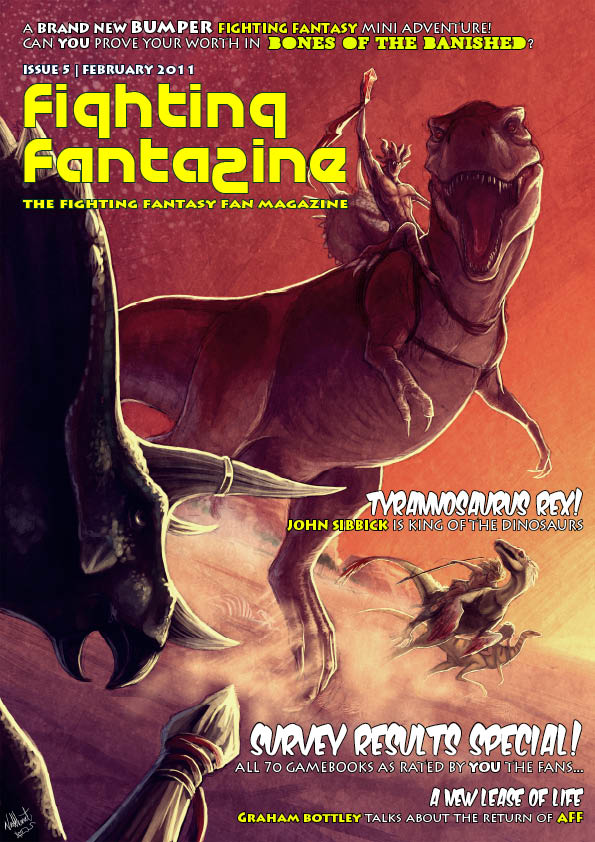
Fighting Fantazine issue 5 is out!

If you have not seen Andrew Wrights blog,

1)  Why not?
2)  You may have missed the news that Fighting Fantazine issue 5 is out! 

Below is Andrew's post describing what is in this great issue.


Editor Alex Ballingall has really been burning the midnight oil putting this incredible package together! Among the many amazing features included inside its bumper 104 pages:
  • An astounding cover by Natalie Roberts.
  • An interview with John Sibbick, illustrator for Fighting Fantasy, Games Workshop, and many excellent dinosaur and extinct prehistoric animal books. Includes never-before-seen pencil roughs of some classic FF book covers.
  • Bones of the Banished - a 274 paragraph Fighting Fantasy adventure written and illustrated by Brett "Jediboyy" Schofield. Brilliant stuff!
  • Results from the previous Fighting Fantazine survey, including extensive essays on the ten best Fighting Fantasy gamebooks. (I've contributed a piece on Steve Jackson's Creature of Havoc).
  • An interview with Graham Bottley, writer of the revised Advanced Fighting Fantasy RPG system, due for publication soon by Arion Games.
  • Guillermo Paredes' Omens and Auguries, featuring all the latest gamebook news.
  • Jamie Fry gatecrashes the lair of notorious Fighting Fantasy author Ian Livingstone.
  • Dan Satherly attempts the infamous Sky Lord by Martin Allen - the final science-fiction adventure in the Fighting Fantasy series.
  • Part 2 of the Adventure Game series, where yours truly talks about how to plan the structure of your own Fighting Fantasy adventure.
I have written one of the essays - I wrote about Moonrunner.  I liked it from the start but after going through it in depth in order to write the essay about it, I liked it a whole lot more.  I love the atmosphere of the book and I think that Karam Gruul is a great villain.

You can download issue 5 from here. The main website can be found here.

Enjoy!

Coming soon - What writing 25 paragraph microadventures has taught me.

Thursday, January 27, 2011

Future projects

They say that imitation is the highest form of flattery, and I am flattering Andrew Wright by making a post about future projects on this blog. 

Telling you all about it will motivate me to do these posts as well. 

Please please give me feedback in the comments section.  I would love to hear from my followers about what you want to read about.

You Adventure ends here

I intend to finish this series off with a post about how death paragraphs reveal information, a few of my personal favourite failures and then a conclusion.  So three more posts of this.

Codewords

When shoud we use them?

What should they be?

Do we have any neat tricks we can do with codewords?  (I'm looking at you, Crimson Tide)

Handling stupid decisions in gamebooks

What constitutes a stupid decision, why you should offer them and what the consequences of them should be.

Wounds and healing

How deadly should your wounds be?  Should food and water provide healing or should it be a long hard process to recover?  How deadly should combat be? 

Mass battles in gamebooks

What systems have been used and how should they be handled?

Gods and priests in gamebooks

What are your gods like?  What role do priests play in your world?  How are they different from sorcerers with a sense of morality?

Money and shopping in gamebooks

How important should it be?  What can be bought and sold in gamebooks?  What other things can money buy?  How many currencies should you have?  Should you have it so they hero never has enough money?

Food and water in gamebooks

Should it heal?

Should hunger and thirst cause damage?

Generic meals or named food?

Revealed information in gamebooks

What are the good points and bad points of showing a reader that something different will happen if they have an item or codeword? 

How are programs which don't reveal this information play differently?

Should gamebooks tell you how you feel?

Description or emotions?  How does it affect your character?  How does it affect the game?

Skills and abilities in gamebooks

What skills and abilities add to a gamebook.  What they take away.  How to make sure you have a balance of character creation choices vs choices in the book.

The level of magic in gamebooks

What magic items are available?  Can you buy them like food or are they rare and well hidden?  How many magical monsters or magic wielders do you come across in the book?  Does your level of magic fit the leevl of the rest of the book?    What kind of spell systems could you have?

Items in gamebooks

How items can be used.  How they shouldn't be used.  When do you have too many items?  Would an encumbrance system help?

Morality in gamebooks

What does having a sense of morality in gamebooks add to the gamebook?  How can you enforce that morality?

What writing microadventures taught me

It's amazing what a 25 paragraph gamebook can do.

Amateur gamebooks, gamebook programs and games that read like gamebooks

A list of wonderful things I have found online. 

So there you go.  Please leave feedback about the blog as a comment so far and tell your friends!

Something to look out for.

Fighting Fantazine issue 5 will be out soon.  Don't miss it!

And finally...

I like cats.  I also found this blog about a cat, which has 180 followers.  So here is a picture of a cute cat. 


If you like cats and H.P. Lovecraft, I recommend The Cats of Ulthar, a short story by Lovecraft which I enjoyed.

Thursday, January 20, 2011

Your adventure ends here...go to 14. What?

Here's a death paragraph from The Den of Dragons by J.H Brennan.  It is the second Grailquest book.


48

You enter the cottage and the entire place caves in on top of you.  It's no fun being an adventurere sometimes, Pip. 

Go to 14.

Why I like this paragraph

This death paragraph breaks the fourth wall.  If a gamebook breaks the fourth wall, it is usually in a death paragraph or to tell you that you are a cheat.  However, Grailquest does this a lot.

The main reason why I like this death paragraph is that it reminds you that death is not the end.  In all Grailquest books, 14 is the paragraph that you go to when you are dead, which sounds a bit wierd.  What do you need to do when you are dead?  A lot, it turns out.

On paragraph 14, you wake up in Merlin's home.  In the Den of Dragons, it's a crystal cave.  He then tells
 you to reroll and enter the village again.  Here we have a lot more personable death than a full stop.

How did I get into this mess?

I started the game in a village where I turn to a paragraph if I want to enter a particular building.  I enter this building and it collpases on me.  On my head be it.

What have I learnt from this

Death is not the end.  It can be very useful.  I'm not sure, but in this case I think I get to keep equipment and I'm also forewarned.

Another useful feature of haveing death not being the end is that you can have 'save points' in the book.  Talisman of Death by Jamie Thomson and Mark Smith allows you to restart the book at a particular point depending on where you were killed.  If you were killed in the Greyguilds (a city), you go back to (Almost) the beginning.  If you were killed outside the Greyguids, then you return to the point where you have just left the Greyguilds.  This doesn't happen in all cases, such as dying in combat or if you die as a result of one of Death's minions, but it helps in this situation.


292

A spray of brightly coloured light speeds from Thaum's hands into your eyes, dazzling you.  Cassandra stabs you neatly in the heart as Tyutchev cleaves your head from your shoulders.  Turn to 109.

This is the first death paragraph that a seven year old me read.  It seems apparent that Thaum, Cassandra and Tyutchev do a pretty good job of killing you, so I was quite surprised to be able to turn to another paragraph.  Paragraph 109 tells you that as your spirit floats gently towards the Valley of Death, the gods that summoned you offer you the chance to be returned to life and try again. 

Other death paragraphs

My death paragraph collection is not a completely original idea.  I remember reading several death paragraphs on a website.  I couldn't remember what it was, so I fired a message on the Titan Rebuilding Yahoo Group.  Andrew Wright, who has a great gamebook blog provided me with the answer. 

The page is on the Black Tower website, archived at http://www.ffproject.com/download.htm.  It can also be found here.


Saturday, January 8, 2011

Happy new year!

Happy new year!

I have been neglecting the blog recently - december is both a hectic and a tiring time for me at work and  then there are all the holidays.  However, I am now refreshed and relaxed.  You could say that my stamina has been replenished. 

However, I have been working quietly away and keeping my finger on the pulse. 

First of all, there is a new gamebook blog, written by Andrew Wright who has also written tons of great gamebooks which you can find on http://www.ffproject.com/download.htm.

The blog can be found on:

http://fantasygamebook.blogspot.com/

http://fantasygamebook.wordpress.com/

http://fantasygamebook.livejournal.com/

It has only been active for a short time, but it already contians several well written posts with references for further reading.  In fact, it was Andrew's post about gamebook blogs that has inspired this post as it showed me that people are taking notice that I haven't updated yet. 

So read it - it is really informative.  Andrew's latest posts contain a great review of Heart of Ice, a gamebook by Dave Morris.  You can find it on his blog for free (it is half way down the page).  I'm ashamed to say that I haven't read it yet, but I am putting it on the top of my list.

Secondly, it was announced that Advanced Fighting Fantasy (AFF) is being revised, re-written and reorganised by Arion games.  It is due to be released in Spring 2011.  The website for the new Advanced Fighting Fantasy is here:  http://www.arion-games.com/AFF.html.

I am looking forward to it.  I have the AFF gamebooks and I enjoyed the unique way in which it was presented.  Adventures were presented as films with scenes, characters and props.  The approach did not take itself too seriously, either, which I enjoyed.  It made the book an entertaining read for the director while they were planning an adventure.

The side of me that was all about games mechanics noticed a few things though (and when I was younger, I went through a phase that was all about games mechanics.  Sometimes I would scan gamebook paragraphs to see if I needed to changed stats or gain an item and jsut ignored all the lovely description that the author had gone to lots of trouble to write - sorry!).

First of all the old problem of having a skill range between 7 and 12 was exacerbated by the rule that every point in skill you had allowed you to pick a point in a special skill. 

The value of that special skill was your skill + the number of points you had allocated to that skill (maximum 4).

This means that a skill 7 character had 7 points to use and the maximum value they could have was 11.

A skill 12 person had 12 points to use and the maximum value they could have was 16.  The minumum value they could have was 13.

So a skill 12 character could have 12 special skills with a value of 13, while a skill 7 character could have a value of 11 for their best skill and only 3 points left to spend. 

I also think that there needs to be clarification on what the skills do and how balanced the skills are.  Some skills overlap with others.

The scouting skill allowed you to sneak and hide outdoors.  However, there was already a sneak and hide skill.

The heavy armoured combat skill which allowed you to fight in heavy armour.  However, there were no rules for what heavy armour did.

There was a battle combat skill and siege combat skill which allowed the character to fight well in a mass battle and siege.  What did that mean exactly? 

Excellent vision and excellent hearing are both  self explanatory, but there is also an awareness skill which allows the character to detect anything. 

The strength skill allowed you to increase the damage you inflict in combat by 1 - I'll have that one!  Heal allowed you to restore other peoples' stamina. 

The magic system also needs tidying up.  There was a priest magic list and a sorcerer magic list.  However, they were too similar.  Priests had offensive spells and sorcerers had healing spells.  Priests had to follow a moral code of their god or be excommunicated and lose the chance to learn more spells. They only had a few spells that sorcerers did not have.  Sorcerers, on the other hand, could do what they liked and had lots of spells that priests could not access.

I just read what I wrote and realised that I was sounding a bit down on AFF.  I enjoyed reading the books immensly.  I was never able to find a group to play with, but I'm sure I would have liked it.  These issues are easily tidied up and I look forward to the new releases!

I am working on my post about endings in gamebooks which are a result of bad choices (I really wanted to say bad endings there, but that would be ambiguous).  However, I am getting sucked in to reading a lot of endings.  A lot of them are very entertaining.