Sunday, July 24, 2011

Fabled Lands RPG review

The first of many  Fabled Lands source books has been released.  This one concerns the rules for character creation and role playing.  It also has details on the city of Yellowport, the sulphur choked city that most players of the original solo gamebook series would find themselves in.

The RPG introduces new rules to the system that the gamebooks never had.  There are two new characteristics - muscle and intelligence, two new classes, skills (abilities that all characters could possess), powers (abilities that only players of certain classes could possess), rules for multiclassing and spell lists.


The system still retains its simplicity whilst being incredibly versatile in terms of character creation.  Since its world is based on the sandbox gamebook series, the flavour of the classes and the description of many aspects of the Fabled Lands - its history, its geography, its religions, its animals and monsters and its civilisations - are all immensely detailed.  Finally, it contains an in depth look at Yellowport and some of its personalities.  Hopefully, these descriptions of this rich and varied lands that is the Fabled Lands will continue in its future sourcebooks.


Fabled Lands gamebooks


Fabled Lands was a series of gamebooks written by Dave Morris and Jamie Thompson.  The idea behind the books was to create what is now known as a sandbox  setting.  Twelve gamebooks were planned but only six were published.

However, the gamebooks have enjoyed a resurgence in popularity with beautifully designed apps, reprints of the first four books and now an RPG version.  Now, Greywood Publishing plan on releasing a sourcebook for each of the twelve Fabled Lands books with the Sokara (the land from book 1) book out in September and the Golnir (the land from book 2) book out in December.

Ease of Reading


A sample page from
Order of the Eternal Knight
I found the sourcebook a very easy and interesting read.  Game information is presented in a clear systematic way so it is pretty easy to find on a page.  The contents page is very detailed, listing all of the headings in the book, so it is easy to see what the chapter is about.  It is also easy to see which chapters you may want to miss out if you are anxious to start a game and don't want to read what the setting is all about.

The game rules are very simple but they are still very well explained and examples are given for combat (the only vaguely complicated part of the rules.)  Those of us who have already read the Fabled Lands gamebooks will already have a good knowledge of the background of Harkuna and the basic rules.  You will just need to learn the new rules made for the RPG.  Also, those of us who have used a D20 system  will find some skills and rules familiar.  Those of use who have read both could start up a quest or two in next to no time.

One of the cons in the books is that it uses terms before they are defined and  that it lacks an index or glossary for you to look them up.
This means that you will have to read all of the rules before you get a good idea of how they work.

Aesthetics


The map of Harkuna (it is black and white in the source book)
This is taken from the Fabled Lands Blog.


I'm the sort of person who just wants to get the information, but aesthetics are important to a book, so I will give my inexpert opinion.  The book itself is about the size and shape of A4 (it is a bit shorter and a bit wider.)  It is softback with a colour illustration on the cover and black and white illustrations inside.  There are a few full page illustrations of scenes in rooms and bits of buildings.  There are plenty of smaller illustrations though, including pictures of a member of each profession, a picture of each monster (unfortunately, they are behind their description so we can't see them in their full glory) and other scenes.  I prefer the sketches to the computer generated images, but that's a              personal preference.

The double page map (above) is both very detailed and very pretty to look at.  I enjoy looking at maps, especially world maps and I thought this was the best piece of art in the book.


Now I will go through the chapters of the book and what they cover.

Chapter 1 - Character Creation

A character sheet
Character creation is a five step process:

1)  Choose your character's background.

There are several backgrounds that you can choose from with a short description of what your life was like in that particular background.

Choosing your background gives you access to a skill or some equipment or money.

2)  Generate your character's description.

Here you randomly generate the physical description of your character - age, height and build.  Extreme values have a small effect on your stats.  For example, being extremely small gives you +1 on hiding tests and -1 on jumping tests.

You also have a good and bad personality trait to prevent you character being a set of numbers on a page.  Role playing to them gets you extra experience points.

3)  Generate your character's ability values.

The abilities you have in Fabled Lands are:  Charisma, Combat, Intelligence, Magic, Muscle, Sanctity, Scouting and Thievery.

Those who have played with the Fabled Lands system will be familiar with all of the abilities apart from intelligence and muscle which sound quite self explanatory.

Your stats are determined by rolling eight six sided dice and assigning a value to each of your abilites.  You may re-roll if the total value of the dice is less than 20.

4)  Generate your character's stamina value.

Roll 1d6 and add 6.  This is your character's stamina value.  If it reaches 0 or less then every round, the character must roll 1 die.  On the roll of a 1, they die.

5)  Choose a profession.

There are now eight professions in the Fabled Lands RPG.  Each one has a primary ability assigned to them.  That is, you can only be part of the profession if that ability is 5 or higher.  The professions with their primary ability values in brackets are - barbarian (muscle), druid (intelligence), mage (magic), priest (sanctity), rogue (thievery), troubador (charisma), warrior (combat) and wayfarer (scouting).

Professions get a range of skills that they can choose from and a list of powers that are unique to each class.

The professions are flavourful and there is a description of how they fit into the Fabled Lands.  This is better than having a generic fighter.

Making a character is quite a quick, simple but versatile and flavourful process.  It is made more versatile by the fact that when you advance rank, you can either get a new power or train in a new ability.  You also get more skill points and you could also take up a new profession.

Chapter 2 - Skills

Those of us who have played D20 will find this chapter very familiar.  There is a list of 30 skills, the ability they require and the professions that make use of them.  There are simple modifier tables for the skills.

The skills section is quite simple and straightforward in the description and mechanics of the skills.

Chapter 3 - Spells and sorcerers


In the Fabled Lands gamebooks, you did not have to choose from a list of spells.  Instead, you were given the option of using your magic skill in the sections of the book.

The RPG has produced eighteen schools of magic, each with three spells although the number of schools and the number of spells in a school can always be increased.  Some of the schools of magic are:  aeromancy, beastology, divination, healing and telepathy.

Spells are cast by performing a test against magic with a difficulty set by the spell.  You can expand on some spells such as the duration or the number of people that they can effect if you increase the difficulty needed to cast the spell.  However, you cannot  cast a spell with a difficulty higher than 10 + your rank

Chapter 4 - Equipment

Here, you find a list of weapons (both ranged and close combat.)  Each weapon is given a combat bonus value, a cost an encumbrance value and its type (is it basic or military - some professions are only trained in basic weapons.)  Ranged weapons are given a short, medium and long range.

Chapter 5 - Combat


Combat is quite simple to learn.  You roll 2d6, add it to your combat value then subtract your opponent's defence value to calculate how much damage you have done.  This was how it was done in the gamebooks.

There are some additions to combat rules in the RPG.  Every combatant now has a strike value which is determined by rolling 2d6 and applying modifiers (for example, small light weapons increase strike value whilst large cumbersome ones decrease it.)
This is the order of who takes their actions.

Each combatant also has a number of action points (usually 2) per round.  The chapter then describes some actions and how many action points they cost.  All of the actions are pretty standard and anyone familiar with D20 combat will recognise a great deal.  For example, moving costs 1 action point, striking costs 1 action point and charging costs 2 action points.


Chapter 6 - Deities and religion


Here you will find a description of the Gods of Harkuna, how you become and initiate into their religion and the powers that priests of each particular god can obtain.

Chapter 7 - City services

This short chapter gives you the details involved in buying, maintaining, manning and sailing the different types of boats and the ins and outs of being a merchant - the price fluctuations of cargo and the elements of banking, investments and buying a house.

These rules are similar to the rules in the Fabled Lands gamebooks, but they are more detailed so, as with the rest of the rules, even if you know the gamebook rules well, it will do you good to read the RPG rules.

Chapter 8 - Harkuna

One of the great strengths of Fabled Lands is the detailed World in which it takes place.  This had to be created due to the fact that the premise of the gamebooks was that you could explore every corner of Harkuna.

I admit that I'm the sort of person who cares more for gameplay and stats than the mythos of a fantasy world. However, I found reading about the history and geography of the Fabled Lands very fulfilling.  The world map in this chapter is extremely detailed and well drawn.  The descriptions of the different countries are very informative and evocative.

Chapter 9 - For the gamesmaster

Once again the writers of the Fabled Lands RPG make it clear that they haven't created it for 'roll playing' and bog standard dungeon crawls, but that the gamesmaster should be there to bring the world to life.  There are tips on creating a quest and story telling which will help do this.

The chapter then goes into awarding experience and common situations such as listening, bargaining and eating.    Situations have a difficulty rating set to them which the gamesmaster can use as a guideline.  There are also rules for weather and sea travel in case the players want to take up being merchants or want to explore the Violet Ocean.

At the end of the chapter, there is an in depth description of the city of Yellowport complete with statistics of important personalities who live there.  I anticipate that the Sokara sourcebook comes out

Chapter 10 - Monsters and enemies

Harkuna is a human centric world where intelligent non humans such as faerie inhabit out of the way places.  The book does not encourage any race but human for the PCs (it does not give any option to have a non human character in the character creation chapter) but it does give stats for several faerie folk which a smart DM can extrapolate from (however, this will not be in keeping with the flavour of the Fabled Lands)


Each monster is given a threat level, but the book points out that it is to only compare the monsters with each other as different characters with different powers will find different monsters challenging.

The chapter contains some Fabled Lands favourites such as the Scorpion Man and the Ratman.  It also mentions that ghouls can be repelled with a mixture of iron and salt (a reference to the quest in The War Torn Kingdom.)

Appendix - Lair of the Ratmen

This is a short quest adapted from a quest in The War Torn Kingdom where the characters have to descend into the sewers in Yellowport to kill the king of the Ratmen because they are stealing from the merchants' guild.  It is a good example of how a quest could look.

Conclusion


The Fabled Lands RPG is simple, versatile and easy to learn with good explanations of rules.  It gives you everything you need to start a simple quest.  If you have read the Fabled Lands gamebooks, you could use these rules to adapt some scenarios from the gamebooks in order to run as RPG quests.  This could keep you going until September when the Sokara sourcebook (based on The War Torn Kingdom) is released.  I am looking forward to it as I enjoy reading about the world of Harkuna.  I believe the reason why I like this world so much is because I could actually go to every obscure corner of it in the gamebook.  Fabled Lands has plenty of source material to work from and it can be used to create endless quests.

You can buy all of the new Fabled Lands products from Greywood Publishing or from Amazon.

For more news on Fabled Lands, you can visit the blog, here.

Feedback


This is the second review of an RPG sourcebook and I intend to review the Lone Wolf RPG in the future.  Please tell me if I have missed something out, or written too much.  Should I go through every chapter?  Should I list good and bad points?  What do you look for in an RPG review?

Also, what do you look for in a gamebook review?

Please leave a comment.  I like comments :).

Saturday, July 23, 2011

Want to find treasure in the jungle of the World Wide Web? Follow the Amazon.

I've found a few things that us gamebook lovers might find interesting on Amazon.


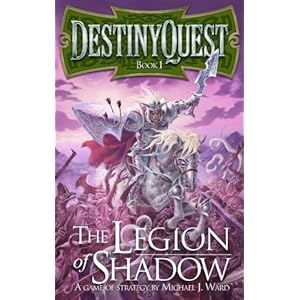
First of all, if you haven't seen my earlier post, Destiny Quest fans out there will be pleased to know that there will be a new edition of Destiny Quest:  Legion of Shadow to be released in March 2012, possibly with new material.  We will also get Destiny Quest 2:  Heart of Fire in September 2012.  Woohoo!  

If you haven't heard of Destiny Quest, you need to. Get on down to its website to check it out.


Kindle gamebooks

Gamebooks are spreading all over electronic media at the moment.  first of all Worldweaver are making Kindle versions of Lone Wolf and Fighting Fantasy gamebooks.

I have also found loads of Choose Your Own Adventure gamebooks for the Kindle and lots of other gamebooks when I searched for gamebook on the kindle.  

So enjoy all of these new additions to the gamebook family and happy reading!

Tomorrow, I'll release a review of the Fabled Lands RPG.  


Sunday, July 17, 2011

Reviews using my gamebook player types system

In this post, I will review four gamebooks using my gamebook player system.  Three are very old and very well known and the fourth is Destiny Quest, which I reviewed in May.  Please comment if you have an improvement for the system or if you think that I have left something out.

The Warlock of Firetop Mountain

Explorer appeal


There are plenty of places to visit and you can choose to attack or not attack some of the denizens.  The maze after the river is a black mark against it as since there is very little that is actually interesting in the maze, it does not count as explorer appeal.

5/10

Puzzle solver appeal


A lot of the problems you come across cannot be solved and have to overcome with trial and error.  There is no clue as to which keys to the warlock's chest are the correct keys.  You have no idea which lever to the portcullis is correct or whether or not you should look at the paintings.

0/10

Champion appeal


Since you can only use gold pieces once, the amount of gold you get in this book is more of a measure of success than a useful item.  There are also items that boost your stats such as a magic sword (that adds to your initial skill but only if you leave your old sword behind) and an iron helm (that adds to your attack strength).  It is not too difficult to kill Zagor if you know the secret, but it is far more difficult to get the treasure.

6/10

Storyteller appeal

There's not much narrative, character development or character interaction.

2/10

Fabled Lands - The War Torn Kingdom

Explorer appeal

You get a huge place to travel around.  You can either side with or try to kill the King and it links in with five other books (and potentially eleven)

10/10

Puzzle solver appeal

There is an overall strategy that you can develop to do well at Fabled Lands, but there are no actual puzzles in the book.

7/10


Edit:  I originally put 5 but I think 5 was a little harsh for this so I've changed it to 7.

Champion appeal

You can measure your success by your level, your stats, the amount of money you have, your titles, the number of quests you have completed, the number of codewords you have and a hundred other things.  There's just no overall victory.

9/10

Storyteller appeal

There are a few stories such as the war between the king and his deposer, what happens to a thief you meet in Yellowport, a secret that a scorpian man shaman has but no overaching plot.  There are plenty of characters, but none are too deep.

7/10


Explorer appeal


Your aim is to cross the enemy countryside to get to your capital city and you can make many choices in which direction to take.  You meet a lot of interesting characters and explore quite a few places.  In addition, you are given the option of doing very unheroic things such as running away when innocents are in danger.

7/10

Puzzle solver appeal


I couldn't see any puzzles in the book.

0/10

Champion appeal


You cannot increase your stats and most of the items you get are mundane weapons, food or money.  You get to improve your character by picking a new skill in the next book.  Most of the champion appeal happens over the whole series.

6/10

Storyteller appeal

The Lone Wolf series' strength is its storytelling.  The world is immersive and detailed.  The prose is full of action and descriptive.  However, you are forced along a particular storyline.

10/10


Explorer appeal


You pick a location on a map and then go to it to see what happens.  This very open ended format gives you lots of choice.  Also, every combat you fight involves lots of decisions.  In some of the quests, you can choose to take sides which provides variety.  However, the consequences of such decisions are usually very similar.

8/10

Puzzle solver appeal


There are some numerical puzzles, but most of the puzzle solving involves working out the best way to defeat each opponent.

10/10

Champion appeal


The whole point of the game is getting the best character.  This has great appeal to champions.

9/10

Storyteller appeal


You are in a very immersing world with great characters.  However, the story has the same general path and ending despite your choices.

6/10

Wednesday, July 13, 2011

Something's up in the Land of Destiny Quest

So I was looking up Destiny Quest on Amazon to see how many people had found my review of this great gamebook helpful (incidently, it was 3 out of 4 but that's not the big thing here.)

The interesting thing is that if you search for DestinyQuest on Amazon, you will get more than The Legion of Shadow, released Feb 2010.

You also get The Legion of Shadow to be released on March 2012.

So there's a second edition coming out?  What could this mean?

Michael has said in an interview that he originally wanted Destiny Quest to be a four act book.  He has also posted new quests on his website as a kind of expansion pack.  Is Michael deciding to put all of these extra materials into one big bumper gamebook?

But that's not all.  There is another release in the Destiny Quest range and that is Heart of Fire:  Destiny Quest Book 2.  Amazon says that it is set to release in September 2012.

This is great news.  Destiny Quest has received rave reviews (see below) from many blogs and magazines, including this one and this is a sign that there is loads more good stuff to come.

So we have something to look forward.  At the moment, we can only speculate about what is to come...

Here is the Destiny Quest official website:  http://www.destiny-quest.com/

Here are some reviews of Destiny Quest:

http://www.amazon.co.uk/product-reviews/1848765428

http://grindingtovalhalla.wordpress.com/2011/05/26/reading-the-text-an-interview-with-michael-j-ward/

http://trollishdelver.blogspot.com/2011/04/destiny-quest-is-paper-mmo.html

http://realmofzhu.blogspot.com/2011/04/destiny-quest-1-shadow-legion.html

Here are some interviews with Michael J. Ward, creator of Destiny Quest:

http://fantasygamebook.blogspot.com/2011/02/destinyquest-interview.html

http://www.ukroleplayers.com/columns/james-grimes/michael-j-ward-interview/

I have become so excited by it, that I have made a vlog about it too:

Sunday, July 10, 2011

Gamebook player types


In my attempt to work out what players want from gamebooks, I'm going to research some RPG players types, apply them to gamebooks and come up with a set of gamebook player archetypes.

My first stop off point was the fount of all knowledge that it www.tvtropes.org.  It has a list of player archetypes for pretty much any game you can think of.  I took the ones from 4th Edition Dungeons and Dragons.


The Dungeon Master's Guide for Dungeons & Dragons Fourth Edition identifies eight player types:


  • The Actor, who has fun by developing and acting out a fictional character

This archetype sounds like they would rather perform deeds and interact with characters in a gamebook rather than collect items and slay beasts.  The developing part implies that the actor would like their character to go through changes over the time they play them.  To me, gamebooks that would appeal to the actor would be the Lone Wolf series, The Crimson Tide (where you play a teenager over a period of years) and Night of the Necromancer (where you play a ghost and discover new powers as well as trying to interact with others as a ghost)

  • The Explorer, who has fun by immersing in a large and detailed fictional world

Fabled Lands is perfect for  this archetype.  Destiny Quest is also a good choice for the explorer as you are given a large area and you can choose where to go.  The Sorcery! series would also be a good option as you travel over a large area and meet many new people.  All gamebooks cater to an explorer to a degree, but the best ones would be a sandbox style gamebook where you can travel anywhere over a large area.

  • The Instigator, who has fun by making something happen, regardless of if it would be logical or in-character.

The Instigator would like gamebooks where they are given lots of different choices when they meet a character.  City of Thieves is a good example, as when you meet someone you either have the choice of talking to them or attacking them, which allows very different consequences.  The number of different actions you are  allowed to take in a gamebook, however is limited by the number of paragraphs and gamebboks with a big mission usually have death as a consequence of doing something radical (such as using the crystal charge to blow up the ironclad ship in Masters of Darkness, where you have to use it at the end).

  • The Power Gamer, who has fun by Min Maxing a powerful character

Any gamebook system with lots of stats which can be manipulated many ways will appeal to the power gamer.  Destiny Quest is a power gamer's dream as you can choose several careers and then find the items that are optimum for those careers.  Fabled Lands could also be good for a power gamer as you could use items that maximise your abilities for your profession.  


  • The Slayer, who has fun by killing things in combat encounters

Most gamebooks would be able to cater to the slayer's needs by adding options of attacking people as well as talking to them or killing guards instead of trying to sneak by them.  It would also help to have lots of combat based items which will aid the slayer in getting a high body count.  Warlock of Firetop Mountain is good with this as you have the option of attacking pretty much everyone except for the sleeping guard at the entrance.  We need an option to attack him.

On a side note, I had a slayer phase when I used to set myself a 'lets see how many monsters I can kill' challenge when I played gamebooks and I would attack monsters even if it were just a hindrance.    

  • The Storyteller, who has fun when the game sessions tell a continuous and engaging story

There are two ways that a storyteller can have a session with a gamebook which tells a continuing and engaging story.  The first is if the gamebook itself tells the story, in which case The Lone Wolf series is the best choice for this storyteller.  The other way is if the storyteller makes up their own story from what the character does in the gamebook.  This requires a lot more effort as you are writing a story as well as playing a gamebook, but it would be good is it would be your story.  Any gamebook would fit the second type.
  • The Thinker, who has fun by solving challenges through strategy and planning

Gamebooks can have plenty of material for a thinker.  They could have puzzles or a situation where they know what is coming and so they can serach an area for an item they need or they can have a situation as in The Shattered Realm Duelmaster books where they have to fight a battle.  Most gamebooks contain thinker elements rather than just being thinker gamebooks.

  • The Watcher, who doesn't care so much about the game itself but about having fun hanging out with his/her friends.

Solo gamebooks won't cater to the watcher.  That leaves the multiplayer ones then - The Fellowship of Four, the Duelmaster Series, The Combat Heroes series or the Blood Sword series.


So it seems that in order to cater to the Dungeons and Dragons archetypes in a gamebook, you can:

1)  Have many options for things to say or do when you meet a character including attacking them (caters to actor, instigator, slayer, storyteller).

2)  Have many paths in order to achieve the goal of the book or have no goal to the book (caters to the explorer, instigator, slayer).

3)  Have paths where a different strategy will be needed to achieve  the goal, including one with puzzle based challenges or challenges based on logical thought (caters to the thinker and explorer).

4)  Have lots of bold characters and good narrative (caters to the actor and storyteller).

5)  Have a game system which gives the characters a chance to develop their stats and also gives them options in scenarios that depend on their stats such as combat (caters to the power gamer and the thinker).

Finally, the only way to appeal to a watcher is to make a multiplayer gamebook.  

How would this translate into gamebook player archetypes?  Right.  I've come up with four characteristics of a gamebook player with help from the DnD 4th edition player archetypes.  These values can also be applied to gamebooks.  for example, the Fabled Lands series has a high explorer value.  They are: 


Explorer


Explorers want options.  They want to be able to go to many places and do many things in scenarios, including behaving completely erratically if they wish, such as going into a village, attacking the mayor and requesting the ogre's hand in marriage.  This covers the explorer, instigator, slayer and sometimes the actor in the DnD archetypes.  


Gamebooks that appeal to high explorer types have many paths to victory or no criteria to victory. 


Gamebooks that would appeal to high explorer types would be the Fabled Lands series.


 Puzzle solver


Puzzle solvers like to work out the solutions to scenarios.  These problems can come in many forms such as puzzles, battle tactics (both personal battles and and mass battles) or apply information given to their advantage.  


A problem or obstacle does not appeal to a puzzle solver if:


1)  You cannot solve the problem unless you find the answer from a random spot in the book.  
2)  You can only get the right answer through trial and error.


Therefore working out which gems to put in the Arm of Telak in Battleblade Warrior does count as a puzzle whereas getting the right combination of gems in Deathtrap Dungeon does not.  This archetype covers the DnD thinker.  


Gamebooks that would appeal to puzzle solver types include the Shattered Realm in the Duelmaster series  Most gamebooks however, use puzzle solving in small doses and are not all about puzzle solving.


The Champion


The champion is all about winning.  The champion's aims include getting to winning paragraph, maximising their character's stats and getting as many great items as possible.  This is a complex thing to measure.  A difficult gamebook wouldn't please a champion but neither would an easy one as it would not give the champion an opportunity to show how amazing they are.  A gamebook would also need a lot of quantitative stats for the champion to show how amazing they are.   This archetype covers the power gamer in the DnD archetypes.


Gamebooks that appeal to champions include Seas of Blood (get lots of gold), Andrew Wright's RAMPAGE! (get rampage points by causing havoc) and The Seven Serpents (kill all the serpents).


The Storyteller


This player likes narrative and interesting characters.  A storyteller is less about achieving victory and more about getting a good experience.  Choose Your Own Adventure books with multiple endings  are good for storytellers, especially if there is not one best ending and the ending you want depends on your personality (see Outlaws of Sherwood Forest).  Books with skills (skills do not have a value - they are either 'Do you have spellcasting or not?') appeal to storytellers as having a skill opens up a new narrative as long as the skills are all balanced - if they are not it becomes the territory of the champion.  This archetype covers the storyteller and actor DnD archetype.  


Gamebooks that would appeal to the storyteller archetype are Virtual Reality books (a choice of skills.  Heart of Ice also has multiple endings with not one best ending),  the Lone Wolf series (a choice of skills and a huge epic narrative with many characters) and choose your own adventure books (may endings where there is not one best ending).


The only DnD archetype I have not covered is the watcher, but that only applies to multiplayer books.  


In my next post, I will rate gamebooks according to their appeal to the four archetypes.  If you feel that there is something that I need to add or have any comments about the system, please leave them.

Sunday, July 3, 2011

Morality and roleplaying in gamebooks or: Why I still give Lord-lieutenant Rhygar the magic spear even though it will be bad for me.

The mood of the canal boat trip
darkened when the argument over
who got to steer turned nasty.
The title refers to the second Lone Wolf (see also the TVtropes page) book, Fire on the Water

All of the Lone Wolf books can be obtained for free from http://www.projectaon.org/

So who is Lord-lieutenant Rhygar and why does he need a magic spear?


Well, if you haven't read the book, here is the story so far...

As the Sommerswerd blasts 
Darklord Zagarna into oblivion,   
a random Giak shouts 'Hi mum!' 
You are Lone Wolf, the Last of the Kai Lords and you are fighting some evil empire led by a gang of powerful creatures called the Darklords. 

You are trying to get to a city so that you can get an uber magical sword, called the Sommerswerd, that only a Kai Lord can use.  It is powerful because it can kill a darklord.  You need to kill a darklord because one of them is laying waste to one of your cities. 


Ok, got that?

If I looked like that
I'd want to be a
shapeshifter too.
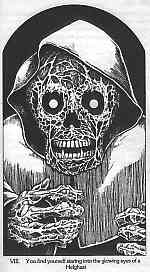
Unfortunately for you, you are being hounded by many monsters including some powerful undead psychic shapeshifters called Helghasts which can only be harmed by magical weapons. 

You may or may not find a magic spear on your journey - it is the only weapon that can harm the helghasts before you get to the Sommerswerd.

Eventually, you and your travelling companion, Lord-lieutenant Rhygar reach a network of tunnels where the noble and brave Lord-lieutenant says that he will hold of the helghasts in order to buy you time.  His sword is not magical which means that he cannot harm them, but if you have the magic spear, you have the option of giving to him so that he can harm them.  My first instinct is to give my brave companion the spear.

A Noodric.
It's Hammerdal time.
However, further on down the tunnel, you may be ambushed by a helghast and if you do not have the magic spear then you are killed.  The only way to get through the tunnels if you do not have the magic spear is if you decide to follow a creature called a Noodnic.  If you have the animal kinship discipline, you can get on with them and they show you through the tunnels.  However, then then steal all of your money, so it's not perfect although it's better than getting killed.

If you do survive and you get to the city of Hammerdal, you are given some bad news.  Lord-lieutenant Rhygar was killed. 

                             You get told the same thing whether you gave him the spear or not. 


You can't touch this.
Until after you really
needed it.
The ironic thing is, we are doing all of this in order to get the Sommerswerd, which is a magical weapon and deals double damage against undead creatures. 

Maybe  Lord-lieutenant Rhygar's sacrifice wasn't even necessary.

It seems that readers were not very happy about this.  The footnotes in the updated Project Aon version of the book state:

"Original version: The choices appear to serve no other purpose other than punishing Lone Wolf with certain death for mercifully handing Rhygar the Spear. The fact that this version was revised and the path that Lone Wolf is given in the Legends of Lone Wolf series also both appear to refute the correctness of this version."


Lord-lieutenant Rhygar can at least
go down in a blaze of glory.
However, I like to imagine that if he did have the spear, he would have taken down a few of the undead monsters with him.  If he didn't have the spear, I imagine that he would have spent the last few minutes of his life as a terrified moving target that can't fight back. 

Giving him the spear still gives me some peace of mind that I have done the right thing, despite the book punishing me for my act. 


This gets on to my point that gamebooks can teach us something about ourselves.  There are some options in gamebooks that, in terms of the game, are completely pointless. 

Maybe it is good to give up items or fight a combat for no reward.  It gives you an insight into your own character.  Sure, there are ways that gamebooks can reward or punish you for behaviours, but does it give you an insight into your character if you do it for a reward or punishment?  It was Dave Morris who gave me that thought in
this interview where he says:

"I remember talking to Joe Dever and he said he’d included a “moral element” in the latest Lone Wolf book. If you failed to rescue some kids from slavery, two or three paragraphs later you were attacked by an unkillable demon. And I was saying, “That’s not morality – that’s just economics! Morality is personal. If you’re swayed by the awareness of punishment then you can’t say it’s a moral choice...”

Dave was referring to the Blood Sword series where 'good' actions aren't necessarily rewarded and 'bad' actions aren't necessarily punished. 

There is a smaller example in Necklace of Skulls, where you can give some children some food, but you get nothing in return. 

Do you really want these two in  your neighbourhood? 
If they were, you'll end up like the both of them. 
Going a bit ape.
 As well as playing a charitable type who gets a good feeling from helping the needy I also used to play a complete psychopath who wanted to take down as many enemies with me as possible. 

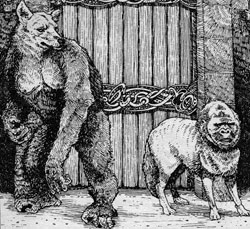
I figured that even if I failed in my mission, my mass murdering will weaken the enemy a bit.  For example, in the Citidel of Chaos, I could attempt to bluff my way past the ape-dog and the dog-ape but then I figured that they would be part of Dire's invasion force and even if I killed him they would still run off and cause trouble, so I made a poor attempt at bluffing and then just attacked them. 

After all, if I don't have a levitation spell at the end of the book, I have to go back the way I came.  So I'm thinking ahead. 


However, some people think that your journey back would not be too successful (the link will make sense if you succed at the gamebook).

Right, I've got everything I
need to go to the loo.
I would also play some gamebooks as a kleptomaniac hero where I would try to get as many items as possible and as much money as possible.  

I would even hang on to items even if they only had one use in the book and I would be severely punished for not using them.  After all, some of the items sound really cool and I would like to hang on to them.  


So there are plenty of choices that we can make in a gamebook that may have no effect on the game or may even punish us but we still make them because we want to role play our character that way or their actions satisfy us more.  However, most of our choices are made with the expectation that they will reward us in the end.  Ultimately, you will want to get to the most victorious paragraph, but you need to make plenty of other choices to get other rewards as a means to that end.  For example, you may need money, better weapons or an ally. 

Some authors give the universe of their gamebook a moral code and they do reward you if you follow it or punish you if you don't.  Here are some ways that this is done.

Leave him alone.
Reward or punish the hero by breaking the fourth wall.

This is when you perform an action and the author decides to give you some kind of bonus or penalty.  In Fighting Fantasy, it usually affects your luck score. 

For example, in City of Thieves, you lose 4 luck points if you kill the blacksmith, who was a 'good man'.  But you gain 1 luck point if you give a beggar a gold piece. 

In some of the earlier books, you could also gain luck in addition to getting some material reward.

This is averted sometimes - the above example from Lone Wolf is one time.  There is also an example from Crypt of the Sorcerer where you have to kill a helpful man and take a luck penalty in order to get an item that is vital for your victory. 

Have different moralities that the hero can follow

Scorpion Swamp lets you choose whether to serve a good, neutral or evil wizard and complete a quest for them.  Different people treat you differently depending on which wizard you work for.  This could also be an example of rewarding or punishing the hero within the story as people treat you much better for following the good wizard and they are far more hostile towards you if you follow the evil wizard.

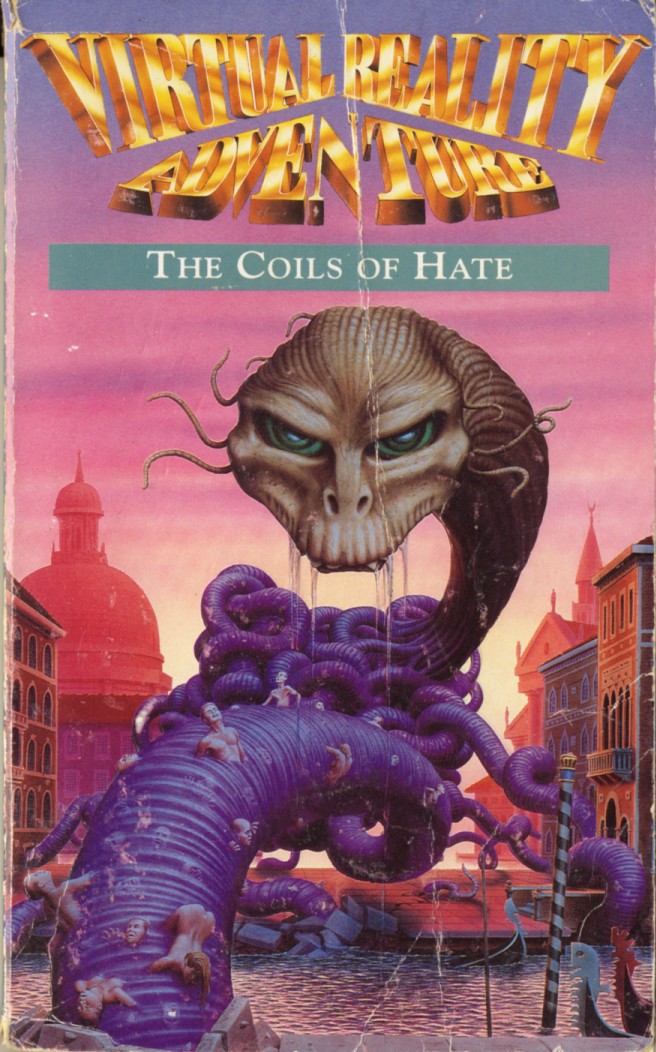
In the Coils of Hate and Down amongst Dead men, certain actions you choose to perform will give you code words to mark what morality you have decided to follow.

In the excellent gamebook Outsider! by Gavin Mitchell you are an assassin in search for your father.  You find three father figures in the book, one is a necromancer (evil), one is a noble (neutral) and one is hero known as Defender (good).  You could choose to give up your life as an assassin and follow one of these three or you could carry one to the 'best' ending which involves learning from all three of them for a while and then leaving them.

Have a score that measures morality and state how it can be increased or decreased.

Your going to be cut
up about annoying
this guy.
This is a subset of the above section.  However, it will seem less arbitrary, you will have been given some guidance on what actions will increase or decrease the score and the score will have an effect on the game in its own right rather than affecting other scores (i.e. in most Fighting Fantasy games where you get a 'moral' bonus or penalty, you change your luck score which has applications beyond the moral).

This makes morality more integral to the game as it has its own score.  It also gives a means to reward or punish players for their actions and lets players know that they will be rewarded or punished for 'moral' or 'immoral' acts.

It also gives the author a chance to give examples of how to increase or decrease the score or at least gives some fairly strong connotations.  For example, Sword of the Samurai does not give an in depth explanation of what is honourable or what is not, but when I was presented with choices in the book, I could point out some choices that would be honourable or not.  It also gave me a bit of education into what samurai found honourable (for example losing your weapon is a big no no).

They're really friends.
Reward or punish the hero within the story.

This is when you perform an action and if it agrees with the morality of the book, your life becomes a lot easier and if it disagrees then your life becomes a lot harder.  However, this is not because the author says so, but because the characters in the book treat you more favourably or following the book's morality just happens to be best for your survival anyway.

In Scorpion Swamp, serving Selator, the good wizard makes your life easy as most of the intelligent denizens of the swamp either help you or are indifferent to you.  If you follow Grimslade, the evil wizard, some of those denizens attack you on sight.

In the Choose Your Own Adventure book, the Race Forever, you can only win one of the races by turning down a bribe and then telling the authorities about it.  If you accept the bribe, you get shot and if you don't tell the authorities, you don't win the race.

Of course, the author may play on this by making it a trap.  After all, heroes would always help the helpless won't they?  One example of this is Portal of Evil.  However, the people who trap you aren't evil and it helps in the long run.

Offer the hero a choice to do something that fits the morality of the book, but do not reward or punish them at all.

You can give money to the beggars or try to save someone, but the only reward is your satisfaction.  Dave Morris does this a lot.  For example, you can give away food in Necklace of Skulls for no gain.  You can also do 'bad' things in the Blood Sword series and not be punished or do 'good' things and not be rewarded.  When Dave was asked about this in an interview, this was his answer: 


I remember talking to Joe Dever and he said he’d included a “moral element” in the latest Lone Wolf book. If you failed to rescue some kids from slavery, two or three paragraphs later you were attacked by an unkillable demon. And I was saying, “That’s not morality – that’s just economics! Morality is personal. If you’re swayed by the awareness of punishment then you can’t say it’s a moral choice.”

To kill the assassin, attack Parsion.
For an easy fight, attack Halvorc.
Although Joe Dever didn't do that in the above quote, he does it a few times in Fire on the Water.  For example, you can give a beggar some money and all that happens is that you get mobbed. 

There is a situation where you are travelling with five people and one of them is trying to kill you.  It does not matter if you choose the assassin or not in game terms.  You could get an easier fight with the merchant with the same consequences.

The only thing stopping you is your desire to play the character as you wish, which for me is important, but super power gamers may play the game just to maximise their stats, not caring what is moral and what is not moral.  They make their choices based on the expectation of the best possible results.  


Moral messages in gamebooks

A lesson in empathy.
There are some gamebooks that contain moral messages woven within the story.  For example, Coils of Hate has a message about persecution.  I've read reviews about it being rather unsubtle about its message (for example, your people are called the Judians).  Also the fact that in this city where persecution is rife, an embodiment of hate arises and threatens to absorb everyone who is hateful (as you can avoid being absorbed if you perform good acts) is a metaphor for the danger of widespread persecution and tyranny.

Considering that, at the time, gamebooks' biggest consumers were young boys, any message had to be unsubtle as it would have been missed.  Even  with all its unsubtlety, when I read Coils of Hate at the age of ten, I was far more interested in how my character with swordplay, spells, charms and cunning would do.  And as a ten year old boy, I think I knew of the persecution of the Jews in Nazi Germany but I had absolutely no way of knowing what it would have been like to have been persecuted.  Coils of hate gave a snapshot into the life of someone who had to suffer persecution.  In that respect, it was a lesson in empathy for me.

Leave them trees alone.
Of course, I never thought about it at the time, but almost everything we learn is not immediately applicable.  A good lesson lies latent in our brains, waiting for such time as it will come in handy.  And if that lesson is for young boys then it has to be unsubtle.

Green Blood is another Virtual Reality Gamebook, this time about saving the environment.  I first read this one in my twenties and thankfully, I caught the message this time.  The same things I have said apply to Green Blood - the message may be unsubtle but it was for younger readers.  There were also messags about coming together in order to face a common enemy (As you had to convince the elves and a dragon to help you save the forest).  If these messages can be woven into gamebooks, then why not?  Every story has a lesson.

Mark had never seen
a production of Hamlet
quite like it.
Jonny really threw
himself into his
Halloween costume.
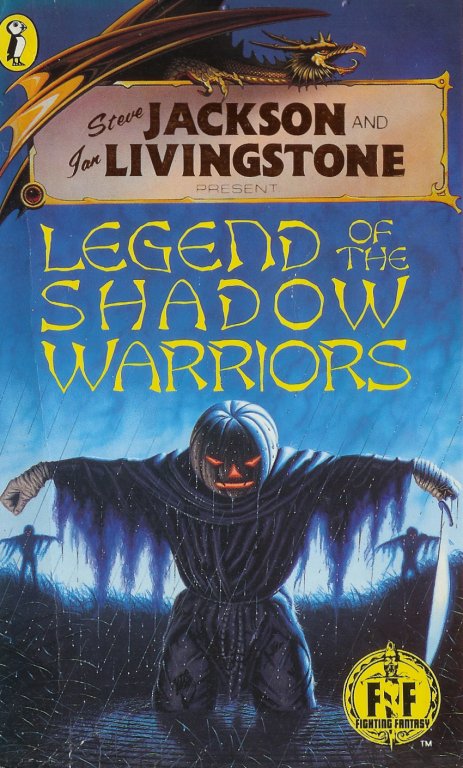
Fighting Fantasy books also have moral messages.  Stephen Hand's Legend of the Shadow Warriors requires you to beat Death, but you cannot kill him.  Instead, you must use The Spear of Life to give him life and therefore forgiving him for his actions.

Moonrunner, also written by Hand, has you bring a war criminal to trial  and justice rather than have you kill him.  These ideas are above the 'kill the sorcerer steal his treasure' ideas in early Fighting Fantasy books.


Gives a whole new meaning to
cracking up.
Stephen Hand also wrote Dead of Night, where you have to kill Myurr, a demon prince at the end of the book.  I don't think there is a moral message, but we do learn that demons and other powerful entities usually require some kind of artefact to stop them being sucked back into their plane.  This also applies in other gamebooks.  


Since gamebooks are about choices, they can also be about morality.  Sometimes, the choice is about the reward and according to some, that means that it is no longer about morality.  However, sometimes, making the 'moral' choice has no effect or may be detrimental, but if you still want to do it, then that shows a good sense of morailty.